

Tonight brings a rare eclipse of the Midnight Sun
Post categories: eclipse, news, northern hemisphere
 |17:20 UK time, Wednesday, 1 June 2011
d ~ 391'065'600 km: day 152 of Earth's orbit
Tonight brings a rare sighting for those lucky enough to live in the arctic - a partial eclipse of the midnight Sun. The partial eclipse we experienced on January 4th 2011 saw the moon pass between the Sun and the Earth, partially covering the Sun's view. Tonights partial eclipse however is special because it will be of the midnight Sun. As strange as it sounds there will be a partial eclipse of the Sun at night.
The Midnight Sun starts in March over the north pole and has its southern most extent on June 21st at the edge of the arctic circle. When either hemisphere is tilted directly towards the sun, the most polar regions are illuminated 24 hours a day, and viewed from Earth the sun is in the sky all day and all night.
For us in the UK we'll not see this eclipse, but sky watchers in places like northern Norway, Sweden, Finland, Siberia, northern China, remote parts of Alaska and Canada, and Iceland are in for a treat. The eclipse begins at sunrise in Siberia and northern China where the penumbral shadow first touches Earth at 19:25:18 UT. Two hours later, greatest eclipse occurs at 21:16:11 UT according to Fred Espenak of the NASA Goddard Space Flight Center.
"At this time of year the Sun doesn't set in Arctic parts of the world, so a solar eclipse is theoretically possible at all hours of the day" says Fred Espenak. He goes on to add that "when the clock strikes local midnight in northern Norway at the end of June 1st, about half of the lingering sun will be covered by the Moon."
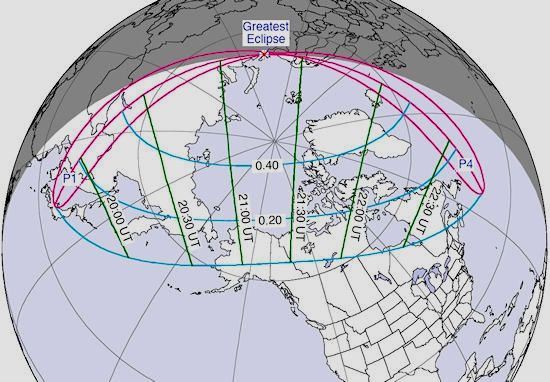
Image © NASA/GSFC (full image here)
If you happen to spot this then add it to our photography pool. For information on the times that the partial eclipse of the midnight Sun will occur take a look at NASA's timetable.
And for those who don't want to miss out on this occasion -
Knut Joergen Roed Oedegaard, an astrophysicist at the Norwegian Centre for Science Education in Oslo will attempt to bring this to us via online automatic photo updates (as part of a project which focusses on the spectacular celestial events 2010-2015).
 Kate Humble:
 Helen Czerski:
 Stephen Marsh:
 Aira Idris:


Comments Post your comment