

Midwest USA update: what is it like to chase tornadoes?
Post categories: locations, northern hemisphere, storms
 |15:00 UK time, Tuesday, 21 June 2011
Distance travelled ~ 442'521'600 km: day 172
(Helen Czerski and some of the 23 Degrees team stayed back in Midwest USA to continue tracking tornadoes whilst the others moved on to the next stop in Egypt to film the Summer solstice. Here is Helen's update from yesterdays chase).
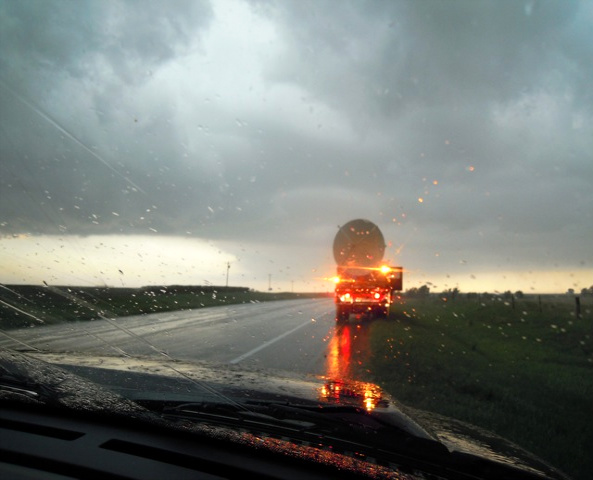
20 June 2011, DOW stopped to scan the sky
If you stand outside in the Midwest, half of everything that you can see is sky. It's easy to see why everyone here is interested in storms - the land is completely flat and open, and you can watch these huge structures in the sky changing and growing from miles away. The rain, lightning, hail, the sudden darkness and the occasional unexpected rainbows are awe-inspiring. By comparison, a human being is tiny, slow and vulnerable.
The process of finding the eye of the storm is less awe-inspiring. The reality of storm-chasing involves patience more often than it requires adrenaline. As I write this, we're waiting with the storm scientists while they decide where we're going today. There are ten scientists and students with laptops, all looking at the current radar data and weather forecasts, discussing whether different wind conditions are more or less likely to combine to produce supercells, and also just waiting to see how the weather changes as the day goes on. Storms tend to develop later in the day, because that's when the ground and air have heated up enough to start building storm cells. So, we have to wait for the complexities of the atmosphere to call the shots. This is why these scientists are out here - the more they understand about tornado formation, the better the forecasts will be. And it won't just be scientists and tv crews that will benefit, but the people whose homes and businesses might get hit.
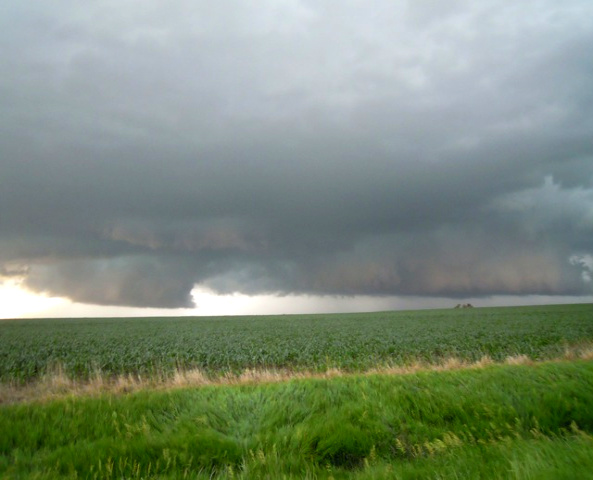
20 June 2011, storm that came closest to dropping a tornado
When the storms do start to develop, the pace changes dramatically. The hunt is on. The radar trucks stop every few minutes to scan the sky in detail. You're right underneath a huge black cloud, and it's moving and changing as you watch it. You drive through heavy rain, hail and really strong winds to get ahead of the storm , and all the time it's above you, metamorphosing, with huge blocks of cloud ploughing through the sky below the main storm cloud. You can see the lower clouds rotating around you. And this was the point yesterday when I finally really understood why people spend so much time trying to see tornadoes. I stepped out of our car, and the speed with which the low clouds were spinning around me was stunning. I could see them rotating around a half-mile wide circle almost as if they were gathering themselves together, and the whole thing was huge and incredibly energetic. It was hard not to think of it as alive, because it was so dynamic. Being right underneath such a piece of atmospheric architecture was genuinely awe-inspiring, and definitely worth the wait. And this one wasn't even a tornado, just a mesocyclone, which is the stage before a tornado.
All this is generated by simple physical processes, operating on a huge scale. Most of the time they're invisible, but when they're all concentrated in once place like this so you can see them, it brings home the scale and power of what's going on around us all the time.
The scientists are getting up, and a decision about where to go has been made. Today is our last chance to see a proper tornado, and it all depends on whether the huge forces in the atmosphere cooperate. All we can do is follow behind and admire.
 Kate Humble:
 Helen Czerski:
 Stephen Marsh:
 Aira Idris:


Comments Post your comment