

If the sun was switched off... well partially

d ~ 10'291'200 km: day 4
The Moon always casts a complete shadow somewhere, a constantly moving cone of darkness that points away from the Sun and out into the universe. Most of the time there isn't anything inside the shadow that would notice the darkness, but every so often the Earth passes through this dark region (known as the umbra) and we on Earth get a peek into the mechanics of the solar system. By celestial coincidence, during a total eclipse the Earth is more or less at the point of the cone, so the sun is almost perfectly blocked for a brief period of time while the Sun, Earth and Moon are all aligned. Total solar eclipses like this are relatively rare, but many of us will get to experience a partial eclipse during our lifetimes.
Here's a great picture of this morning's partial eclipse by a UK photographer:
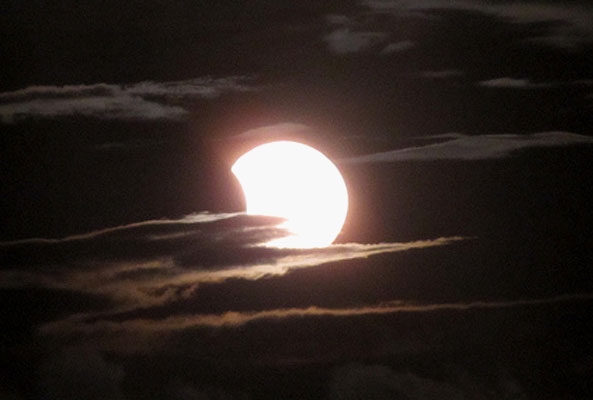
Neil Parley UK / Flickr
If you wish to share your photography and video of weather phenomena, please email us. Let us know what's happening in your part of the world.
In European cities like London and Paris, the eclipse was already underway as the Sun rose, and the Moon covered up almost 70% of our star by 0812 GMT in the British capital, and 65% of the solar disc by 0809 GMT in the French capital. The moon's complete shadow just missed the Earth but the outer partial shadow (the penumbra) passed over us.
Here's an illustration of the conical shadow the moon casts:
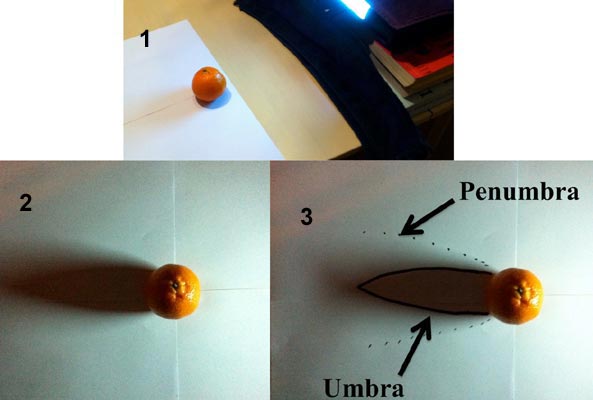
Eclipses are not only amazing things to experience, but they've also been very useful for science. When the sun itself is covered during a total eclipse, the corona (the sun's atmosphere) gets its moment of glory. Helium, the second most abundant element in the universe, was discovered in the corona during a solar eclipse in 1868. It had been there in plain sight all along, but the signal from it was overwhelmed by the intense power of the sun's light. Now, rather than waiting for eclipses to occur to study the corona, scientists make artificial eclipses in front of their cameras. For example, NASA's SOHO coronagraph took these spectacular images of the Sun's atmosphere in December 2010.
Lastly, an eclipse is a powerful reminder of just how important the light from the Sun is for our planet - we get a glimpse of what it would be like if the Sun was switched off. It's the major source of energy for the Earth, fueling plants, animals, the circulation of vast amounts of water around the oceans, and most importantly for this blog it's where energy for the weather comes from. We see hurricanes, blizzards, gales and tornadoes as powerful events, but they're all just concentrating a tiny fraction of the energy that we get from the sun every day into a relatively small area. With all that in mind, here's to the next partial eclipse June 1st 2011!
Helen Czerski is co-presenter of 23 Degrees
 Kate Humble:
 Helen Czerski:
 Stephen Marsh:
 Aira Idris:


Comment number 1.
At 14:35 7th Jan 2011, chris14sale wrote:If the moon's complete shadow missed the earth, what caused the partial eclipse shown in the photo?
Complain about this comment (Comment number 1)
Comment number 2.
At 22:39 24th Jan 2011, Helen Czerski wrote:Thanks for your comment, chris14sale. Anyone inside the complete shadow can't see any of the sun at all. But if you're just outside the complete shadow (in the penumbra, the lighter grey region in the photo), you can see part of the sun and you get a partial eclipse. The reason that this region is light grey and not all black is that it gets some but not all of the light from the sun, which means that some of the sun is covered but not all of it. During the eclipse on the 4th of January, the partial shadow did cross the Earth, even though the complete shadow didn't. So, everyone who experienced the eclipse could still see at least some of the sun all the time.
Helen Czerski (23 Degrees co-presenter)
Complain about this comment (Comment number 2)