Orbit: Earth's Extraordinary Journey

Archives for January 2011

Yellowknife Canada Update: Kate Humble on a Frozen Lake

Post categories:

Kate HumbleKate Humble|19:00 PM, Friday, 28 January 2011

d ~ 72'038'400 km: day 28 of Earth's orbit


Last week the 23 Degrees team ventured to Yellowknife in Canada one of the coldest cities in Northern America. Here's an update from location in below - 37C temperatures.

In order to see this content you need to have both Javascript enabled and Flash Installed. Visit BBC Webwise for full instructions. If you're reading via RSS, you'll need to visit the blog to access this content.

23 Degrees heads to Argentina

Post categories:

Stephen MarshStephen Marsh|21:30 PM, Thursday, 27 January 2011

d ~ 69'465'600 km: day 27 of Earth's orbit

Having spent time in the coldest place in North America the 23 Degrees team are now south in Argentina. Their mission is to travel across South America, from East to West following a single line of latitude to discover why there is such a wide range of climates and landscapes across the continent even though they all receive the same amount of solar energy.

They'll begin their journey in one of the most eerily beautiful places on the planet, the cloud forest of Calilegua. It's called a cloud forest because the tree tops grow right up into the clouds and there's a ghostly fog everywhere. It's not that the clouds are low, more that the forest is high up. In fact, it's around 2000 metres up in the foothills of the Andes. It's a very wet environment because as well as the constant clouds it rains here around 150cm a year.

This region is also the thunder and lightning capital of the world. Here, wet air is transformed into giant thunderclouds which unleash incredible rain and lightning, including a particularly strong form called positive lightning. What makes it so deadly is that it can strike kilometres away from the storm, which could well be the origin of the term "a bolt from the blue".

From there the team are driving up over the Andes. On the way they pass through Paso de Jama at the top of the Andes, right on the border between Argentina and Chile. It's at 4,400 metres so they won't stay long because of the risk of altitude sickness.

On the other side they will, visit one of the wonders of the natural world. The lagunas at Salar de Atacama. These briny lakes are home to thousands of Flamingos that come to feed on algae and shrimps. The shrimps are rather special - they have evolved a way of surviving in this hostile place. If there's a drought, their eggs can go into suspended animation for up to 50 years. When there's enough water gain they burst into life and hatch.

The region around the lakes is incredibly dry. It rarely rains here at all. And the reason for this is the Andes Mountains which form a barrier running down the continent. They block the movement of moisture from the east. Any air that does pass over the mountains has its moisture stripped out and dumped as rain on the other side providing moisture for the cloud forests. By the time the air gets here its hot and dry. This drying effect is called a rain shadow.

After the lagunas Kate and the team will be heading to one of the most hostile places on earth - the Atacama Desert. The amount of sun is the same as back in the cloud forest but the terrain is utterly different. Gone are the lakes - and the water. It's as dry as a bone.

To get a sense of just how dry this place is, the team will stop off at a salt mine - they dig out 11,000 tonnes a day here. Salt can only occur on the surface like this if the climate is dry, and I mean really dry. Any rain at all and the salt will dissolve and be washed away. But it hasn't rained here for 400 years, making it the driest place on the planet.

This desert is so arid here because circulation of air in the atmosphere strips away its moisture. Here's how it works. Hot wet air rises at the equator, but as it rises it cools. Cooler air cannot hold as much moisture, so the water vapour condenses and falls as rainfall, creating tropical rain forests. But the air keeps on rising until it reaches around 15 km. Then it flows horizontally toward the South Pole in what's called The Hadley circulation cell. As the air moves away from its main source of heat - the equatorial region it cools down even more. This cooling makes the air denser and so it sinks back to the surface over the Atacama. As the air sinks it creates an area of high pressure full of stable dry air that won't rise or cool and this prevents clouds forming. No clouds mean no rain - creating the super-arid conditions of the Atacama.

Kate's journey finishes at the Pacific Ocean where the climate changes again. Right on the coast is a peculiar natural phenomena - coastal fog that is so persistent that the local get water by "harvesting" the fog, she'll go fishing with the local fishermen to learn how a cold water current just off the coast is the key to the climate of this strange coastal strip.

Kate and the team will have travelled 575 kilometres due west across South America from lush wet cloud forest to arid desert.

Their journey will reveal that even though the land at this latitude gets the same amount of solar energy, the planet itself has the power to transform the climate and create radically different environments.


What happens if you throw hot coffee into -37˚C temperatures?

Post categories:

Kate HumbleKate Humble|20:43 PM, Thursday, 27 January 2011

d ~ 69'465'600 km: day 27 of Earth's orbit

The 23 Degrees production team and I were in Yellowknife Canada last week one of the coldest cities in North America. Great opportunity to test for myself what would happen if you threw hot coffee into the air with a temperature of -37˚C.

In order to see this content you need to have both Javascript enabled and Flash Installed. Visit BBC Webwise for full instructions. If you're reading via RSS, you'll need to visit the blog to access this content.

What would happen if the Earth spun the other way?

Post categories:

Peter GibbsPeter Gibbs|19:08 PM, Monday, 24 January 2011

d ~ 61'747'200 km: day 24 of Earth's orbit

"Drivetime" seemed a misnomer for Simon Mayo's early evening show on Radio 2 as my car inched out of BBC TV Centre and into the homeward crawl.

Twenty minutes and 200 yards later, Simon read out a question from a listener whose five year-old daughter had asked "What would be different if the Earth spun the other way?" Easy, I thought - everything would travel the other way across the sky and we would greet the sun from the west every morning.

My smugness lasted until Chiswick, when I realised I'd forgotten the little matter of Coriolis.

The Coriolis effect transfers the spin of the earth into the circular motion of winds around a weather system. Storms spin anti-clockwise in the northern hemisphere and clockwise in the south. Reverse the rotation of the Earth and you put the storms into reverse too. Interesting, but apart from confused weather forecasters I couldn't imagine a huge impact.

Reaching the M4, the pace of traffic is picking up to a gentle jog and this seemingly simple question is quickening my thought processes too. What about the jet stream?

This river of high altitude, fast-moving air steers the mid-latitude depressions across the planet from west to east. Swirling masses of cloud and rain are pushed from Japan to the Pacific coast of America, and from Newfoundland to Cornwall. Reverse the flow and climate changes dramatically. The British Isles loses the moderating effect of weather from the Atlantic. A harsher continental climate becomes more likely, with a predominantly easterly flow bringing bitter Siberian winds in winter and hot, dry weather in summer. Goodbye green and pleasant land.

Finally on to the M4. Now that we're really moving, the constant stream of traffic reminds me of the trade winds, another crucial part of our planet's circulation system.

The sun heats the atmosphere more at the equator than it does at the poles. On a stationary Earth the warm air would rise at the equator, moving to the poles where it would sink and flow back to the equator along the surface. Nice and simple.

Rotation complicates things. The flow breaks up into three separate cells known as the Hadley cell, the Ferrell cell and the Polar cell. Northward and southward-moving surface winds generated by the cells are then deflected to right or left by our old friend the Coriolis effect and we end up with the trade winds.

These constant easterly winds in the tropical regions were the motorways of the seas for sailing ships. A captain heading out of southern Spain could depend on picking up the northeast trades for a free ride to the Caribbean. Again, reverse the Earth's spin and the whole thing switches. Patterns of human discovery, subsequent empire-building and the resulting political geography would all be different.

The trade winds also affect the distribution of rainfall across large parts of the planet, influencing the position of some deserts and rainforests and interacting with periodic events like El Nino. It's reasonable to assume that a reversal would alter the pattern of habitable land.

Conclusion - change something as simple as direction of rotation and you change the planet we know.

And beware the innocent questions of five year-olds!

Peter Gibbs is a BBC weather forecaster and Met Office meteorologist

We want to hear from you. If you have a weather-related question for the 23 degrees team to investigate, let us know.

East Coast America Update: The Beauty of Snowflakes

Post categories:

Helen CzerskiHelen Czerski|09:41 AM, Friday, 21 January 2011

d ~ 54'028'800 km: day 21 of Earth's orbit

On Monday, the 23 degrees team travelled to New York to investigate the effects of Lake Effect Snow. Here, presenter Helen Czerski gives us her account of the trip...

We arrived in snowy Oswego, New York around 9am on Monday, and at the beginning nobody noticed the falling snow. Everyone was busy thinking about camera angles, where to park the radar truck and how many layers to wear. After a while there was a pause, and somebody held out their snow-covered arm and said, “That’s incredible”. And it was. Every single snowflake that had fallen on his sleeve was picture-perfect, and we realized that every snowflake we could find had a flawless six-sided branching structure. The snowflakes looked exactly like snowflakes, and we just couldn’t stop looking at them.

It was weird because we all realized at the same moment that what we all knew as a snowflake, the pretty shape that you see on Christmas cards and on winter jumpers, was something we had never actually seen before. In the UK, the temperature doesn’t go very far below freezing and the snowflakes that bump into each other in the air tend to be a bit wet, so they break and stick together. What we see are clumps of broken bits from lots different snowflakes, and it’s easy to miss the six-sided symmetry of the individual crystals. But where we were filming in up-state New York, the temperature was far lower (around -15C) and the snowflakes hadn’t bumped into each other much, so nothing had spoiled the stunning crystal structures.

In order to see this content you need to have both Javascript enabled and Flash Installed. Visit BBC Webwise for full instructions. If you're reading via RSS, you'll need to visit the blog to access this content.

Unspoiled snowflakes are beautiful things. But if this is just frozen water, why don’t we see our ice trays full of snowflakes? The answer is that in the right conditions, water can go from being water vapour to solid ice without passing through liquid water in between, and that’s what happens inside snow clouds. There are water molecules floating in the air around the growing snowflakes, and if they bump into the crystal, they can stick to it and freeze straight away. They might also bump into it and then float off again. The shape all depends on how easy it is for a water molecule in the air to get to and stick to each different part of the snowflake.

In your ice tray, all the water in each ice cube compartment has to freeze in a fixed shape because it has nowhere else to go - it’s liquid and it has to stay in the ice tray. The beautiful dendrite snowflakes that we saw branch out because the water molecules don’t have to freeze wherever they land, and because they’re more likely to land in some places than others. The stickiest places change with time, and depend on the tiny variations in temperature and humidity as the flake travels through the snow cloud. The precise conditions at each time in the journey control exactly how the newest bits are growing. And so, as you go from the middle of a snowflake outwards, you’re reading its own autobiography about the place it grew up.

To read more on snowflakes and what determines their shape, take a look at meteorologist Chris Westbrook's account of its extraordinary transformation from water vapour to intricate snowflakes.

Helen Czerski is co-presenter of 23 Degrees

What determines the shape of a snowflake?

Post categories:

Chris WestbrookChris Westbrook|10:00 AM, Thursday, 20 January 2011

d ~ 51'456'000 km: day 20 of Earth's orbit

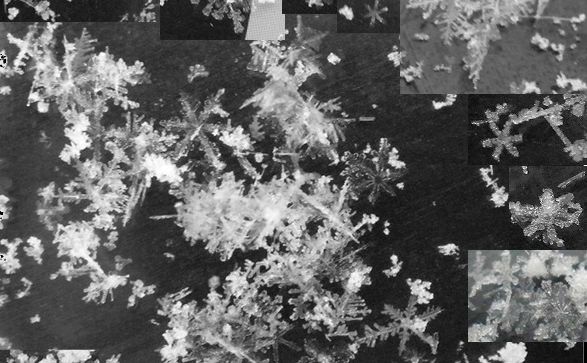
The UK snowfall this past winter gave us a great opportunity to see what snowflakes really look like, rather than just admire them as patterns on Christmas cards. It's often surprisingly easy to observe the shapes of the ice crystals by eye as they fall onto your coat. About a week before Christmas it was snowing heavily in my garden and I took some photos of the crystals which were landing:

Snowflakes shot by Chris Westbrook

Chris Westbrook

I caught the crystals on an old black tin which I keep in my shed (so the surface of it was nice and cold). Most digital compact cameras have a 'macro' mode now, and this is what I used here. The first thing that struck me from these pictures was how much the shape varies from flake to flake. So why is that?

Well, the biggest influence on a snowflake as it grows is temperature. This was first unravelled by the Japanese physicist Ukichiro Nakaya in the 1930s, who was the first to grow snowflakes artificially in a lab. The incredible fact that he discovered is that ice grows in completely different ways depending on what the temperature is. At -2C it forms small thin hexagon shapes; go down a few more degrees to -5C and it forms long slender needle-shaped crystals. Go colder still to -15C and you get the classic six-arm stellar snowflakes we all know and love: these are often 100 times as wide as they are thick. A bit colder still at -20C we get crystals shaped like pencils. Below -25C it gets even more complicated, with many individual pencil or hexagon crystals growing out from a single point to form messy complex structures.

So the shape of a snow crystal depends on the temperature at which it formed in the atmosphere right? Well this is often kilometres above us in the atmosphere: so by the time they fall to earth they've been falling for a couple of hours. During this time they will have passed through a whole range of different temperatures, modifying the shape of the crystal as it grows. To complicate things further, as the crystals fall through the cloud they inevitably collide with each other, sticking together to form clusters. The closer the temperature is to 0C, the 'stickier' the surface of the ice gets - that's why you get the really huge fluffy flakes when the temperature is hovering close to the freezing: these big flakes are dozens of individual crystals stuck together like the one in the centre of my photo.

So how can researchers possibly observe this complicated evolution of snowflakes as they grow, fall and stick together? Well one way is using radar. Just as aircraft reflect radio waves, so believe it or not, do snowflakes. Our research group at the University of Reading uses radars based at the Chilbolton Observatory to unravel the evolution of snowflakes as they fall through clouds, monitoring their shape, fall speed and number. This may seem a bit academic, after all many of us in the UK only get a few days of snowfall each year. But of course, even if the temperature at the ground is above 0C, the temperature several kilometres above us is well below freezing. So clouds of snow crystals are above us throughout the year - it's just that if they fall to earth, they melt into raindrops first. In fact, the majority of rain in the UK forms this way - by melting snow formed many kilometres up in the atmosphere.

Chris Westbrook is based in the Department of Meteorology at Reading University

Have you got any interesting observations of snow crystals over the winter? Let 23 degrees know here.

23 Degrees heads to Yellowknife Canada

Post categories:

Stephen MarshStephen Marsh|15:44 PM, Wednesday, 19 January 2011

d ~ 48'883'200 km: day 19 of Earth's orbit

Today Kate Humble and the 23 Degrees team have travelled deep into the middle of Canada to Yellowknife, the coldest city in North America.

We chose to film on the 19th because it is the day that holds the dubious honour of being on average the coldest day in the northern hemisphere. It's odd that this particular day is the coldest because it's now almost a month since the winter solstice - the shortest day when the northern hemisphere gets the least amount of sunlight. The planet is tilting back towards the sun and we've been getting more solar radiation for several weeks. So in theory, it should be getting warmer. But it's not. It's actually been getting colder. Why? It's all about the balance between heat coming in and heat going out. At the moment we are losing more heat than we are getting. As winter starts the amount of radiation from the sun begins to fall. So the Earth begins to cool down, losing heat from the surface that is radiated into space. But the Earth loses heat slowly, so well into January the northern hemisphere is still cooling down, still radiating heat into space. This cooling effect is more powerful than the warming that comes from increased solar radiation. Not until late January does the increase in solar radiation finally become strong enough to compensate for the heat being lost to space.

The team in Yellowknife will be hitting the highway with ice road trucker Blair Weatherby. As you can guess from the name, he drives not on asphalt roads but roads made from ice. These ice roads are a lifeline for the citizens of Yellowknife because during the summer they are surrounded by hundreds of lakes and impassable bogy tundra. When it freezes ice roads are built across the lakes - linking the community with the outside world and the town comes alive. When cruising along the ice roads with Blair we'll meet some "ice engineers" who build and maintain the roads using snow-ploughs and chainsaws.

Here's a great clip from The History Channel's Ice Road Truckers highlighting how the ice roads are not always safe and extremely unpredictable:

Presenter Kate Humble will also discover why Yellowknife is the coldest city in North America. It's strange that it hold this title because Yellowknife's not in the northern-most part of the continent, and it's not even the most northern city. Barrow in Alaska is around 800 km [500 miles] closer to the North Pole - yet it's not as cold as it is in Yellowknife. So why is Yellowknife colder? The clue is a peculiar detail in Yellowknife's location - it's slap bang in the middle of the continent - a long long way from the sea. And that's the key. The sea absorbs heat from the sun during summer - and holds onto it for a long time. In fact long after the land has lost its heat. So towns like Barrow which are by the sea are kept warmer by the surrounding water even though they are much further north. Poor old Yellowknife is so far inland it loses lots of heat and has no ocean to keep it warm.

Kate will be updating us on the journey soon, so stay tuned...

Will we withstand the freeze for Lake effect snow?

Post categories:

Stephen MarshStephen Marsh|18:05 PM, Friday, 14 January 2011

d ~ 36'019'200 km: day 14

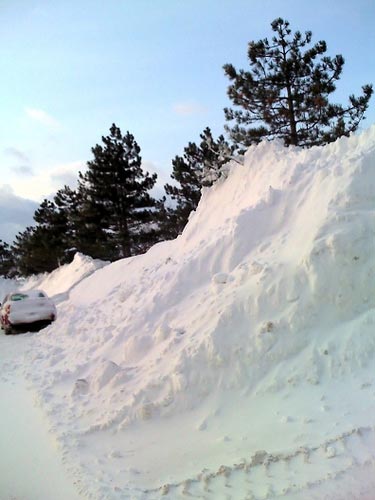
Today and tomorrow the 23 Degrees team will be filming in the towns of Syracuse and Oswego in Upper New York State to discover what triggers the intense snow storms called "Lake Effect Snow".

Lake effect snow in Buffalo

Every year this part of the world experiences fierce snow storms that can dump up to 150 centimetres in a day.

The origin of these storms is a mass of cold air that forms over the freezing tundra of Canada. This freezing air mass races southwards and barrels into the Great lakes on the border with the USA. At this time of year the water in the lakes is slightly warmer than the lower level of air above it. When the freezing air mass passes over the lake it absorbs the moisture evaporating from the lake. This causes two things to happen. First the air becomes wet and second the air warms up. What this means in weather terms is that the cold air mass has become warm, wet and unstable.

It starts rising and forms clouds over Upper New York State. They are the beginning of a special kind of snow storm that can lead to some of the fastest dumps of snow in the world, "Lake Effect Snow".

Physicist and Presenter Helen Czerski is travelling into the heart of the storm with meteorologist Scott Steiger to discover what triggers these incredible snow storms. Steiger is trying to discover exactly what conditions develop inside the cloud that triggers the formation of snowflakes and the intense dump of snow. He hopes by understanding what's going on in the clouds he can develop prediction models to help the local communities prepare for the devastating snow storms that are prevalent in this area.

Queensland floods: How can water be so destructive?

Post categories:

Helen CzerskiHelen Czerski|17:39 PM, Thursday, 13 January 2011

d ~ 33'446'400 km: day 13

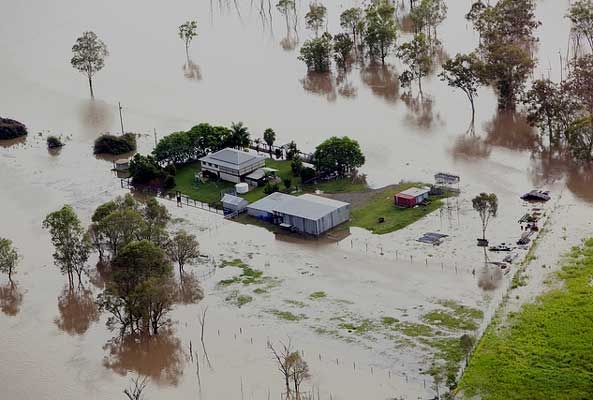
We have all seen the floods that have ripped apart Queensland Australia, and in a time that would normally mark the end of rainy season in Sri Lanka have also seen abnormal cloud outbursts driving nearly 325,000 people from their homes, according to last reports. Clearly water is an essential part in keeping us nourished in our day-to-day lives but its disastrous nature can also make us feel powerless.

Floods in Queensland - Australia

In a sense, flood water is like a leaking battery. Energy from the sun lifts water up (by evaporation) and gives it a huge amount of gravitational potential energy, charging the battery. When you look at a river, you're looking directly at energy on the move. On the plus side, we can use some of that energy to generate electricity to run ram pumps, one of my favourite inventions. On the negative side, the huge amount of available energy means a lot of stuff that's been broken and moved can be left behind. This is what enables water to carve river beds out of solid rock, to devastate any human habitation that gets in the way of a tsunami and to pick up things like cars and boulders and carry them off. Something gets in the way of an aqueous river of energy, and pays the price.

Love-hate relationship with water

Humanity really does have a love-hate relationship with the power of water, and the people of Queensland Australia are currently wading through the second half of that association. The problem with water is that it's really heavy and flows fairly easily. But the best thing about water is also that it's really heavy and flows fairly easily. The ocean of air that we live in also flows easily, but it's less dense than we are (so a fixed volume of air is much lighter than the same volume of human) and that makes all the difference. When we push on the air, there isn't much resistance. But when we push on water, it really pushes back.

Helen Czerski is co-presenter of 23 degrees

The Sun and the Solar Wind: Earth has been spared the fate of Mars

Post categories:

Stephen MarshStephen Marsh|14:56 PM, Monday, 10 January 2011

d ~ 25'728'000 km: day 10

Although space looks empty, it's not. It's full of lethal particles and radiation - and a lot of it comes from our Sun.

We know that the Sun warms our planet, provides the light by which we see and is vital for life on Earth but it also blasts out a barrage of deadly radiation.

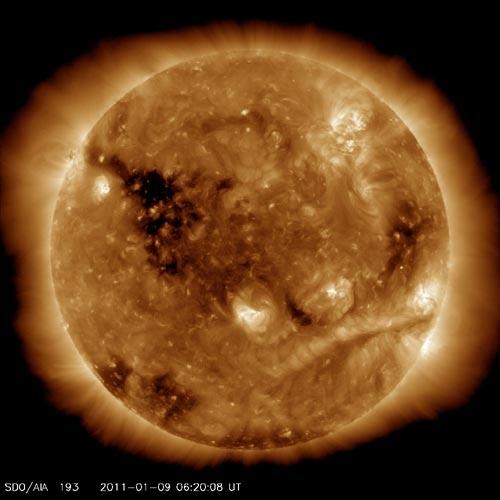
In science fiction movies there are killer suns deep in space threatening to wipe out planets, and our Sun can be just as deadly. At the beginning of January a coronal hole opened up on the surface of the Sun and a stream of deadly radioactive particles blasted towards Earth.

Coronal Hole

NASA

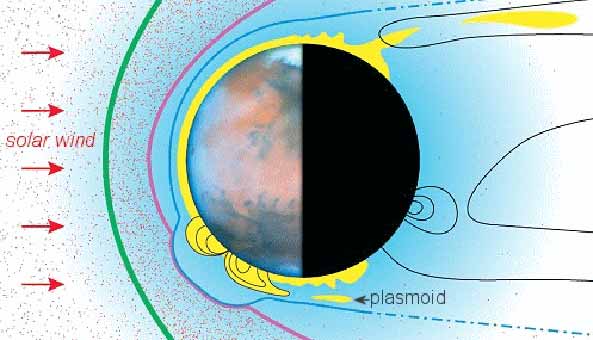
Every day we are hit by a blizzard of radioactive particles. It's called the solar wind and it carries about one million tons of electrically-charged gas particles, away from the sun every second. It's made up of protons, neutrons, electrons, and alpha particles, the same materials the sun is made of and these particles travel through space at velocities of hundreds of kilometers per second. The barrage of solar wind is 24/7 but when a coronal hole opens up this allows a more intense solar wind to escape and shoot towards earth.

This wind can be deadly. Take a look at Mars. About a billion years ago it had an atmosphere. But over the millennia the solar wind has stripped the atmosphere from the planet's surface. Without its protective atmosphere, temperatures dropped and all the water was blasted off, leaving a cold barren planet.

Mars - Solar wind

NASA / Steve Bartlett

Fortunately our planet has been spared this fate, because we have a protective shield generated deep within the Earth. The core of the Earth is a ball of molten iron that spins, and it generates a magnetic shield that extends out into space. This shield deflects the solar wind around the planet. Some of the solar wind is deflected towards the weakest point of the shield, the poles. Here they react with oxygen and nitrogen in the atmosphere to create streams of different colours - a phenomenon known as the Auroras or northern and southern lights.

It's believed that Mars also had a molten iron core generating a protective shield. But because Mars is so much smaller than Earth its core cooled down and stopped spinning so the shield collapsed leaving the planet at the mercy of the solar wind.

Normally solar wind travels at around 400 km per second [250 miles a second] but the wind blasting out of a coronal hole shoots out at up to 800 kilometres a second [500 miles a second]. These solar wind particles will take around two to four days to reach earth but fortunately our magnetic shield is up to the task and deflects the potentially deadly particles away from the planet. The results of the cosmic battlefield should seen in the far north, is the shape of really dramatic northern lights.

If you are lucky enough to witness this celestial light show please email us your pictures or video.

January 3 - closest point to the sun, can you believe it?

Post categories:

Stephen MarshStephen Marsh|17:07 PM, Friday, 7 January 2011

d ~ 18'009'600 km: day 7

You might ask why we chose January 3rd to begin filming. Well believe it or not, it's a very special day. Despite the freezing weather we are getting at the moment, the Earth is at its closest point to the sun it will get all year. It's called Perihelion which is Greek for "near to the sun", and right now the Earth is 5 million kilometres closer to the sun than it will be in July, when it's at its furthest point.

Perihelion highlights how fascinating the relationship is between the earth and its cosmic star. Who would have thought that at the point when we are closest to the sun, we would experience such freezing temperatures? To kick-start our trip, 23 Degrees presenter Kate Humble and the production team visited Aonach Mor - one of the highest mountains in Scotland.

In order to see this content you need to have both Javascript enabled and Flash Installed. Visit BBC Webwise for full instructions. If you're reading via RSS, you'll need to visit the blog to access this content.

Perihelion is a result of the slightly strange shape of the Earth's orbit around the sun. It's not a perfect circle, it's an ellipse, and the sun isn't even in the centre, it's slightly off to one side. So at the moment we are just 147.1 million kilometres [91.4 million miles] from the sun. You are probably thinking - if we are closer, then why aren't we warmer? Well, our journey around the sun is complex and there's another factor that shapes our climate that is more powerful than just how close we are to the sun. And that's the tilt of the planet. Earth doesn't sit upright; it's tilted over to one side at an angle of 23.5 degrees.

The tilt and the Earth's motion around the sun create the seasons. In January the northern hemisphere is tilted away from the sun so the sunlight is spread more thinly over the northern half of the planet so we get our winter. Meanwhile the southern hemisphere which is now tilted towards the sun gets more sunlight and therefore enjoys summer. Gradually the Earth moves around the sun until July when the Northern hemisphere tilts towards the sun, when the reverse is true.

Now – in January – we are in midwinter, but the northern hemisphere is already starting its journey back towards the sun and over the next few months we will get more and more sunlight and slowly the Northern Hemisphere will rise from its slumber and move towards spring.

If the sun was switched off... well partially

Post categories:

Helen CzerskiHelen Czerski|18:26 PM, Tuesday, 4 January 2011

d ~ 10'291'200 km: day 4

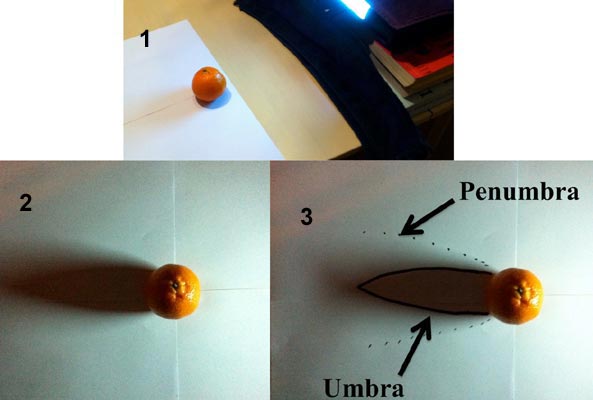
The Moon always casts a complete shadow somewhere, a constantly moving cone of darkness that points away from the Sun and out into the universe. Most of the time there isn't anything inside the shadow that would notice the darkness, but every so often the Earth passes through this dark region (known as the umbra) and we on Earth get a peek into the mechanics of the solar system. By celestial coincidence, during a total eclipse the Earth is more or less at the point of the cone, so the sun is almost perfectly blocked for a brief period of time while the Sun, Earth and Moon are all aligned. Total solar eclipses like this are relatively rare, but many of us will get to experience a partial eclipse during our lifetimes.

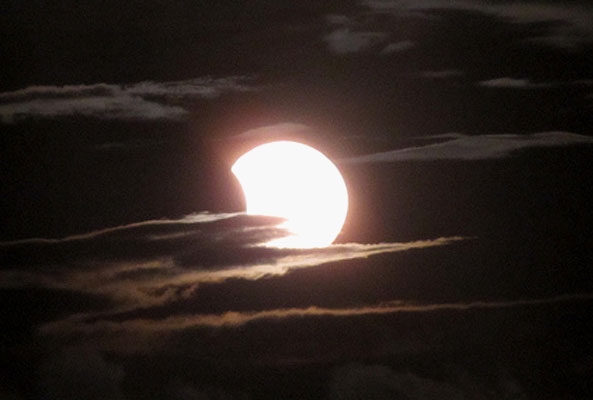
Here's a great picture of this morning's partial eclipse by a UK photographer:

Partial Solar Eclipse

Neil Parley UK / Flickr

If you wish to share your photography and video of weather phenomena, please email us. Let us know what's happening in your part of the world.

In European cities like London and Paris, the eclipse was already underway as the Sun rose, and the Moon covered up almost 70% of our star by 0812 GMT in the British capital, and 65% of the solar disc by 0809 GMT in the French capital. The moon's complete shadow just missed the Earth but the outer partial shadow (the penumbra) passed over us.

Here's an illustration of the conical shadow the moon casts:

Corono

Eclipses are not only amazing things to experience, but they've also been very useful for science. When the sun itself is covered during a total eclipse, the corona (the sun's atmosphere) gets its moment of glory. Helium, the second most abundant element in the universe, was discovered in the corona during a solar eclipse in 1868. It had been there in plain sight all along, but the signal from it was overwhelmed by the intense power of the sun's light. Now, rather than waiting for eclipses to occur to study the corona, scientists make artificial eclipses in front of their cameras. For example, NASA's SOHO coronagraph took these spectacular images of the Sun's atmosphere in December 2010.

Lastly, an eclipse is a powerful reminder of just how important the light from the Sun is for our planet - we get a glimpse of what it would be like if the Sun was switched off. It's the major source of energy for the Earth, fueling plants, animals, the circulation of vast amounts of water around the oceans, and most importantly for this blog it's where energy for the weather comes from. We see hurricanes, blizzards, gales and tornadoes as powerful events, but they're all just concentrating a tiny fraction of the energy that we get from the sun every day into a relatively small area. With all that in mind, here's to the next partial eclipse June 1st 2011!

Helen Czerski is co-presenter of 23 Degrees

23 Degrees' first post: We are all on the journey together

Post categories:

Stephen MarshStephen Marsh|14:11 PM, Monday, 3 January 2011

d ~ 7'718'400 km: day 3

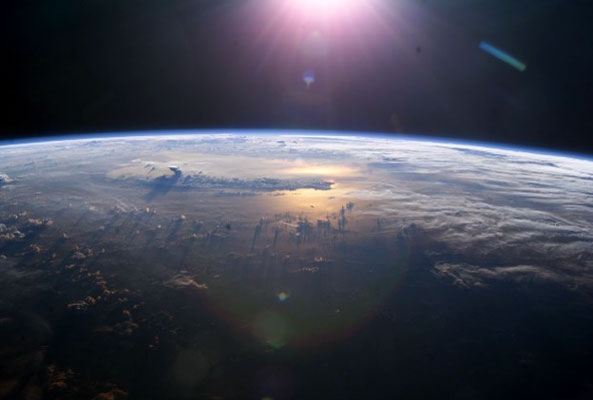
Though we may not realise it we are all on a unique and extraordinary journey - our annual 940 million kilometre [584 million mile] voyage around our sun. Each and every one of us is sitting on a giant lump of rock, the Earth, that's hurtling through space at 107,200 kilometres [66,700 miles] an hour and spinning like a giant top.


Earth and the Sun

Image Science & Analysis Laboratory, NASA Johnson Space Centre - ISS007E10807

For the next year we are going to follow that epic journey for a whole orbit - a single year. From our unique perspective in space we will see how gigantic forces like the tilt of the Earth and its spin determine our climate and influence the life cycle of every living thing on the planet. We will discover how the special characteristics of our journey around the sun create the seasons, power the most spectacular weather on the planet, and even dictate how we live our lives.

But we can't do this journey without you. We can't be everywhere on the planet so please let us know what is happening in your neck of the woods. If you capture cool clips of weather in motion or want to share your photography, please email us. Let us know what's happening where you are - is there a storm brewing? Are you experiencing floods? Or is there a meteor shower? Be our eyes and ears. This is a global adventure and we want you to join us for the ride.

For example, we are going to visit the coldest place in North America, a place so cold that if you were trapped outside you'd freeze to death in a few hours. We'll be travelling to the Atacama Desert, the driest place on earth; so arid that in some places it hasn't rained for hundreds of years. We are also journeying to the southernmost tip of South America to sail round Cape Horn. It's one of the windiest places on the planet and the vicious winds blow all year round.

Later in the year we are visiting the Temple of Kukulkan, at Chichen Itza in the Yucatan Peninsula of Mexico to learn about our ancestor's relationship with the sun. The Mayans built this temple sometime between the 9th and 12th centuries AD and its one of the wonders of the planet. The temple has 365 steps, one for each day of the year and when the sun rises on the spring equinox in March it highlights a sculpture of a plumed serpent carved into the side of the temple.

We are also travelling to Greenland to discover why sea ice melts so long after the land has warmed up and to India to learn what triggers the largest weather event on the planet, the Indian Monsoon. We start our journey on the summit of Aonach Mor in Scotland to learn about our elliptical orbit

But this series isn't just about the weather. It's also about all the other ways in which our journey through space affects the planet. We're all familiar with the idea that we live within the protective embrace of our atmosphere, but looked at another way, we also live inside the atmosphere of the sun; we're continually bombarded by its radiation, we feel the force of the solar wind, and small changes in what you might call the sun's "weather" can have big impacts here on Earth.

As we journey around the planet we will build up a picture of how Earth's weather changes as the planet journeys around the sun. And learn how every cloud, every rain drop, every snowflake, every bit of weather we see and feel is determined by the cosmic dance we make with our star.

But as Billy Connolly says; "there's no such thing as bad weather, only the wrong clothes".

Stephen Marsh is the Series Producer for 23 Degrees

BBC © 2014The BBC is not responsible for the content of external sites. Read more.

This page is best viewed in an up-to-date web browser with style sheets (CSS) enabled. While you will be able to view the content of this page in your current browser, you will not be able to get the full visual experience. Please consider upgrading your browser software or enabling style sheets (CSS) if you are able to do so.