 | 13 November 2014 |

| |
| BBC Homepage | | |
| |||
| Contact Us | | |
Nature FeaturesYou are in: Black Country > Nature > Nature Features > Spot the parakeet 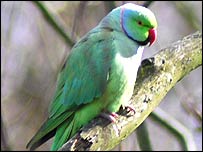 Rose-ringed parakeet Spot the parakeetBy Dr Stefan Bodnar Sightings of beautiful Rose-ringed parakeets have been reported in the Black Country and on the outskirts of Birmingham for several years. Help map out exactly where the birds are by sending in your photos... Help playing audio/video If you lived in Australia, parrots and parakeets are as familiar a part of the landscape as blue tits are here, with their raucous, gregarious flocks descending to feed on fruits and seeds. Rose-ringed parakeetsEmerald green feathers and a rose-red beak, with a pink and black ring around the face and neck They usually eat fruit, nuts and seeds Nesting is in a large nest box or an old woodpecker nest hole Females lay between two and four eggs Chicks are looked after by both parents Who'd have thought that this sight is now becoming familiar not in Brisbane, but in the Black Country! Signalled usually by its piercing 'bill, bill' contact call and a rapid flash of a green bird with a long tail, the rose-ringed parakeet is now an established and rapidly expanding resident in the Black Country. It all started with occasional sightings in the late 1980s and early 1990s - breeding in the wild was confirmed in the late 1990s. Since then increasing numbers, sometimes with flocks forming and it looks like the green corridors, the rivers, and conjoined back gardens are important for this species moving from place to place. 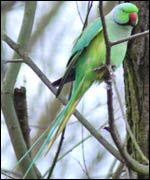 Rose-ringed parakeet - Pic: Colin Sedgewick Where have these birds come from?Originally from Africa and Asia, the birds have been kept as pets. Both deliberately liberated birds and escapees are the founders of the feral population now in the U.K. In Britain there are two main population centres, the largest based around south London, Surrey and Berkshire and by 2005, this consisted of many thousands of birds, known as the ‘Kingston Parakeets’. However, they are real 'stay at home' birds and their sedentary, non-migratory nature means that our local parakeets are likely to originate from locally released birds rather than having spread north from London. Suburban livingAveraging 16 inches, the rose-ringed parakeet is one of the few parrot species that seem able to adapt to living in suburban habitats, gardens and parks, and in our wet, temperate climate. 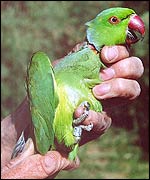 Ringed parakeet Many parrots escape from captivity each year into the wild and reports of African Greys, Hahn’s Macaw, budgies, lovebirds and cockatiels are widespread. Sadly, they are unable to cope with the climate and habitat and quickly perish if not caught and returned to captivity. The rose-ringed parakeet is an exception; the species is now considered a 'naturalised' UK species, sustaining feral populations independent of any continuing releases. In fact in the Black Country they are likely to be wild born birds that have lived all their lives in the wild. Spot the parakeetThe sexes appear different, with the male sporting a black neck-ring and pink nape band whilst the hen and immature birds of both sexes show no neck ring or just a faint shadow. 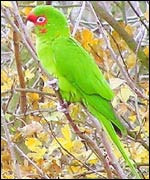 Mitred parakeet They are intelligent parrots and their quickness to learn and love of 'showing off' explains their popularity as pets. Despite being kept as pets for hundreds of years, we know relatively little about their breeding habits. We know that they use holes in trees often made by other species such as woodpeckers and may compete with these and other native birds for nest sites. Food for thoughtThey feed on a wide range of fruit, seeds and agricultural crops, but in urban areas love nothing better than hanging feeders and bird tables, especially in winter. They are big, brash, bullies though, even scaring off magpies and grey squirrels. 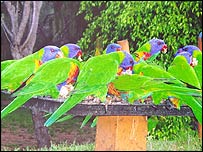 Rainbow Lorikeets In the last few years we have been monitoring their breeding sites, recording timing of fledging, numbers of young and where possible ringing birds. Gathering this information is really important for us to understand their movements and behaviour and this is where you can play your part. We are looking for sightings of parakeets in the Black Country, to build up a map of where they are and what these cheeky (but to my mind also charming) birds are up to. Dr. Stefan Bodnar, Biodiversity Officer, Birmingham City Council Send in your sightingsIf you spot a parakeet, take a picture and send it to: [email protected] and help map out exactly where the birds are. last updated: 23/06/2009 at 13:08 You are in: Black Country > Nature > Nature Features > Spot the parakeet    [an error occurred while processing this directive] |
| | About the BBC | Help | Terms of Use | Privacy & Cookies Policy |
