| 24 September 2014 |

| |
| BBC Homepage | | |
| |||
| Contact Us | | |
Local HistoryYou are in: Black Country > History > Local History > Black Country Dialect 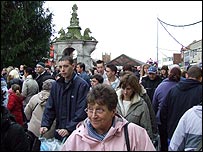 Dudley town centre Black Country DialectBy contributor Ed Conduit Ed Conduit, from Stourbridge, has been researching the Black Country dialect at Manchester Uni, under Prof. Richard Hogg, editor of Cambridge History of English. Ed tells us about Germanic words and lower tongues. Use the comment box, below, to have your say on Ed's findings.Black Country Dialect (BCD) appears to keep some features of Early Middle English. This is particularly true of its vowels, which seem to be systematically different from those of standard English. 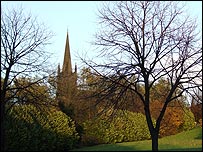 Ancient Church Hill, Wednesbury Think of the word pairs tay/ tea, pays/ peas. Feel your tongue as you say them. The standard pronunciation has the tongue nearly as close to the roof of the mouth as it will go. The BCD version has it a little lower. Then take the pairs fairse/ face, Crairdley/ Cradley. Standard English uses the “ay” vowel here, while BCD has the tongue less close. Now take boon/ bone, gooin/ going. In these vowels the tongue is closest at the back, but again the BCD version is less close. Black Country tonguesThe interest of this is that standard English changed between the times of Chaucer and Shakespeare, in a process called “the Great Vowel Shift”. Over several generations all English vowels changed. The general movement was that the tongue became one step closer to the roof of the mouth. Although some of the differences seem in the other direction e.g. strung/ strong, lung/ long, BCD may have kept the vowel sound of Early Middle English and resisted the GVS. 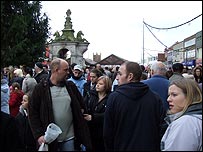 Dudley Town Centre - November 2006 Verbs also seem to show persistent features from early Middle English. Past tenses in BCD are often made weakly, by adding –ed, where standard English has a strong past. Consider gi’d/ gave, si’d/ saw, cotch’d/ caught. Weak past tenses tended to happen in lower-class English during the couple of centuries when French was the official language, and nobody was teaching “correct English”. There may be a couple of verbs where BCD has a different strong past e.g. fun/ found. Black Country verbs do not seem to have a perfect. Think of these sentences: “the glass wuz took out o’ the frairm” and “if er’d a-knew it wuz yer birthday, er’d a-bought yer a present”. The speakers know that their teachers would have corrected them to say “the glass was taken” and “if she had known it was your birthday . . ”, but they consistently use the simple past in all such situations. Four out of five words are GermanicOld English did not have a perfect, and it came into Middle English by using the verb “to have” in a new way. For example, “I have the fish as caught” eventually became “I have caught the fish”. The verb to be was also used for while, for example “I am come”, but then dropped. French and German made similar introductions of a perfect aspect. Black Country seems to have managed without it. The speaker above uses “a-knew” for this purpose. 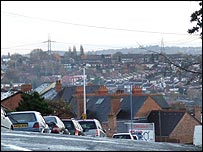 View from Church Hill, Wednesbury Interest in dialect usually starts in listing different “words”. In fact there are only a handful of words that are used exclusively in this part of the West Midlands. “Bostin fittle” is the main example. While most BCD words are also found in English in other parts of the world, BCD relies very heavily on words of Germanic origin. Four out of five words are Germanic, with virtually no Norse or Welsh, and a few words from French. This continues the trend of the priest Laghamon, who wrote a history of the English people around 1205. In his church near Stourport he managed to write 30,000 lines of Midlands English with only 100 French words. The preference for the Anglo Saxon of Mercia continues to give Black Country its distinctive sound. ===== Ed also told us that: "The Black Country word list on the BBC Black Country website [created by the readers of the website! See the link on the right for the list] turns out to be fairly inaccurate when I researched it. Have your say! What do you think of Ed's findings? How close is your tongue to the top of your mouth?last updated: 06/08/2008 at 19:23 Have Your Saywordsley mon Dawn - From "Down Under" wordsley mon wordsley mon Phil NAC Mon YVONNE B Gornal Bloke quarry bonk bloke ken chatwood patrick donald hayes secker bc mon Douglas Winterborn wordsley mon Adrian Baillie blackcountry paddy bill witts ' GOLLY' hedgefud staffs Kevin Wright Susan FJ Bartling Chris Bate wordsley mon mike s mike s wordsley mon bostin mon Joan Huybens, Mulgrave, 3170, Vic.Australia Simon B Gemma, Wolverhampton Mandy Sutton Patrick Warner Nina Ridding Dave Tonks david lilley Sandra Wilkes nocky the Ole Mon Vivo from OZ daz from tipton Tony bull Bob Cooper George Rhodes Amanda Evans K Slater rob Tom Davies julie Diane Fellows mike S Ivan Hall Alexlouise Dermot Wardley Simon B Gary mt h smith Melissa and Maggie Ronni Allan Dermot Wardley lisa of tipton jo Simon Baugh Frank Claire Jones Dee Don JH gemma Jodie Rock Cass Len Gough Geoff Adams Z Gary Page Alan Wild Ron John Fox billy spake mon Amy - May john Becky Millward Alec Pugh John S Benjamin Riches Simon B bill owens Morris edwards John Rich Steve Harper. Zoe Pat Ken Pomlett Kam Singh Mike Lewis Paul Freeman elaine Dave C. Simon B Doug Smith Lee Platt Ed Conduit Gail Morgan Jem Gino Steve Mark Towns Dermot Wardley Derek Wrighton Robert Farmer Chris Thomas Liz Kerry Houghton SEE ALSOYou are in: Black Country > History > Local History > Black Country Dialect |
| | About the BBC | Help | Terms of Use | Privacy & Cookies Policy |