A linear sequence goes from one term to the next by always adding (or subtracting) the same value.
The number added (or subtracted) at each stage of the linear sequence is called the common difference.
Examples of linear sequences occur when things change by the same amount each time.
How to find the next term in a linear sequence
Have a go yourself

Image caption, Click to see a step-by-step slideshow.

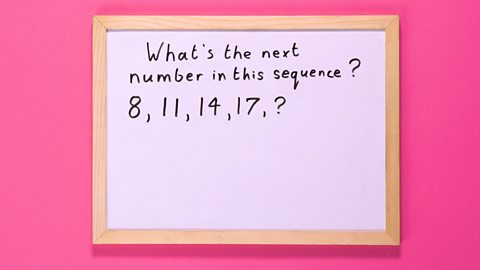
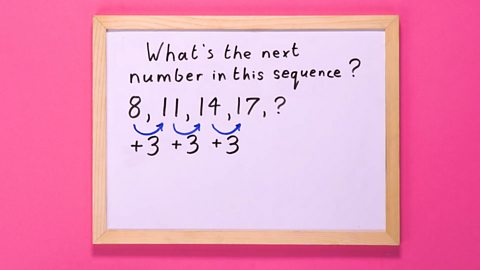

1 of 5
How do they work?
Example 1
Here is the linear sequence:
8, 11, 14, 17…
- To find the next term in this sequence we calculate the common difference.
- In this example the common difference is +3.
8 (+3) 11 (+3) 14 (+3) 17 (+3) …
Therefore, the next term in the sequence would be 20 (17 + 3)
Example 2
Here is another linear sequence:
70, 60, 50, 40 …
In this example the common difference is -10, because 10 is subtracted from each term to give the next term in the sequence.
70 (-10) 60 (-10) 50 (-10) 40 (-10) …
The next term in the sequence will be 30 (40 – 10)
When a linear sequence is plotted on a graph, it always gives a straight line.
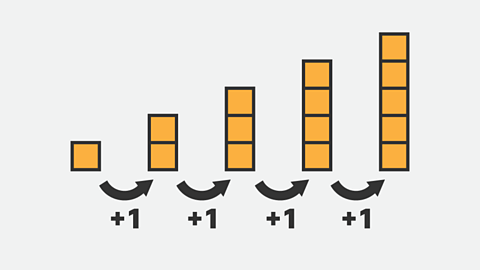
Common examples of linear sequences
- Shape patterns (see image).
- Someone walking the same distance every 10 minutes.
Linear sequence activity
Find out how much you know in this quick activity.
Arithmetic sequence quiz
Test your knowledge with this quick quiz.
More on Sequences
Find out more by working through a topic
- count4 of 5

- count5 of 5

- count1 of 5

- count2 of 5