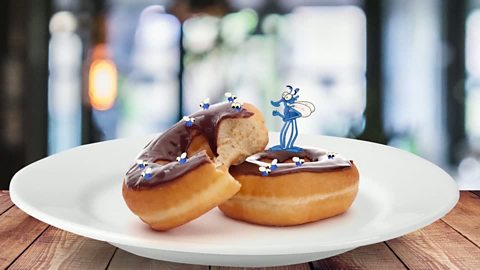
NARRATOR: Planet Earth is quite an amazing place because its full of life.
From creatures that are so small you can’t even see them, to creatures that are so huge they could
squash our whole house!
Each different kind of animal is called a species and all species are related to each other, it’s like a
very strange sort of family. It’s also a very confusing family because there are millions of species on
Earth.
How can we work out who’s related? That’s what classification is all about. It allows us to put all
different species in groups and work out in what way they are related to each other based on similar
features.
For instance, a dog and a lion. Are they closely related? They’re different but not THAT different.
They’ve both got the same sort of body shape, and each has fur and feeds milk to their young. They
both belong to the group called ‘Mammals’.
What about a duck and a fly? Are they closely related? They both have wings, they both lay eggs but
they aren’t the same things. The fly has six legs, the duck has two. Ducks have feathers, flies don’t.
They don’t belong to the same group.
Animal groups
Animals can be divided into groups or 'classified' by looking at the similarities and differences between them.
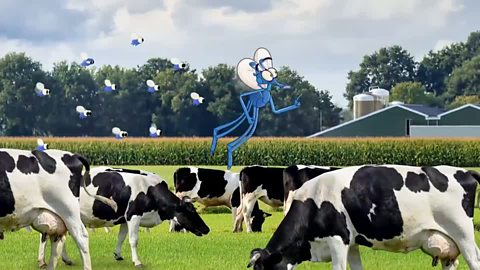
Animals are divided into two main groups. Animals that have a backbone are called vertebrates. Animals that don't have a backbone are called invertebrates.
Vertebrates and invertebrates are divided into smaller groups. Vertebrates, for example, are divided into fish, amphibians, reptiles, birds and mammals.
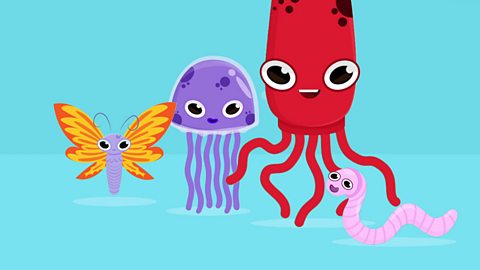
There are many different groups of invertebrates too. They include invertebrates which have soft bodies such as jellyfish, worms and molluscs (like slugs and squids). There are also groups of invertebrates with hard bodies, such as insects, crustaceans and spiders.
More on Living things
Find out more by working through a topic
- count2 of 36

- count3 of 36
- count4 of 36
- count5 of 36