Polar habitats
Polar habitats are often cold, windy and covered in frozen snow and ice.
At the top of the Earth is the North Pole, and at the bottom of the Earth is the South Pole.
The North Pole is a point in the Arctic ocean, which is in the Arctic region and the South Pole is found in the region of Antarctica.
All animals need the same important things to survive; water, air, shelter and food and a polar habitat provides plenty of all of them for all the species that are found there.
Animals don’t choose their habitat because they are suited to it. Their adaptations (the features that make them suited to their environment) happened randomly. If these adaptations help an animal to survive then they are passed on to its offspring. This is called evolution.
Watch: All about polar habitats
Head to the Arctic Circle and learn about polar habitats.
We are here.
But have you ever wondered what plants and animals live in a polar habitatand how they survive in the cold?
Well, wrap up warm, we're off to the Arctic Circle to find out!
Brrr… It looks really cold here.
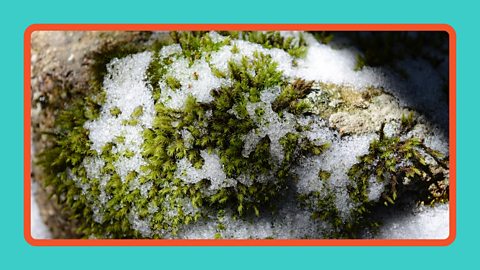
There are not many plants that can grow here as all the water is frozen. But this small bank of moss survives by growing close to the ground, keeping it out of the freezing wind.
And there's an animal here that only lives in the Arctic, but I think it's hiding…
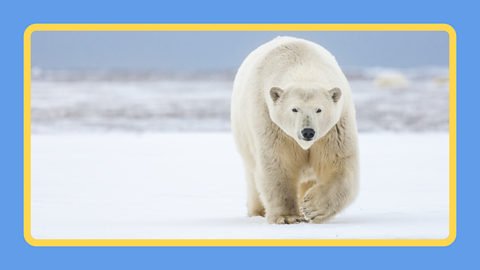
There it is! A polar bear!
Its thick fur helps it to hide and keep warm in the freezing cold.
Plus an Arctic fox. It can hear its prey, deep under the snow.
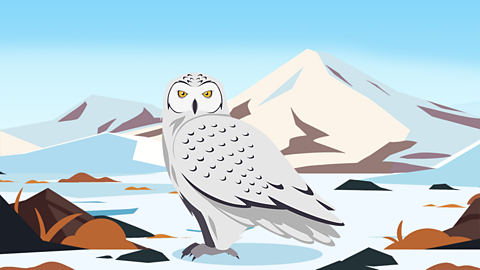
And a bird! The snowy owl. They nest on the ground as there are no trees.
And what about the South Pole on the other side of the Earth? What will we find in Antarctica?
Oooh, it looks even colder here.
Wow! A plant is growing here too, Lichen. One of the ways it survives is by taking water directly from the ice.
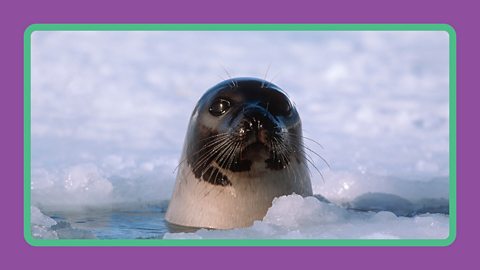
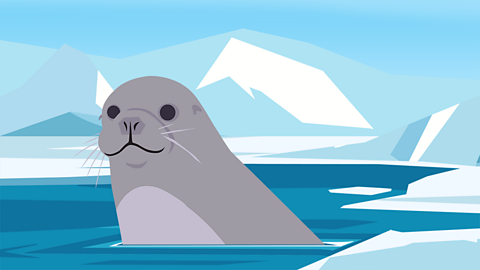
A seal sitting on the ice! They have lots of fat under their skin that keeps them warm.
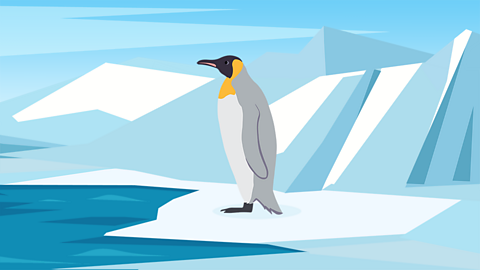
A penguin off to look for food. They're only found here in the South. They're birds, but can't fly. Really good swimmers though!
So, polar habitats are cold, windy and covered in snow and ice.
Oooh! I'm off to find a radiator!
Fascinating polar facts
In the winter, the North and South Poles receive no daylight.
A polar bear's skin is actually black. Its thick white fur provides camouflage and helps keeps it warm.
The coldest temperature ever recorded on Earth was at a research station in Antarctica in 2013, when it fell to -89.2°C.
There are no trees in the Antarctic, and only two species of flowering plant.
The North Pole is surrounded by the Arctic Ocean.
A narwhal's tusk can grow up to three metres in length.
The Arctic tundra has over 1,700 species of plant.
98% of the continent of Antarctica is covered by ice, in places up to 4.7 km thick.
What are polar habitats like?
Polar habitats are extremely cold. Temperatures can plunge to -90°C or lower.
There is very little rain and most falls as snow. In fact, Antarctica is actually a desert because it rarely ever rains.
Because of the way the Earth spins, the poles have very long days and nights. For at least one day a year there is an entire day of darkness in these habitats – and also a full day of sunshine.
The ground is permanently frozen. Very few plants grow in these habitats as the frozen ground makes it difficult for the roots to reach down into the soil. The plants that do grow often have shallow roots, which means they can’t grow very tall.
There are often strong winds which create blizzard conditions.
Adaptations
Plants and animals like polar bears, penguins, seals, and Arctic foxes have adapted to survive these harsh conditions:
- Animals have thick fur, feathers, or blubber to keep them warm.
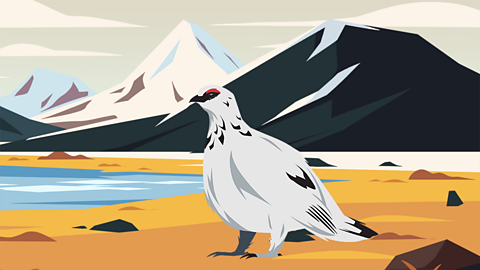
- They often have white fur or feathers to camouflage themselves in the snowy environments.
- Plants have adapted to bloom and reproduce quickly.
How do animals and plants adapt to a polar habitat?
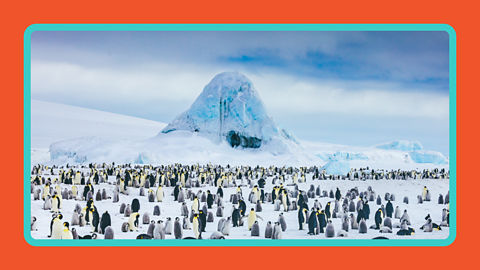
Image caption, Penguins
Penguins are the most common bird in the Antarctic. They have a thick layer of feathers which keep them warm in the freezing temperatures.
1 of 5
Did you know?
Scientists are worried about how fast climate change is melting the polar ice caps.
From 1992 to 2022, the planet's frozen poles lost 7,560 billion tonnes in mass as ice melted. This loss of water has meant that sea-levels around the world have risen by 21mm.
How do you think this will affect polar bears which hunt their prey on the pack ice of the Arctic?
Important words
Adaptation – The way animals change to suit living in different conditions.
Air – All animals need air to breathe. Although they live in water, whales, walrus and seals all need to come to the surface to breathe.
Blubber – A thick layer of fat that helps keen animals like walrus and seals warm.
Evolution – The way that animals can develop small differences over time.
Food – The things an animal or plant eats and obtains nutrition from.
Polar habitat – The environment where an animal or plant lives at either the North or South pole.
Precipitation – Water that falls from the sky such as rain, snow, hail and ice.
Shelter – Where an animal finds protection from the weather and predators.
Water – All animals need to drink or take in water to survive. Penguins can drink salt water.
Activities
Activity 1 – Find the polar animals
Activity 2 – Polar habitats quiz
Activity 3 – Sort the polar animals
Play Galaxy Pugs. game
Help the pugs observe Earth’s animals, learn how to grow plants, study the human body, experiment with materials and much more!

More on Living things and their habitats
Find out more by working through a topic
- count7 of 11
- count8 of 11
- count9 of 11

- count10 of 11