Judaism and Hanukkah
Hanukkah is a Jewish festival known as the festival of lights. In Hebrew, the word Hanukkah means dedication or re-dedication. It celebrates a miracle that happened in Jerusalem over 2,000 years ago.
Watch Zack as he celebrates the Jewish festival of Hanukkah with his friends, family and the local community.
My name is Zack and I'm Jewish. It's the middle of winter and we're celebrating Hanukkah. It's an eight day festival where families and friends get together to remember a time when Jews had to fight for their rights.
Over two thousand years ago, Israel was ruled by a foreign king who banned our religion. He used the temple in Jerusalem, our holiest place, to make sacrifices to statues of Greek gods, which was really offensive because Jews believe in only one God who can't be seen.
But the Jews rebelled against the king and re-dedicated the temple, which means they made it holy for God again. A seven branched candlestick called a menorah was supposed to be lit at all times, but there was only enough oil to keep it burning for one day.
Somehow, by a miracle, the lamp kept burning for eight days until more oil could be made. Ever since then, Jews have celebrated the eight days of Hanukkah, which means dedication. And we light candles to remember the miracle.
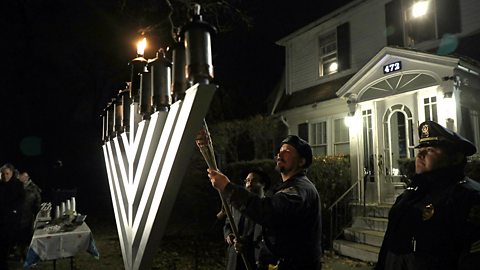
We use a special candlestick called a hanukkiah, which is like a menorah, but with nine branches rather than seven. A candle for each night of the festival and an extra one called the shammash, Hebrew for helper, which is used to light the others.
During Hanukkah, some children's families give them gelt, which means money. It can be real money or chocolate coins. It's used in a game called dreidel, where you can win some more gelt or lose it all.
Every year we light a big hanukkiah in the town and we give out donuts to everyone. It's traditional to eat food cooked in oil to remember the miracle of the burning menorah. So as well as donuts, we have latkes which are fried potato cakes and I always eat too many.
I love Hanukkah: lighting the candles, playing games, eating donuts. It always makes me feel so much closer to my family and my community and thankful to God that we still have our religious freedom. Happy Hanukkah!
What does Hanukkah celebrate?
Over 2,000 years ago in Jerusalem, a Syrian king called Antiochus banned the Jews from worshipping their God; he put a statue of Zeus (a Greek god) in their temple and sacrificed a pig to him. This was extremely offensive to the Jews because the Ten Commandments forbid them to worship anyone else other than God. The Jews refused to obey the king’s order, and a small group of Jews called the Maccabees fought back against the king’s army. After three years, they won the war and recaptured Jerusalem from the Syrians. When the Jews returned to their temple, they found it had nearly been destroyed. They cleaned and repaired the temple and when they had finished, rededicated the temple to God.
Following the re-dedication, the Jews then wanted to light the menorah (a candlestick which has seven branches), but they only had enough oil for one day. Miraculously the menorah is believed to have stayed alight for eight days until new oil arrived. Some Jews refer to this as the ‘miracle of the oil’. Hanukkah remembers this remarkable event and the re-dedication of the temple to God.
Hanukkah is celebrated in November or December and lasts eight days. Most people believe this represents how long the oil lasted, although others think there are different reasons why the celebration lasts eight days.
How is Hanukkah celebrated?
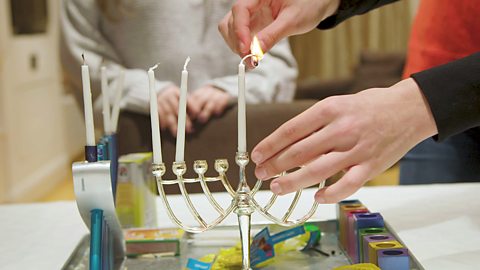
A special menorah is used for this festival, called the hanukkiah, which holds nine candles – one for each of the eight days of Hanukkah, and one for the candle which is used to light the others (called the helper or shamash candle). Each evening the family light a new candle so that by the end of the week all eight are lit. When they do this they will say prayers and may sing songs. Many Jews also eat fried potato cakes, called latkes.
On each of the eight nights of Hanukkah, many Jewish families give children presents, this is often money called gelt. Games are often played at Hanukkah, especially dreidel, which is a spinning top that has a Hebrew letter on each of its four sides.
Other Jewish festivals
Two other important festivals in Judaism are Rosh Hashanah and Yom Kippur, both of which take place in the autumn.
Rosh Hashanah is the Jewish new year festival, which remembers the time God created the world and humans, and lasts for ten days. These days are known as the Days of Awe because during this time, Jews will reflect on the things that they have done wrong, do their best to set things right with those affected, and seek forgiveness from God. Many Jews believe that Rosh Hashanah is a time when God looks at the good and bad things each person has done in the past year. Therefore, during the festival, many Jews will make a special effort to perform good actions.
Yom Kippur means the Day of Atonement and occurs at the end of Rosh Hashanah. Jews believe that on this day, God seals shut the book (called the Book of Life, which is used to decide whether a person has done enough good deeds, and therefore will have a good New Year. During Yom Kippur, most Jews will not work and instead fast for 25 hours. Importantly, Jews will go to the synagogue where they say prayers and make sure that they ask for forgiveness for anything they have done wrong.
Jewish festivals in pictures
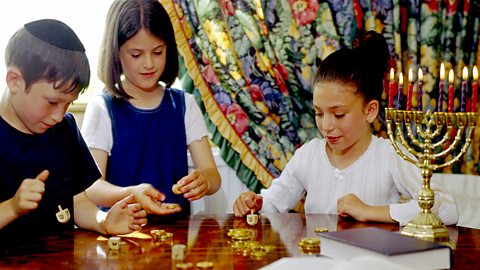
Image caption, Playing dreidel at Hanukkah
During the Jewish festival of freedom at Hanukkah children and families will often play a game called dreidel. It is often played for chocolate money.
1 of 5
Quiz
Solve the Story!
An exciting new series from the Other Side of the Story, designed to help young people strengthen their media literacy skills.