- An introduction is the opening paragraph of an essay
- It should briefly introduce the topic and outline your key ideas
- An introduction might also provide context and try to hook the reader’s interest
Learn how to introduce a topic and hook the reader in from the start of your essay
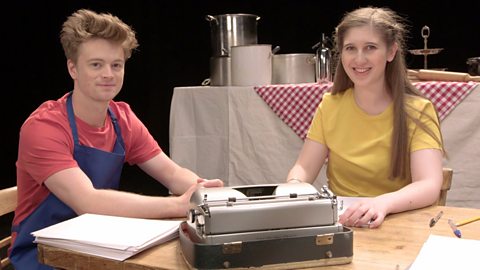
Female: This writer thinks he has what it takes to cook up a deliciously dazzling introduction.
Welcome to Master Essay.
Male: Thank you for having me.
Female: Today you’re going to be writing an introduction. Are you ready?
Male: Ready.
Female: Your time starts now. Good luck. Can you talk us through what you’re going to do?
Male: The essay question I’m answering is ‘To what extent do you agree that cooking should be taught in schools?’
Female: Mmm, a tasty topic. How will you make sure that your introduction wins over the judges?
Male: My first sentence will introduce my topic and hook them in. There are many ways you can do this. You could use techniques like alliteration, ‘Learning to cook creates confidence in the kitchen’, or by directly addressing the reader, ‘Do you know the difference between boiling and baking?’
Female: I do, thank you for asking. Can we hear your opening sentence?
Male: Everyone knows the way to someone’s heart is through their stomach, but finding love is only one reason why everyone should learn to cook.
Female: Ah, you used a well known saying for your opening. Nice idea.
Male: I did, and it relates to cooking. Your hook should always be relevant to the essay’s main idea.
Female: You don’t always have to use a well known saying though. What now?
Male: Next, I’ll demonstrate why this topic is important by providing some brief context.
Female: Okay. How?
Male: I’ll point out the rising obesity levels in the UK and that cooking for yourself is much healthier than ready meals or dining out.
Female: Good point. And next?
Male: Now I’ll state my main idea and highlight my supporting points. This allows me to move on from my introduction into the main body of my essay.
Female: And what is your main idea?
Male: Cooking should be included in the National Curriculum, because it is essential to leading a healthy lifestyle, living within a realistic budget, and it’s a skill you’ll have for life. I’m keeping it brief because it’s just my introduction.
Female: True. Well time is up. Let’s taste, I mean read, your introduction.
Nice! A powerful opening line that gets me interested, gives some context and sets out your view point. It’s short and concise and the main point is well defined. Brilliant. Congratulations! You’ve advanced to the next round.
Male: Yes. Thank you. Woo! Yes. Thank you so much.
Female: And remember, the approach used here can be applied to writing an introduction to an essay on any topic. So, that’s it for introductions. We’ll see you next time on Master Essay.
Keep it short and focused
The content and style of an introduction to an essay will depend on the purpose of your writing. If the essay title is in the form of a question, then the introduction will need to outline your answer to the question.
Introductions should be:
- short - no longer than a paragraph
- focused on the essay question, statement, title or topic
Grab the reader's attention
Think carefully about your opening line. Aim to get the reader’s attention. There are different ways to do this. You could use:
- a well-known saying or phrase
- a statement that deliberately tries to shock or challenge
- humour
- techniques like alliteration or a rhetorical question
These approaches may not work in all introductions, for example, humour may not be appropriate in a formal critical essay.
Give some context
In some essays, it can be useful to give some brief context in an introduction. This could be:
- historical - what point in time are you writing about?
- location - what country, town or area are you writing about?
- social - does the reader need to know anything about the society at the time?

Introduce your main points
An introduction should give the reader a glimpse into your thoughts on the subject. You could briefly:
- introduce your main idea or key point
- highlight your other supporting points
What to avoid
- Avoid phrases like ‘In this essay I’m going to write about …’
- Avoid a detailed analysis of the text in your introduction.
- Avoid moving away from your topic. Stay focused on the essay title.
Remember
An introduction will give the reader their first impression of your ideas. So it’s useful to spend time thinking and planning what to include.
Quiz
Find out how much you know about writing an essay introduction in this short quiz!
More on Discursive, persuasive and informative writing
Find out more by working through a topic
- count13 of 13
- count1 of 13

- count2 of 13

- count3 of 13