What are past, present and future tenses?
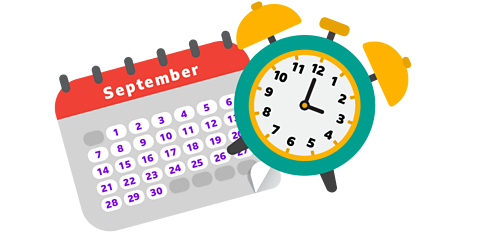
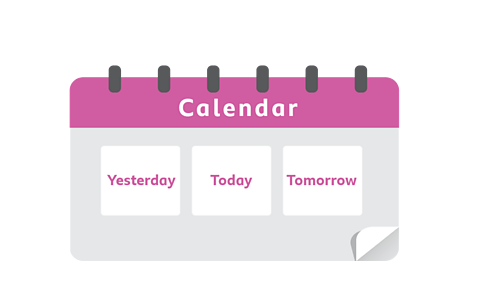
Past, present and future tense are used to show when something happens.
The past tense tells us something has already happened.
Yesterday, I played in the garden.
The present tense tells us something is happening now.
I am playing in the garden.
The future tense tells us what is going to happen later.
Tomorrow, I will play in the garden.
Activity: Past, present and future tenses
Learn about past, present and future tenses with Moop’s alien diary. Then, take the quiz to test your knowledge!
Using the past, present and future tense
Past, present and future tense are used to show when something happens.
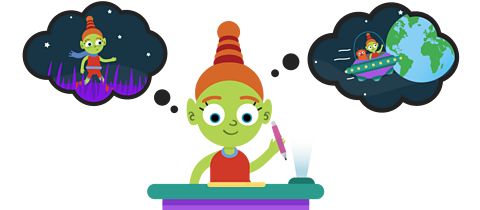
A verb is a doing (or being) word. You can tell the tense of a sentence by looking at the verb.
Past tense verbs like 'ran' and 'blew' describe things that have already happened.
Present tense verbs like 'fly', 'see', and 'wags' show actions that are happening now.
Future tense verbs like 'will' and 'am going' describe actions that haven’t happened yet.
Example 1
Is the sentence below correct?
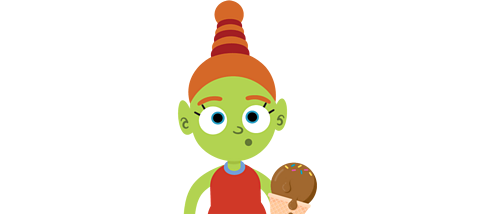
Moop will ate ice cream.
✓ No.
The word ‘will’ shows that something is going to happen in the future, but 'ate' is a past tense verb. These two tenses don't match, so the sentence is not correct.
Depending on when Moop is eating her ice cream, the sentence will look like this:
Moop ate ice cream - Past tense
Moop eats ice cream - Present tense
Moop will eat ice cream - Future tense
Example 2
In the sentence below, when did Moopdog tell his friends?
Moopdog told his friends all about the one-tailed dogs he had seen on Earth.
a) Before he went to Earth.
b) He’s telling them now.
c) When he got home.
✓ c) When he got home.
We know this because the past tense verbs 'told' and 'seen' tell you that the action has already happened.
Moopdog couldn't tell his friends what he had seen until after he saw it.
Task
Yesterday, today, tomorrow!
Can you think of three actions - one you did yesterday, one you are doing now and one you will do tomorrow?
For example:
Yesterday, I played with my little brother
Today, I’m listening to a story
Tomorrow, I will practise the piano.
Karate Cats English game! game
Head to the dojo to become an expert in spelling, punctuation and grammar.

More on Grammar
Find out more by working through a topic
- count10 of 10
- count1 of 10
- count2 of 10
- count3 of 10