Dig deep to uncover the facts about fossils.
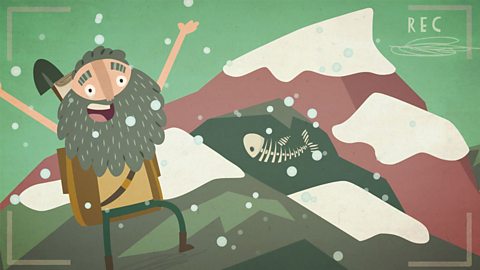
Greetings! Emmet here, and I'm about to witness an extremely rare event – a fossil being made!
Some animals, many millions of years ago, were buried quickly after their death in substances like sand, volcanic ash or mud.
Did you see that? Fantastic!
Usually the soft parts, like the muscles, rot away leaving the hard parts, like the skeleton, behind.
Then, over time, more layers of sediment cover the remains. That's why fossils are only found in sedimentary rocks.
Now, this guy's been under a whole lot of pressure and, in that time, the sediments around the bone has compacted to form rock.Water has seeped into the bone and dissolved it completely.
Minerals, in the water, are then deposited inside this mould and ta-da! Our fossil is made!
Then, over millions of years, the rock rises to the surface and is worn away by erosion.Man, I dig fossils!
Fossilisation
A fossil is the preserved remains or traces of a dead organism. The process by which a fossil is formed is called fossilisation.
It’s very rare for living things to become fossilised. Usually after most animals die their bodies just rot away and nothing is left behind. However, under certain special conditions, a fossil can form.
After an animal dies, the soft parts of its body decompose leaving the hard parts, like the skeleton, behind. This becomes buried by small particles of rock called sediment.
As more layers of sediment build up on top, the sediment around the skeleton begins to compact and turn to rock.
The bones then start to be dissolved by water seeping through the rock. Minerals in the water replace the bone, leaving a rock replica of the original bone called a fossil.
Play Bitesize games
Level up now! Take on the latest primary games on Bitesize.

Times tables 1-12!
Practise the times tables with our songs, videos and quizzes
More on The Earth
Find out more by working through a topic
- count4 of 8
- count5 of 8
- count6 of 8
- count7 of 8