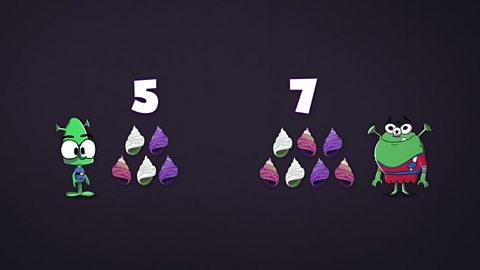
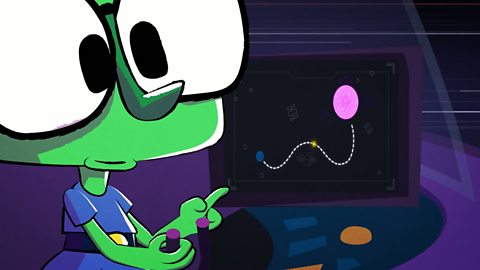
Snoot and Fin count spaceships from the space station.
NARRATOR: Hello Snoot. Hello Fin.
BOTH: (ALIEN LANGUAGE)
NARRATOR: I see you’re at the space station.
Have you come to see the space ships?
SNOOT: (ALIEN LANGUAGE)
NARRATOR: How exciting! How many space ships can you see?
That’s 1… 2… 3… 4 shuttles in the service area, 1… 2… 3 rockets in the docking bay and 1… 2 flying saucers in the loading area.
What a lot of different ships.
How many are there altogether?
SNOOT: Er… Oo…
NARRATOR: Why don’t you start by adding the 4 shuttles and the 3 rockets?
4 add 3 equals 7.
Then take that 7 and add the 2 flying saucers.
7 add 2 equals 9.
FIN: (ALIEN LANGUAGE)
NARRATOR: Alright Fin, if you’ve got another way of counting them up, be our guest.
Ah, I see.
You prefer to start by adding the 2 flying saucers and the 3 rockets.
2 add 3 equals 5.
Then we take that 5 and add the 4 shuttles.
5 add 4 equals 9 as well.
BOTH: Aha!
NARRATOR: That’s right, it doesn’t matter which pair of numbers you add together first: you could do 4 add 3 add 2, or 2 add 3 add 4, the answer’s just the same.
SNOOT: (ALIEN LANGUAGE)
NARRATOR: What’s that Snoot?
(LAZER SHOTS FIRED)
More space ships?
Oh dear, intergalactic raiders.
I think we may have lost one or two ships…
Which order is best?
It doesn't matter which order you add numbers in. The answer will always be the same. Use the order that is easiest for you.
Top tip
You might find it easiest to add number bonds first.
If you had to add 3+5+7, you might want to add 3+7 first to make 10.
Which way round should I add two numbers? video
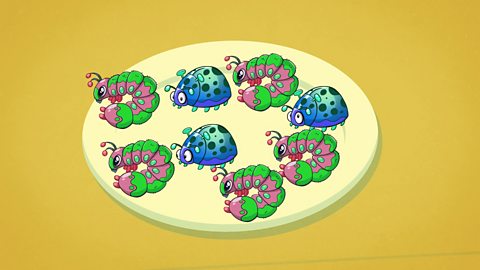
Fin and Snoot add up some of their favourite snacks: space grubs and astro bugs.
How can reordering numbers into number bonds help me add them? video
Snoot and Fin rearrange numbers and make number bonds when adding moons.
Find more 1st Level resources from BBC Bitesize
First Level is a stage of Scotland’s Curriculum for Excellence.

More on Numbers and number processes
Find out more by working through a topic
- count5 of 25