What are instructions?
Instructions tell us how something should be done. They guide us, step by step and in the right order, so that we can achieve our goal.
You need instructions if you want to bake a cake or cook a meal. We call the instructions for baking or cooking something a recipe.
You also need instructions if you want to play a game. The instructions will help everyone know what to do.
If you want to make something, like a climbing frame in your garden, you will need instructions.

Getting started
When you write instructions you start with the title.
The title lets everyone know what your instructions are about.
For example, if you are writing instructions about how to bake a birthday cake, your title would be ‘How to Bake a Birthday Cake’.
Next, write down a list of the things you need. When you bake a cake, the things you need are called the ingredients.
When you write down instructions you usually number them 1, 2, 3 and so on.
Bossy verbs
You can use bossy verbs to start each sentence. Bossy verbs tell us to do something like measure the flour, mix the two eggs and add the eggs to the flour.

Time connectives
You can also add time connectives to your instructions.
These are words such as first, then, next and finally.
These words help to link the instructions together and tell the reader when to do something.
For example, you could write:
- First measure the flour.
- Next mix the two eggs.
- Now add the eggs to the flour.
You can finish writing your instructions by saying, ‘Now, enjoy your cake.’
If your instructions are about how to build a car you could say, ‘Finally, you have built your car.’
Short sentences in the right order
It is best to use short sentences when writing your instructions.
You should also write them in the correct order so that the person reading them does not get muddled up. Imagine if you were writing a recipe and you wrote –
- First put the cake in the oven.
- Now mix the eggs
The person reading your instructions would get very confused. In fact, the person wouldn’t be able to follow your instructions. That’s why they need to be in the right order.
Why not have a go at writing some instructions after you have watched the kids looking for treasure?
Example: How to find treasure
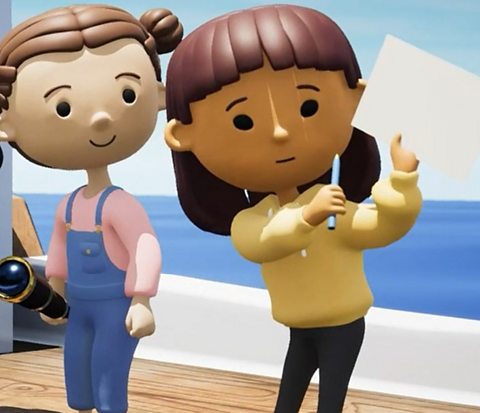
The kids are on a boat together in the open sea.
Sophie is looking through her telescope. She is searching for treasure. Suddenly there is a loud bang and a pirate appears!
You would think a pirate would be the right person to help find treasure, wouldn’t you? But, guess what? The pirate has lost her treasure map, so she needs to shout the instructions to the kids as Lara writes them down.
NARRATOR
What are you looking for Sophie?
SOPHIE
I’m looking for treasure!
[LOUD THUD]
NARRATOR
Woah! What was that?
PIRATE
Ahoy mateys! I was looking for me hat, and must’ve taken my eye off the wheel… What are you all looking for with that telescope?
ALL KIDS
(in unison) TREASURE! / Yarrrr!
SOPHIE
Do you know where we could find some?
PIRATE
I do, as a matter of fact!
ALL KIDS
Yes! Woohoo!
PIRATE
Listen up now! First you take a left at the–
ROBIN
Hang on, don’t you have a treasure map?
PIRATE
Ehhh… (tuts) I must have lost it with my hat…
NARRATOR
I’ve got an idea - why don’t you write down the instructions in order so you can follow them as you go through each step! That way you won’t mix them up or forget them.
LARA
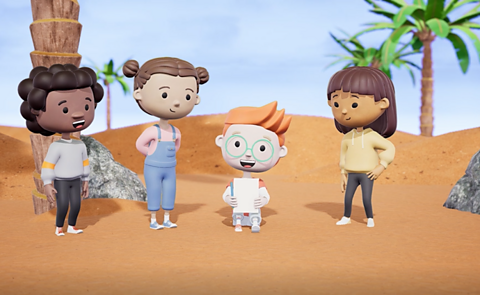
I can write as you tell us the directions!
PIRATE
Happy days! So first ye turn left at the giant boulder…Next ye go through the rainbow cave, and then ye arrive at the pirate ship where the treasure is!
…
PETE
We did it! We found the treasure!
NARRATOR
Well done everyone!
Writing down instructions helps you to organise your thoughts and carry out tasks, step by step and in the right order.
More on Writing
Find out more by working through a topic
- count5 of 37
- count6 of 37
- count7 of 37
- count8 of 37