German word order is quite different to English. But don’t worry, you will soon get the hang of it once you know the rules!
Word order: How to build sentences in German
In German the order you say and write things is important. For example, the verb is always the second idea in the sentence. Not necessarily the second word but the second idea.
Ich esse Pizza - I eat pizza.
Ich is the first idea and esse is the second idea.
But if you put oft - ‘often’ - first, the word order changes like this:
Oft is the first idea and because the verb has to be the second idea you flip the verb and the subject round to esse ich, so it would literally be Often eat I pizza.
Sometimes the first idea is not just one word but a phrase like jeden Tag - ‘every day’.
Jeden Tag esse ich Pizza - Every day I eat pizza.
Now, there are some situations where parts of verbs get booted to the end of the sentence.
For example in the perfect tense, the past participle goes to the end of the sentence.
Ich habe eine Pizza mit meinen Freunden gegessen - I have eaten a pizza with my friends.
And when you use modal verbs like ich will - ‘I want to’ - the infinitive goes to the end of the sentence.
Ich will Pizza essen - I want to eat pizza.
So with the verb as the second idea and some verbs booted to the end of the sentence you should start to get your words in the right order.
The second idea
In a German sentence, the position of the verb (doing word) is very important. It has to be the second idea in the sentence.
An idea in a sentence can be one word:
- Ich spiele Tischtennis - I play table tennis.
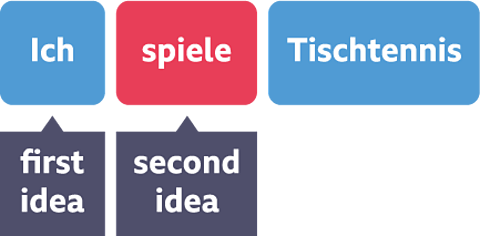
In this example, ich is the first idea and spiele is a verb and is therefore the second idea.
But sometimes, the idea is more than one word.
- Mein Freund spielt Tischtennis - My friend plays table tennis.
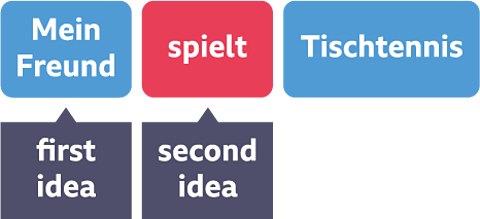
In this example, Mein Freund is two words, but it makes one idea. It is the first idea in the sentence. Spielt is a verb, so it is the second idea in the sentence.
Time phrases
If you want to say when you do something, you can use a time phrase, such as oft (often) or jeden Tag (every day). You need to make sure the verb is still the second idea. One way of doing this is by putting the time phrase straight after the verb:
- Ich spiele oft Videospiele - I often play video games.
- Ich esse jeden Tag einen Apfel - I eat an apple every day.
In both of these examples, the verb is still the second idea.
Inversion
You can also start the sentence with a time phrase and flip the verb and the subject (the person doing the verb) so the verb still comes second. This is called inversion.
- Oft spiele ich Videospiele - I often play video games.
- Jeden Tag esse ich einen Apfel - I eat an apple every day.

Remember, the second idea isn’t always the second word! Many time phrases are made up of more than one word:
Ich höre jeden Tag Musik - I listen to music every day.
Jeden Tag höre ich Musik - I listen to music every day.
Ich gehe nächste Woche zum Park - I am going to the park next week.
Nächste Woche gehe ich zum Park - I am going to the park next week.
Watch out! You can’t put a time phrase at the end of the sentence. It has to go after the verb or at the beginning of the sentence with the verb as the second idea.
Using connectives
If you want to make your sentences longer, you can use connectives to link two sentences together. Fortunately und (and), aber (but) and denn (because) do not change the word order.
Und - and
Ich spiele Tischtennis und ich mache Karate - I play table tennis and I do karate.

Aber - but
Ich esse gern Salat, aber ich esse nicht gern Gemüse - I like eating salad but I don’t like eating vegetables.

Denn – because
- Ich esse gern Kuchen, denn es ist lecker - I like eating cake because it is tasty.
- Ich drehe Videos, denn es ist unterhaltsam - I film videos because it is entertaining.
- Ich spiele Rugby, denn es macht Spaß - I play rugby because it is fun (translated literally as it makes fun).
Using modal verbs
If you are using a modal verb like können (can, to be able to) or müssen (must, to have to) with an infinitive, the modal verb is the second idea and the infinitive moves to the end of the sentence.
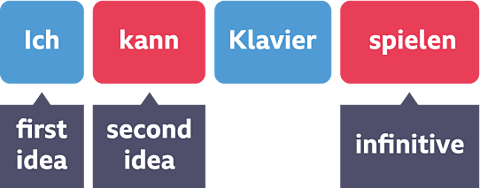
Ich kann Klavier spielen - I can play the piano.
Kann is the second idea. Spielen is at the end of the sentence.
The perfect tense
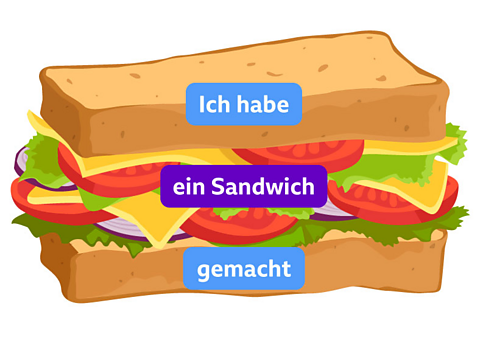
The perfect tense is a past tense. It is formed with three parts: a subject, an auxiliary verb and a past participle. When using the perfect tense, the auxiliary verb is the second idea and the past participle is moved to the end of the sentence.
Any extra information you want to add to the sentence is sandwiched in the middle of the two verbs:
Ich habe Fußball gespielt - I have played football. (translated literally as I have football played).
You can think about this like a sandwich. The pronoun and auxiliary verb make up the top slice of bread, the detail is the filling, and the past participle is the bottom slice of bread!

Quiz
Find out how much you know about German word order in this short quiz!
Game - FestiLingo: German. game
Visit the festival and practise German language skills in this game

More on Grammar
Find out more by working through a topic
- count8 of 8

- count1 of 8
- count2 of 8
- count3 of 8