Find out how to change an electrical circuit
NARRATOR: That ice cream dispenser is out of control Frank!
Let’s look at how it’s set up.
We can see it’s a series circuit because everything is connected to one path.
The power is coming from the battery, running along the wires, which are conductors made from metal.
These take power to the motor, which is spinning the ice cream scoop.
If there’re any gaps, the power won’t flow! So to control the scoop, we just need to put a break in the circuit.
Let’s put a switch in there – if the switch is off it breaks the circuit, and if it’s on the power continues to floooowwwwww.
Just flick the switch to turn it off Frank! And if you fancy an ice cream, flick it to turn it back on!
FRANK: Argh!!
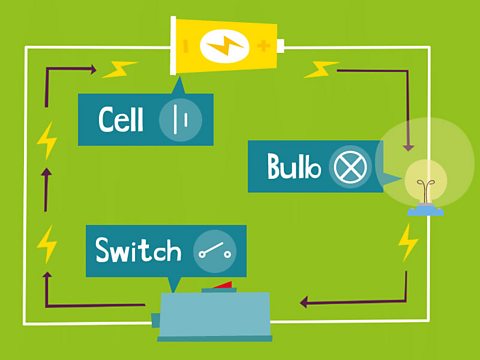
Circuits
Electricity can flow through the components in a complete electrical circuit.
A circuit always needs a power source, such as a battery, with wires connected to both the positive (+) and negative (-) ends. A battery is made from a collection of cells connected together.
A circuit can also contain other electrical components, such as bulbs, buzzers or motors, which allow electricity to pass through.
Electricity will only travel around a circuit that is complete. That means it has no gaps. You can use a switch in a circuit to create a gap in a circuit. This can be used to switch it on and off.
When a switch is open (off), there is a gap in the circuit. Electricity cannot travel around the circuit. When a switch is closed (on), it makes the circuit complete. Electricity can travel around the circuit.
Times tables 1-12!
Practise the times tables with our songs, videos and quizzes

More on Electricity
Find out more by working through a topic
- count1 of 5
- count2 of 5

- count3 of 5