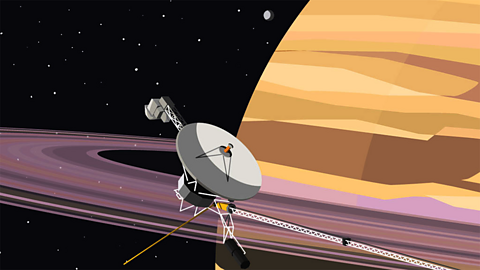
Explore the solar system's gas planets and learn about their properties.
Narrator: Further from the Sun, in the outer reaches of the solar system, we find the gas planets.
Much larger than the rocky planets, these cosmic giants are accompanied by numerous moons.
Jupiter, famous for its red spot, is the largest, followed by Saturn with its rings made of ice, rock and dust.
Uranus and Neptune come next.
Whilst unmanned spacecraft have approached the gas planets, actual landings are not possible because of the lack of solid surfaces.
What? What’s this?
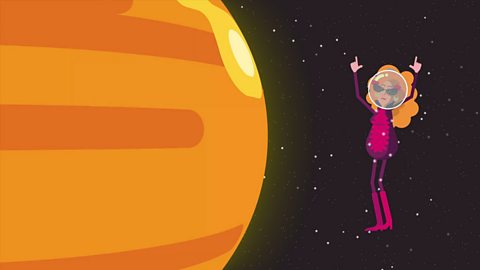
Stella: Don’t land on them now,
They’re not very stable,
They’re gaseous balls,
Don’t land on them now,
They’re hydrogen and helium,
They’ve no surface at all,
They’re not very stable,
They’re not like a table,
In fact they’ve got no surface at all!
No surface at all!
Gas planet facts
- The gas planets are Jupiter, Saturn, Uranus and Neptune.
- They are the furthest planets from the Sun.
- They each have many moons.
- They are much bigger than the rocky planets.
- They're balls of hydrogen and helium - you couldn't stand on the surface of the planet because it's not solid.
Times tables 1-12!
Practise the times tables with our songs, videos and quizzes
More on Space
Find out more by working through a topic
- count4 of 9
- count5 of 9
- count6 of 9
- count7 of 9