Your time at the International Space Station (ISS) is at an end. Now you face one last test of your scientific skills and astronaut training - returning home alive.
You’ll have to get your speed and angle of descent spot on. To do this, you and your crew must understand how air resistance and gravity work.
Even if you get your calculations right, your capsule will glow white-hot under the tremendous heat of re-entry. Get them wrong, and it could melt or skim across the earth’s atmosphere, and be thrown out into space. Think you can handle the pressure?
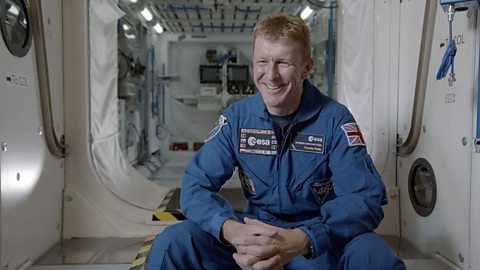
Tim Peake and Fran Scott explain the science behind getting the astronauts back home. Archive: NASA
MALE NARRATOR: After six months of living and working on board the International Space Station, astronauts have to make their way back down to Earth. Three of them cram into the Soyuz capsule with not much more room than the back seat of a car, and drop the 400 km out of orbit and back down to Earth.
After the capsule detaches from the Space Station a quick blast on the thrusters slows it down and gravity does the rest, pulling it back to Earth. The capsule slows from about 28,000 km an hour in orbit and drops into the Earths atmosphere, streaking across the sky at 800 km an hour.
And this is a pretty bumpy ride and one of the most dangerous parts of the mission. We have to get the re-entry angle just right. Too shallow and the capsule will bounce off the Earths atmosphere like a skimming stone and off out into space. Too steep and the capsule will burn up on re-entry.
Even getting the angle just right means the capsule glow white hot, which is why it has a special protective heat shield and this is because the of the friction with the Earths atmosphere.
FEMALE NARRATOR: It’s just the force of gravity that brings the astronauts back to Earth, as Issac Newton may have once said; “What goes up, must come down”. But slowing the astronauts down, well that’s a completely different matter.
How on Earth do you stop something that’s travelling at 17,000 miles an hour? Well to be honest with you it’s the Earth’s atmosphere that does most of the work. As the craft enters the Earths atmosphere, the air rushing past the craft creates friction. And that force, which is also known as ‘air resistance’ or ‘drag’, that slows the aircraft down.
But if something rubs past another object fast enough, like air whooshing past an aircraft at high speed, then things are going to get extremely hot - because friction creates heat. Just like, you know when you get your hands and you rub them together really, really hard, ah…
Then they get hot as well.
Now people in the olden days used this idea of friction creating heat to rub sticks together to make fire. But that used to take a long time so instead, I’m going to use this drill. And I’m going to do it on this little bit of wood and see if we can create some heat…
DRILL BUZZES
So what we can see with our heat sensitive camera is that as the drill whizzes round it rubs against the plank so much that it creates enough friction and heat to create the smoke.
There you go can you see the smoke that’s coming off? Just there? Now that, is because the heat is being created by the friction. The friction is the drill rubbing on the wood. Oh and I can smell the smoke as well from here.
So there you go, friction cough creates heat.
So if like the astronauts capsule, you’re travelling through the Earths atmosphere, things do get extremely hot. Over 1600 degrees Celsius. That, is hot enough to melt steel.
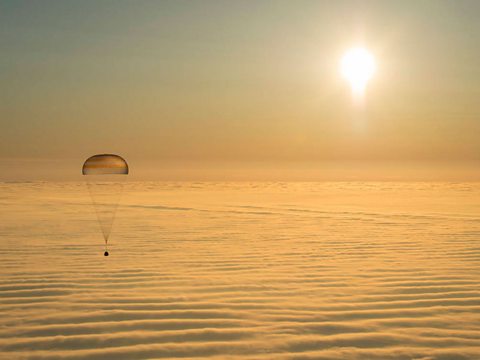
And for the final few miles the astronauts have another trick to help them. The capsule unfolds huge parachutes. The largest is 10,000 square meters – about as large as four tennis courts. A massive surface area that catches the air, acting like a natural break. This slows the craft down to a safe speed.
Bringing the astronauts safely back to Earth.
Too close for comfort
The moment of truth is here. You say goodbye to your ISS colleagues, enter your cramped Soyuz capsule and close the hatch. Ahead of you is the bumpiest journey of your life.
For the last week you’ve been rehearsing your undocking and descent procedures. The undocking sequence begins, and the hooks that connect the Soyuz to the ISS detach. As you drift away, mission control uploads the data your onboard computer needs to get home.
You monitor the descent angle closely as the de-orbit procedure begins to slow you down, the Soyuz separates into three parts, the explosive bolts slamming and banging like sledgehammers. Your descent module begins its re-entry. Its heat shield is working overtime.
At 8.5 km above ground level, the capsule’s huge parachutes start to open. You feel gravity dragging on your body as you come into land.
Welcome back to Earth!
Click below to learn more about the ISS, its astronauts, and the Earth they are orbiting.
More on Earth and space
Find out more by working through a topic
- count14 of 18
- count15 of 18

- count16 of 18

- count17 of 18