The definition of the word probability is the chance that an event will or will not occur. Some things are certain or impossible. However, many things can't be predicted with total confidence like flipping heads on a coin or rainy weather.
The best we can do is to say how likely they are to happen. For this reason, we need to be very careful about the language we choose to use.
Where we cannot predict for certain what might happen, we can still use terms such as: very likely, likely, possible, unlikely, very unlikely instead.
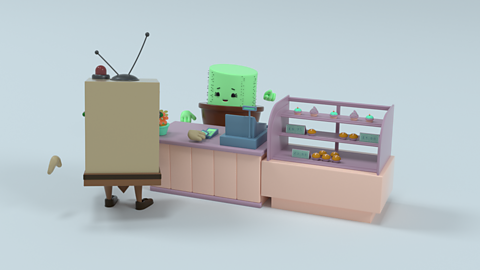
Narrator: An elliptic creature deep in thought, Professor Eggs is uncertain about something. Chance would be a fine thing
Radio: Even though it’s impossible they’ll be a solar eclipse, with an unlikely 25% of some snow. It’s guaranteed today that the sun will rise. 75% of wind and a 50% chance of some sunshine, all day. So, you should toss a coin, if you need an umbrella today.
Narrator: The weather is a perfect example of probability. And the language it uses to describe the outcome of events.
We are certain that there will be, a sunrise. It is very likely, that there will be wind. There is an even chance of rain or sunshine. It is unlikely that there will be snow. It’s impossible, that there will be a solar eclipse. A coin toss is 50/50 outcome, because it can land either side, heads, or tails. If Professor Egg’s coin lands heads, then he will bring his umbrella with him in case it rains. That was a highly improbable outcome.
To calculate probability, we need to follow three simple steps:
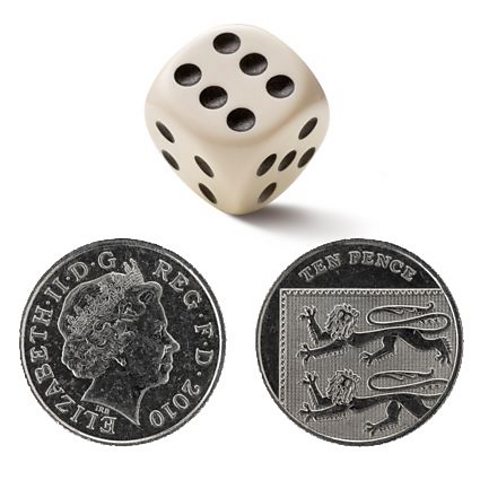
- Identify an event with at least one possible outcome (rolling a 6 on a die)
- Find the number of outcomes that can happen from the event (six total outcomes because there are six numbers on a die)
- Divide the total number of events by the total number of possible outcomes (one event divided by the six possible outcomes that could occur. This results in a fraction of 1/6).
The probability that you will roll a 6 on the first try is one in six, so we can say that this is fairly unlikely to happen, but far from impossible.
When the number of possible outcomes are reduced, we can predict the probability of an event happening with much greater certainty. For example, flipping heads or tails on a coin. With only two possible outcomes (heads or tails), the probability of landing on one or the other is one in two (1/2). This is also known as having a 50/50 or evens chance. In this case, our chances of landing on heads is much more likely that rolling a 6.

We make choices every day, often without being able to predict with total certainty what the outcome of our choices will be.
By understanding that probability is simply a ratio of the times an event is likely to occur divided by the total possible events, we can begin to measure how likely the choices we make will have the outcome we really desire.
Just keep that in mind the next time you are deciding whether to bring an umbrella or not.
More on Processes in mathematics
Find out more by working through a topic
- count2 of 33
- count3 of 33
- count4 of 33
- count5 of 33