Watch: Changes to road travel
There are two main ways to travel on land. One way is on roads and the other way is on railway tracks. Let’s see how transport has changed.
Aunt Maya: Put your seatbelt on please, Rian.
Rian: Why do we need to wear seatbelts, Aunty Maya?
Aunt Maya: For safety - just in case we need to stop suddenly or we bump into another car. The seatbelt stops you from flying forward and being hurt.
Rian: Oh, what a great idea seatbelts are! So what part of our journey are we doing today?
Aunt Maya: We're driving south from here in Scotland, all the way through England. Ready?
Rian: Let's go. It's so quiet in this car.
Aunt Maya: That's because it's an electric car. Many cars have an engine that uses petrol or diesel fuel to make them go. They let out smoke and pollution that is not very good for the planet or for us. But electric cars have a big battery that powers the motor and makes the car move. They cause less pollution because they don't make any smoke or fumes.
Rian: Like a bigger version of my remote-control car at home.
Aunt Maya: A bit like that, yes.
Rian: Can this car go really fast?
Aunt Maya: It can go fast, but we need to stick to the speed limit.
Rian: What's a speed limit?
Aunt Maya: A speed limit is the fastest speed you're allowed to travel. That sign shows us that this road has a speed limit of 20 miles per hour.
Rian: Is that how fast we're going?
Aunt Maya: We are just a little slower than 20.
Rian: Why do we have to go so slowly?
Aunt Maya: It's for safety. We're in a town and there are people walking around, people on bikes and the roads are quite small.
Rian: That car looks different.
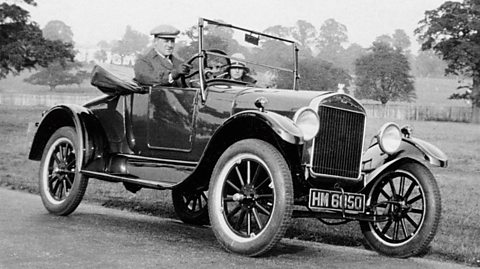
Aunt Maya: Yes, that is a very old car. It is different from cars today.
Rian: The wheels are really thin.
Aunt Maya: It doesn't drive as fast and it doesn't have any electric windows.
Rian: What? When were the first cars made?
Aunt Maya: The first motor cars were made more than 130 years ago in Germany and soon after, cars were being made in factories all around the world. In America, someone called Henry Ford made a car that lots of people could afford to buy, so it didn't take long before cars were everywhere.
But cars weren't the first type of transport to use wheels. Wheels were an amazing invention. Some people even say it was the most important invention of all time. People from all over the world have been travelling with wheels for a long time. For example, some built carriages and chariots with wheels that could be pulled along by animals or people.
Rian: Pulled by people! That sounds like hard work.
Aunt Maya: And then of course, there were bicycles. The first bike was invented over 200 years ago in Europe.
Rian: Wow, that bike looks so different to bicycles today.
Aunt Maya: Not all that comfortable - which makes this next story even more amazing. Annie Londonderry became the very first woman to cycle all around the world. She set off from this part of America in 1894. She had to catch boats between some countries, but she cycled across Europe all the way through Asia and then caught a boat back to America from Japan. She finished her journey exactly a year later, where she had started.
Rian: Amazing! But she's not wearing a helmet. Mum always says you should wear a helmet when you cycle.
Aunt Maya: Well spotted. Bicycle helmets hadn't been invented when Annie made her journey. They didn't realise how dangerous it could be if you fell off and bumped your head. Now we know that helmets can help keep our heads safe.
Rian: This road we're on now is much bigger.
Aunt Maya: This is called a motorway and this one has three lanes on each side so more cars can go on the road.
Rian: And we're going faster.
Aunt Maya: Yes, the speed limit here is 70 miles per hour.
Rian: There are a lot of different vehicles on the motorway too.
Aunt Maya: Yes, lorries which transport things like food all over the country.
Rian: There's a van. My dad has a van for his work so he can carry all his equipment.
Aunt Maya: He does. And look - there's a passenger coach.
Rian: A coach can carry lots of people.
Aunt Maya: They transport more people in one journey than we can in a car.
Rian: My favourite type of car is a racing car.
Aunt Maya: They are pretty great. People race lots of different vehicles for fun.
Rian: Like monster trucks. When I'm older, I'm going to try and drive one of those.
Aunt Maya: An electric monster truck, I hope.
Rian: Definitely.
Roads: bicycles
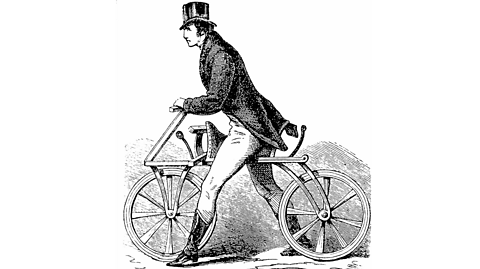
- The first bicycle was invented in 1817 by Karl von Drais. It was called a Draisine.
- There were many popular designs for bicycles. For example, the penny-farthing had a big wheel at the front and a small wheel at the back.
- Bicycles became much more popular when they were made with two wheels of equal size and rubber tyres. These were known as safety bicycles. The design looks similar to bicycles today.
Roads: motor cars
- The first steam-powered car that could carry passengers was made in 1769.
- German inventor Karl Benz created the first petrol motor cars in 1885. They only had three wheels!
- The Model T Ford was the first car that ordinary people could afford to buy. It was made between 1908 and 1927. It is one of the biggest selling cars of all time.
- The roads in Britain were not built for cars. As cars became more popular, new roads needed to be built. In 1959 the first inter-city motorway was built in Britain. It runs from London to Leeds.
Watch: The history of rail travel
Rian: I'm so excited, Auntie Maya! I can't believe we're going to spend the night on the train and sleep in these bunk beds!
Aunt Maya: Well, we're travelling a long way across India for this part of our journey.
Rian: We're setting off. How does a train work?
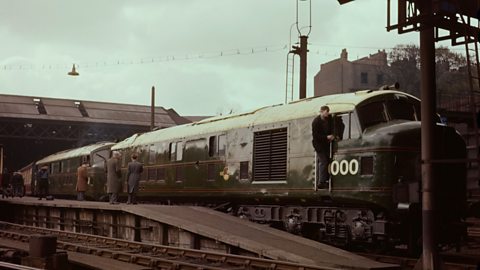
Aunt Maya: This one is an electric train, but some other trains use diesel fuel to power their engine. Let's take a look on my tablet. Train engines pull carriages that can carry all sorts of things. We're on a passenger train, so it carries people. But trains are also used to transport food, machinery and even animals over long distances. You can see there are wheels all along the engine and the carriages. These wheels sit on the rails that guide the train along its route.
Rian: Amazing! Who thought of that idea?
Aunt Maya: Using rails is a very old invention from all over the world. Rails have been discovered in China that are over 2000 years old. They think a horse was used to pull a cart along the wooden track.
Rian: That was so long ago!
Aunt Maya: I know! Some of the earliest rail transport in Europe was used around 500 years ago. But they were very different from modern railways and were just used for transporting things over a short distance. They had a rope system that was pulled by humans or animals that would pull little carts up a hill.
Rian: Now that does sound like hard work!
Aunt Maya: And then steam-powered trains were invented. What do you notice about this one?
Rian: There's loads of smoke or something coming out of that tall tube on top of it. What's happening inside there?
Aunt Maya: That is the steam and smoke coming from the engine. Fire and coal were used to heat up water and then turn it into steam. That powered the engine. The tube is a chimney that lets the steam and smoke out.
Rian: Nice! So where did they use steam trains first?
Aunt Maya: The first working train was used in Wales and the first passenger train journey was made over a short distance in 1825.
Rian: Wow! So who built that train?
Aunt Maya: A man called George Stephenson. He designed many different steam engines. But it was his son, Robert, who built the most famous early one. It was called Rocket.
Rian: Good name!
Aunt Maya: I thought you'd like that one. Rocket took part in a competition with other engines along a short line of railway track. Out of all the entries it was the only one that completed the distance.
Rian: Good work, Rocket!
Aunt Maya: Rocket was used as an engine in the very first railway line joining two cities together. Soon after this, steam trains and railway lines were built all over the world.
Rian: Where are your favourite train journeys around the world?
Aunt Maya: That's a good question. There's lots to pick from because it became such a popular way to travel. There was one called the Orient Express, which travelled all the way from London to Istanbul in Turkey. And there is one called the Trans-Siberian Railway, which travels for more than six days all the way across Russia.
Rian: Wow, that's really far!
Aunt Maya: But some trains just travel short distances. Lots of cities around the world have an underground railway, sometimes called a metro or subway or tube.
Rian: What do people use them for?
Aunt Maya: Underground trains below cities can take people to their jobs or help people avoid car traffic on the roads above.
Rian: How fast can we go on a train?
Aunt Maya: Pretty fast. The quickest trains are designed a bit like jet planes to make them go super fast.
Rian: But they don't have wings, do they?
Aunt Maya: No, but the bullet train from Japan looks a bit like a jet plane, doesn't it?
Rian: It does!
Aunt Maya: Anyway… It's getting late. Shall we sort these bunk beds out?
Rian: Let's do it!
Aunt Maya: When we wake up tomorrow morning we should be nearly at our next stop.
Rian: Excellent!
Railways
- In 1829 Robert Stephenson invented one of the first steam engines. It was called Rocket and it could travel up to 29 mph.
- The first modern railway opened in 1830. It carried passengers between Liverpool and Manchester.
- The world's first underground railway was opened in 1863 in London. This grew over the next 100 years and is now known as the London Underground or the Tube.
- Between the 1930s and 1960s, steam engines began to be replaced by diesel engines.
- Today, diesel engines are being replaced by electric trains.
Activities
Activity 1: Put the vehicles in the right order
Activity 2: Transport on land quiz
Back in time with...Astonishing Activists game! game
Play this fun game to learn about Nelson Mandela, Emmeline Pankhurst, Rosa Parks and Guy Fawkes.
More on Changes through time
Find out more by working through a topic
- count5 of 7
- count6 of 7

- count7 of 7
- count1 of 7