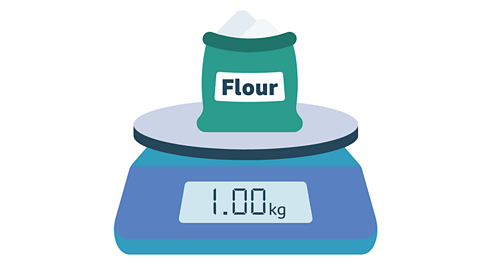
What are kilograms?
When you measure the mass of an object that is more than 1,000 grams, you should describe it in kilograms.
Kilograms can be shortened to 'kg'.
1 kilogram = 1,000 grams
or
1kg = 1,000g
Quiz: Measuring in kilograms
Test out your knowledge of measuring mass in kilograms with this quiz, then read on to complete the page.
Grams and kilograms
Here is a paper clip. It has a mass of 1 gram, which can be written as 1g.
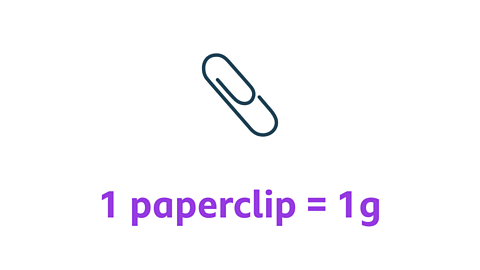
What would be the mass of 1,000 paper clips?
They would have a mass of 1,000g.
When the mass of an object is heavier than 999g, we use another type of measurement.
Working with numbers in the thousands would become difficult, so we use kilograms instead.
There are 1,000 grams in a kilogram. You use the letters 'kg' after the number to represent kilograms.
1,000 paper clips would have a mass of 1kg in total.
Food that you buy in the shop is usually measured in grams and kilograms.
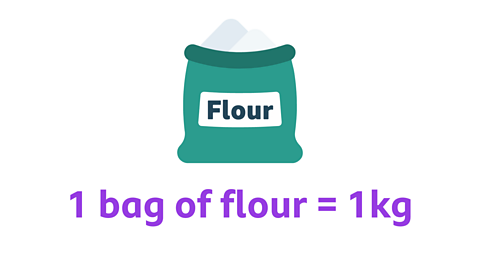
Here are some examples of objects that could have a mass of 1 kilogram.

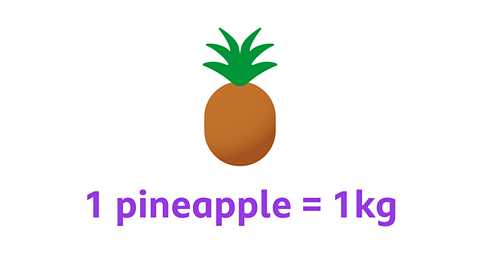
Here are some objects that often have a mass of more than 1 kilogram.
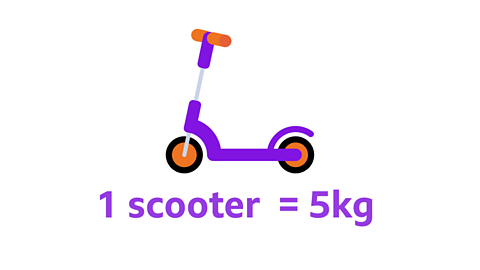
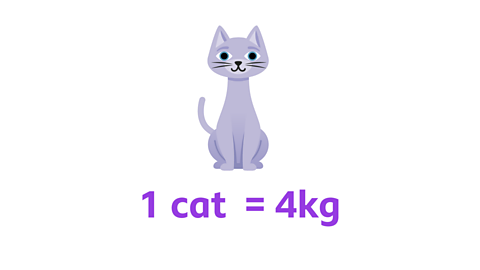
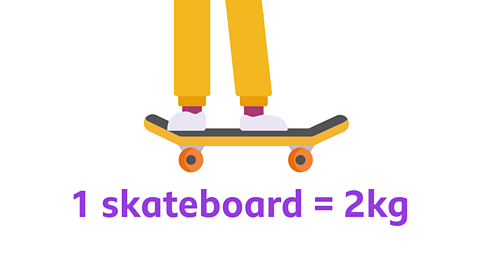
Measuring the mass of objects
You can use balance scales to measure the mass of objects in kilograms.
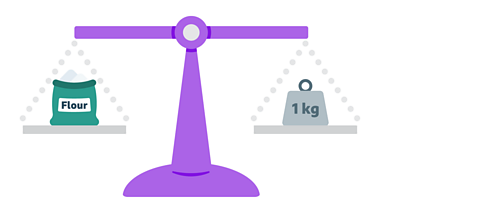
Masses for weighing can come in 1kg, 2kg, 5kg, 10kg, 20kg and more.

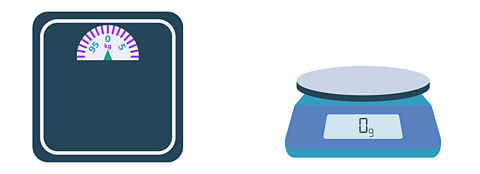
You can also use a set of scales showing the mass on a dial with a pointer.
Or digital scales, such as these, which show the mass as a number.
Reading scales
You can use your knowledge of number lines to help you read scales.
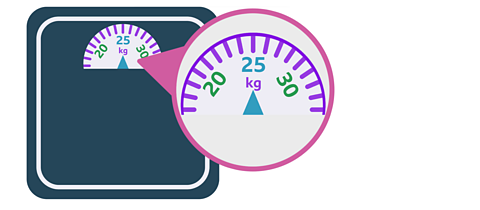
Because weighing scales are often small, you don’t always see all of the numbers marked on them.
This number line shows where some numbers would be on a number line to 100 in tens.

To read the dial on scales, it’s the same thing but the number line goes round in a circle.
Here is the number 25 on a scale.
Example 1
Use balance scales to measure the mass of the following objects.
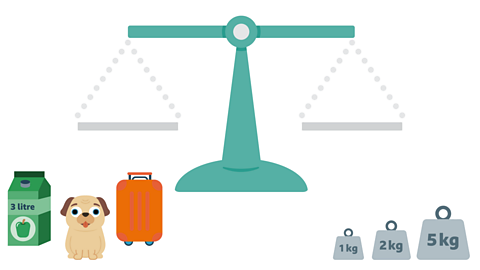
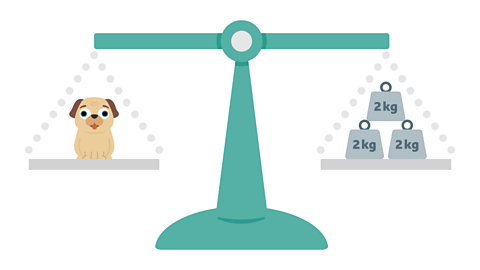
Image caption, Take a look at the pictures in this slideshow and work out the mass of each object.
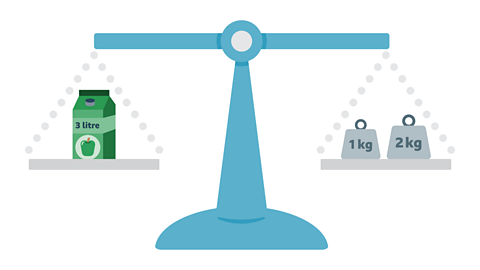
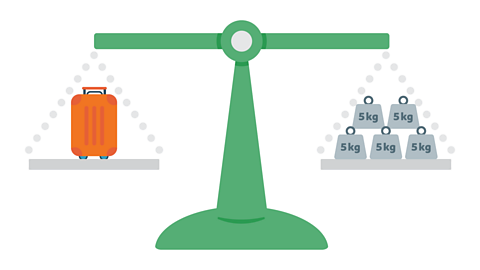
1 of 4
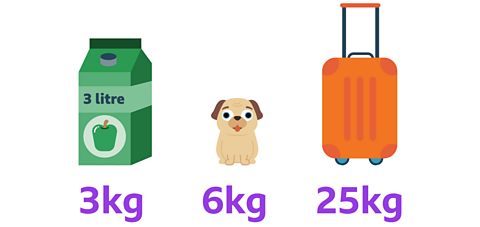
What is the mass of the puppy, the suitcase and the juice?
Which has the greatest mass?
Which has the least mass?
✓ Here are the answers:
- The juice has a mass of 3kg.
- The puppy has a mass of 6kg.
- The suitcase has a mass of 25kg.
- The suitcase has the greatest mass and the milk has the least mass.
Example 2
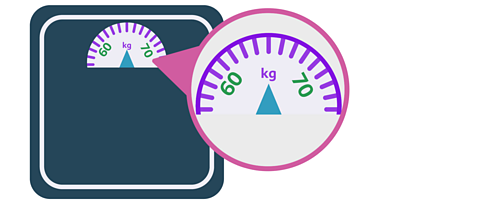
What number would this scale show if you subtracted 5kg?
✓ It would show 60kg.
The scale in the picture shows the mass is 65kg.
Did you work out that 65 was halfway between 60kg and 70kg?
You then need to subtract 5kg from 65kg to find the answer.
65kg - 5kg = 60kg
The scales would show 60kg if you subtracted 5kg.
Example 3
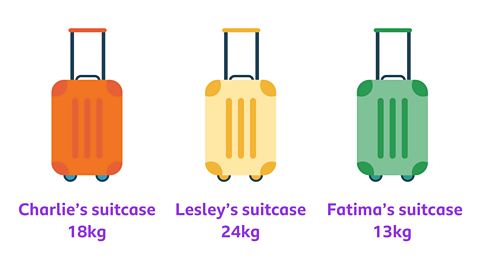
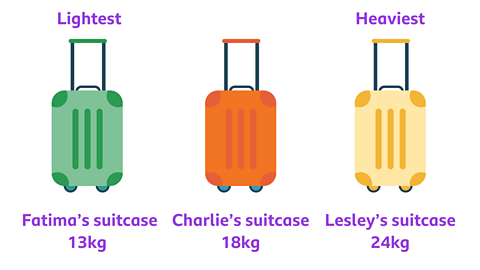
Who has the heaviest suitcase?
Who has the lightest suitcase?
How much more mass has Lesley’s case than Charlie’s?
✓ Here are the answers:
Lesley has the heaviest case. It has a mass of 24kg.
Fatima has the lightest case. It has a mass of 13kg.
Lesley’s case has 6kg more mass than Charlie’s.
Lesley’s case has a mass of 24kg. Charlie’s case has a mass of 18kg.
You can use subtraction to find the answer:
24kg - 18kg = 6kg
Game - Karate Cats Maths
Karate Cats Maths: KS1 Maths

Karate Cats Maths game. game
Train with the Karate Cats to become an expert in addition and subtraction, multiplication and division, place value and more!
More on Measuring
Find out more by working through a topic
- count7 of 7
- count1 of 7
- count2 of 7

- count3 of 7