What are the key facts about the famine?
- A potato disease ruined the crops in Ireland, making it very hard for people to get enough food.
- Many people became very hungry and sick, and over a million people died during the famine.
- Thousands of Irish families left their homes to start a new life in places like America.
Speaker 1 – Quintin: Hi everybody, and welcome back to QQFFM. As you all know, it's me, Quintin Question. And this handsome fella is Frank the Facts Machine. Come on, come on everybody, let's get started. It's history time again today and we're waiting for some cool questions. Here we go. Ok, Chilli Ice Cream wants to know about the history of chewing gum.
Speaker 2 – Frank: In the late 1840s, John B Curtis developed the first commercial chewing gum from the sap of Spruce trees.
Speaker 1 – Quintin: Nah. OK, Cheesy Biscuits is looking for some info on the history of hot air balloons. Hmm, but that's a bit lightweight. Get it, lightweight, hot air balloons, right? Anyone? Aw never mind. OK, Giant Haystacks wants to know if it's true there was a famine in Ireland less than two hundred years ago. Right, well it seems a bit unlikely to me, but what's the truth about the famine, Frank? Did it really happen?
Speaker 2 – Frank: Yes, Quintin, I'm afraid the Irish Potato Famine is a fact. Between the years of 1845 and 1852 potato crops were ruined by disease.
Speaker 1 – Quintin: Yeah, you know I like spuds as much as the next guy, but there are other things to eat.
Speaker 2 – Frank: Unfortunately millions of Irish people were so poor that all they had to live on were potatoes. Their farms were too small to grow other crops and potatoes were nutritious and easy to grow. So when the disease hit they had nothing to fall back on. And although the mainly English landowners and merchants continued to grow and sell food, little or none of this went to feed the starving. More than a million people died of hunger and another million were forced to leave Ireland and seek a better life in England or in faraway countries such as Canada, Australia and America.
Speaker 1 – Quintin: No way! It’s kinda hard to believe that so many people could be left to starve to death. Did the ones we escaped have a happier end?
Speaker 2 – Frank: Some went to England, which meant a trip to Liverpool. So many Irish people ended up there that it's sometimes called Ireland’s second capital city. However others had to travel to North America and Australia. This meant being on a boat for months in terrible conditions with sickness, hunger and rats for company. Those who survived the journey then had to try to start a new life in an unfamiliar country, but eventually many of those who emigrated from Ireland settled and had a big influence on life there. They even changed how people spoke as their words were adopted into American slang. Words like ‘buddy’, ‘cop’, ‘racket’, ‘gee whizz’, ‘so long’ and ‘phoney’ are all likely to have come from the Irish language. Now there are people with Irish roots all over North America, including famous faces like Billie Eilish, Barak Obama and Ryan Reynolds.
Speaker 1 – Quintin: Unbelievable. Who would have thought that a tiny island like Ireland would have such an impact?
Speaker 2 – Frank: In fact Quintin, the number of people in the world currently claiming Irish heritage is around 70 million.
Speaker 1 – Quintin: No way! That's about 100 times the population of this island.
Speaker 2 – Frank: Actually it's around 10 times the population.
Speaker 1 – Quintin: Oops, sorry, me, maths, you know, not really big buddies. Hey ‘buddy’, that's an Irish word, ha ha. See you all next time on QQFFM. So long everyone! Hey, there's another one. Gee whizz. Hey, I can’t stop this, ha ha!
Between 1845 and 1849, Ireland was affected by a famine. This famine killed an estimated one million people either from starvation or disease.
Thousands of people emigrated to America across the Atlantic Ocean to escape this famine.
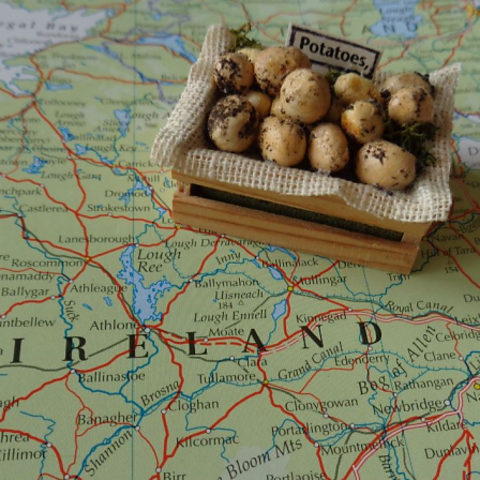
How important were potatoes?
In 1841, Ireland had a population of just over eight million.
Approximately half of this population, four million, depended on potatoes as their main food, with a little fish or milk as their only other food source.
Potatoes were very useful in a lot of ways - they were easy to grown, healthy and easy to cook, and they could be fed to animals too.
Lots of potatoes could be grown in a small area, so with a bit of land, a family of six could grow enough potatoes to feed them for a year.

What was the Potato Famine?
In 1845, a fungus affecting the potato crop arrived in Ireland. The potato fungus quickly swept across the whole country. Many people found that their potato crops had rotted away in the ground.
Sometimes, people could dig up good potatoes, and they had rotted within a day or two.
The situation was made worse by the Corn Law, which kept the price of corn too high for Irish people to afford to buy it. However, the famine worsened when the potato harvest failed again in 1846 due to the potato blight.
The British government did try and help a little. In 1846, Prime Minister Robert Peel ordered £100,000 worth of corn to be sold cheaply in Ireland to limit starvation.
Soup kitchens and public work programmes were also set up. However, these steps didn't go far enough.
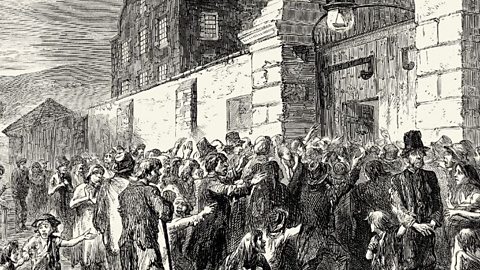
Panic began to spread, and people started eating anything they could find – even grass. Tragically over one million people died between 1846 and 1851 because of the Potato Famine.
Many of them died from starvation. Lots more died from disease and illnesses associated with starvation.
What is emigration?
With few other choices, many Irish people decided to leave Ireland and emigrate.
Emigration means leaving your own country to live in a different country.
Many emigrants left Ireland in 1847. Those that were able to leave had very little to bring with them. Many did not have enough food to last the 40-day journey across the Atlantic or money to buy food.
Some people emigrated to Great Britain and Australia, but most emigrated to America.
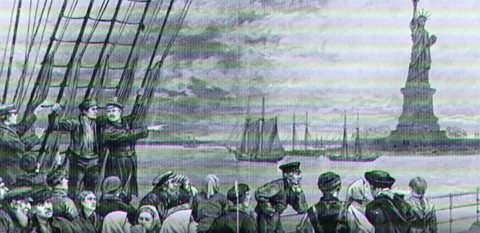
Because it was cheaper to travel to Canada, many people travelled to Canada first.
Then they walked across the border into the United States of America.
Approximately two million people - about a quarter of the population at the time - left Ireland between 1845 and 1855 due to the impact of the potato blight.

Image caption, Ruins of an Irish cottage from the time of the famine

1 of 3
