What is a prefix?
Prefixes are a group of letters that change the meaning of a word when they are added to the start.
Most prefixes mean a similar thing when they're added to different words.
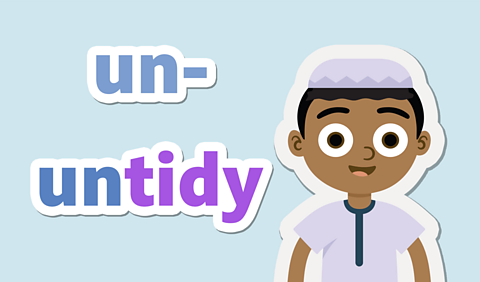
The prefix un- usually means not. For example:
- unhappy
- unlocked
- unfair
The prefixes dis- and mis- usually have negative meanings. For example:
- disagree
- disobey
- misbehave
The prefix re- usually means again or back. For example:
- redo
- reappear
- redecorate
The prefix sub- usually means under. For example:
- subheading
- submarine
Watch: How to use prefixes
Fudge, Pudge and Grudge learn about what a prefix is.
Find out what prefixes are with Bitesize KS1 English.
Prefixes are a group of letters which change a word's meaning when they're added to the start.
Hang on a minute. Are you tidying up?
Nice job, looking tidy.
That doesn't sound good.
Oh, great. You've made it untidy. Really helpful.
Oh, lovely. You're doing some decorating.
Oh! Pack it in. Now somebody's going to have to do some redecorating.
Right, let's just try and behave.
Adding a prefix can really change a word's meaning.
Like misbehave.
Yes, like that.
Activity 1
Activity 2
Activity 3
Activity 4
Karate Cats English game! game
Head to the dojo to become an expert in spelling, punctuation and grammar.

More on Prefixes and suffixes
Find out more by working through a topic
- count2 of 5
- count3 of 5
- count4 of 5
- count5 of 5