What are structures?
A structure is an object made from many parts.
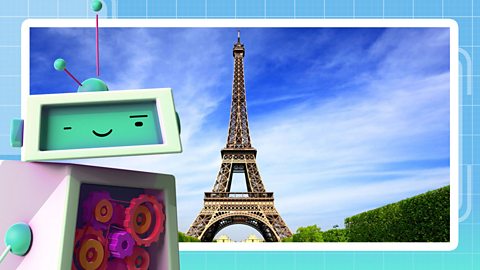
Buildings and bridges are examples of structures.
When making a structure, it’s important to use simple ways to make it strong.
Video: Strengthening structures
Join Aaron in the workshop as he explains some simple ways to build strong structures.
Buildings, bridges, tunnels. All of these are structures that are built for us to use. But how do we make sure they are strong enough for us to live in, work in or travel across?
First up, let’s take a look at walls.Now, this wall looks pretty solid and strong, but what happens if we tap away at this brick here at the bottom? It all collapses.
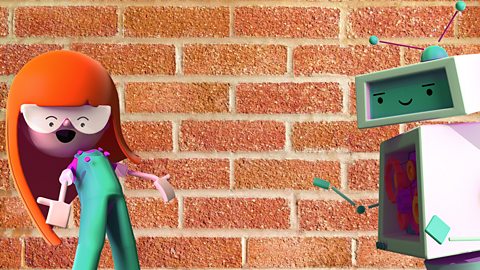
One way to make sure a wall is stronger is to use a building technique called a running bond. Now, a running bond is where the ends of the bricks all overlap one another, just like this.
Now, if we tap this brick here, the wall stays strong because the bricks are interlocked. This means there are no weaker vertical joints that go all the way from the top to the bottom, like there were in our other wall.
For a real brick wall, we often use a paste, called mortar, that acts like glue and sticks the bricks together. The taller you build a structure, the more unstable it becomes.
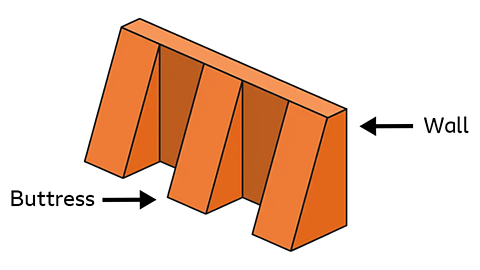
Imagine this block is a tall tower. One way of making a structure stronger is to widen the base. And we can do this by adding a support called a buttress. They support the structure by making the bottom wider.
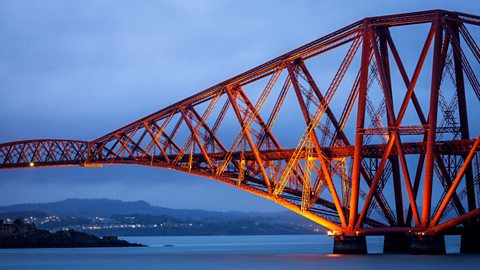
This helps to prevent it from tipping over. Buttresses can create a triangular shape at the bottom. Triangles are much stronger shapes than squares, and that is why you’ll see lots of triangles when you look at bridges and other structures.
So, next time you’re out and about, have a look for some of these strengthening techniques, like interlocking bricks in walls, buttresses on buildings such as castles, or triangles on bridges.
What are structures made from?
Structures can be made from many different materials. Here are a few examples.
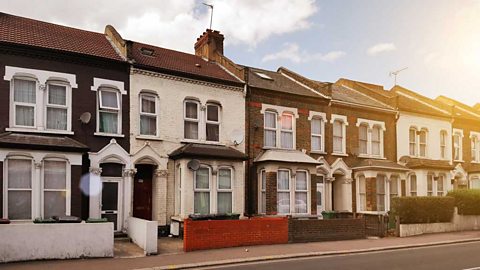
Image caption, Houses
Houses are made from bricks. Bricks are made from clay that is baked in an oven to make it hard.

1 of 3
Strong foundations
Buildings need to have strong foundations. A foundation is the bottom part of a building which holds up the top part.
Strong foundations can be made by building wider and thicker walls at the bottom of a building. These are called buttresses.
Buttresses can be made from stone, brick or other strong materials.
Strong shapes
Bridges and tall buildings are often made from frame structures. Materials are put together to make shapes, such as squares and triangles.
When building structures, it's important to remember that triangles are stronger than squares.
Using triangles in a structure to make it stronger is called triangulation.
To make tall buildings and large bridges, materials are often arranged into triangles.
Brick bonding
Houses and castles are usually made from bricks or stones.
Brick bonding describes the way bricks or stones are stacked and arranged to make a structure strong.
A common type of brick bond is a running bond.
This is when bricks or stones are stacked in layers and the joints overlap.
Find the structure
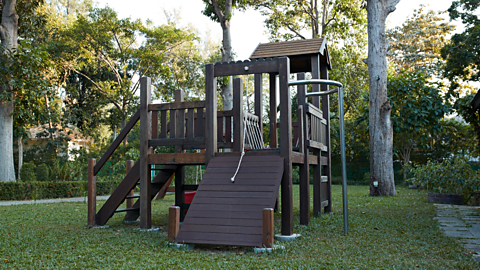
Can you find the different structures in these pictures?
Key words
| Brick bonding | The way bricks or stones are stacked and arranged to make a structure strong. |
| Buttress | A wide wall structure used to strengthen and support a building. |
| Frame structure | A frame structure is made of different strong parts joined together. |
| Foundations | The bottom parts of a building which hold up and support the top part. |
| Layers | When materials are stacked on top of each other they form layers. |
| Overlap | To cover the edges or joints of materials when layering. |
| Running bond | A type of brick bonding where bricks or stones are stacked in layers and the joints overlap. |
Quiz
Find out what you know about structures in this true or false quiz.
Play BBC Bitesize games! game
Fun, interactive games for children aged 4-11, with maths, English, science, history and many more subjects.

More on Structures
Find out more by working through a topic
- count3 of 3
- count1 of 3