Key facts about Barbara Hepworth and her art
Barbara Hepworth was born in 1903, in Wakefield, West Yorkshire. She died in 1975.
She was a British artist most famous for her A type of art that is three-dimensional or not flat..
Her sculptures are Art that doesn't represent reality, but uses shapes, colours and textures for effect.. They usually have smooth shapes and curved lines.
She loved nature and was inspired by the shapes and lines that she saw in it, such as hills and pebbles from the beach.
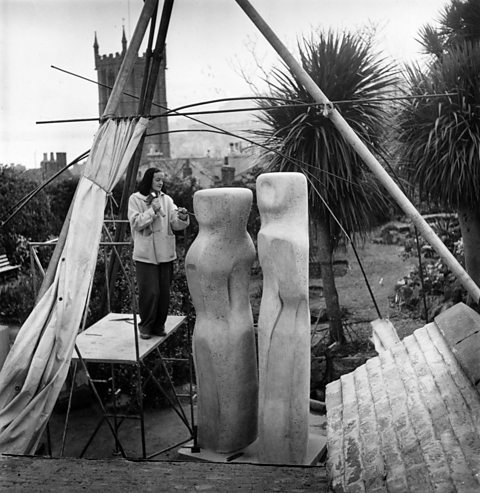
Hepworth's sculptures have different How something feels when you touch it. on them.
She used materials like wood, stone and A type of metal. and often added strings to her sculptures. Hepworth said "the strings were the tension I felt between myself and the sea, the wind or the hills."
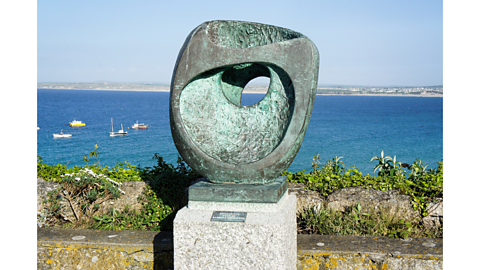
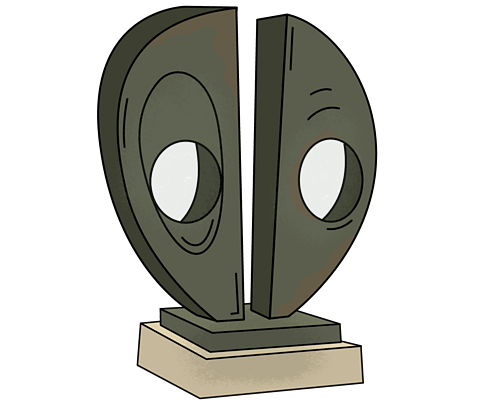
Many of Barbara's sculptures are outside in nature and in public places such as parks. Her sculptures often have holes in them so that you can look at the nature on the other side through them.
Watch: Barbara Hepworth - the sculptor
Find out about the life and work of Barbara Hepworth
Narrator: Barbara Hepworth was born in 1903, in Wakefield, West Yorkshire.
She studied at Leeds School of Art and the Royal College of Art in London.
She then spent time in Europe developing her ideas and skills.
In Paris, Barbara saw the abstract art of Wassily Kandinsky and in Italy, she was amazed by the Roman sculptures.
Barbara found this mix of abstract painting and sculpture really exciting.
Barbara used large pieces of wood or blocks of stone. She carved abstract shapes with different tools.
Nature often inspired these shapes especially the landscapes of St Ives.
She created holes to show the inside of the sculptures as well as the outside.
She used metals and casting techniques to make some of her largest sculptures. One was nearly six metres tall.
Barbara Hepworth helped to create a new identity for modern British sculpture.
Her work has been seen and appreciated by millions of people.
What materials did Barbara Hepworth use?
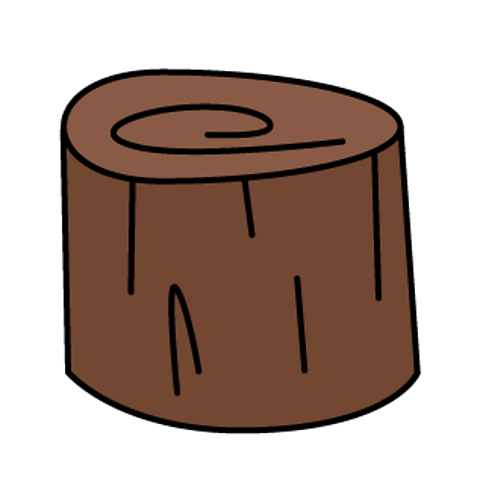
Take a look at some of the materials Barbara Hepworth used to make her sculptures.
Barbara Hepworth's factfile
Barbara Hepworth and her work
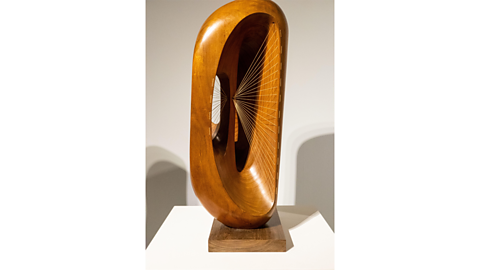
Image caption, 'Fugue' (1956)
This sculpture is made out of wood. You can see the natural lines of the tree. Barbara filled the hole with tightly pulled strings. The hole lets light through and also creates a shadow inside the sculpture. This sculpture is on display in The Fitzwilliam Museum, in Cambridge, England, instead of outdoors. Image: Barbara Hepworth © Bowness.
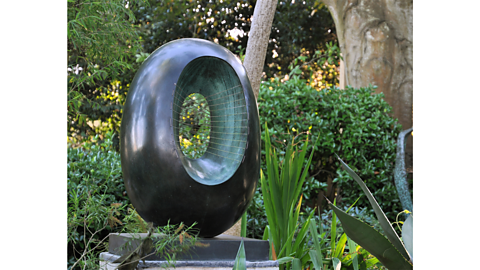
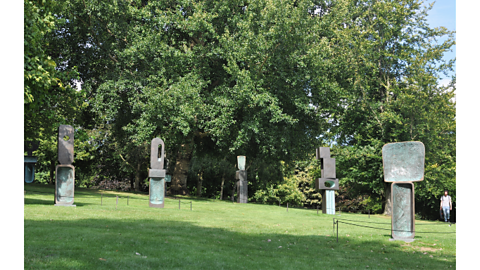
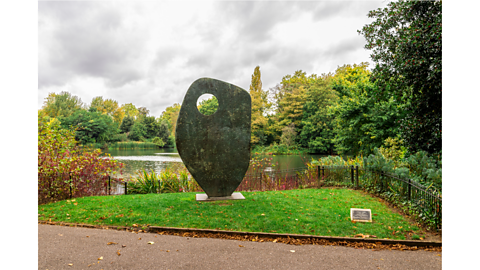
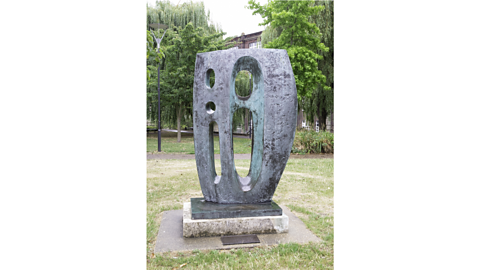
1 of 6
Activity
Activity
Make your own sculpture
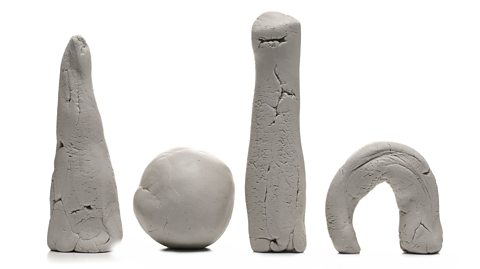
You don't have to use wood or bronze to make your own sculpture. Why not try to make one with soft dough or modelling clay ?
It doesn’t have to look like anything in particular. It can be abstract like Barbara Hepworth’s sculptures.
Try and make:
- a 3D circle (a sphere)
- a 3D triangle (a pyramid)
- a 3D square (a cube)
You could even add a spy hole in your sculpture like Barbara Hepworth did.

Try using your hands and fingers in different ways to make your sculpture.
You could make some parts of your sculpture feel smooth and some of it feel rough or bumpy.
Use your fingers to poke holes through the middle of your sculpture.
Try rolling the dough or clay back and forward using all of your fingers, to make a cylinder or sausage shape.
See if you can join two different sculptures together to make a new one.
Did you know?
- Barbara Hepworth made around 600 sculptures in her lifetime.
- Some of her sculptures are so tall that she had to climb a ladder to make them.
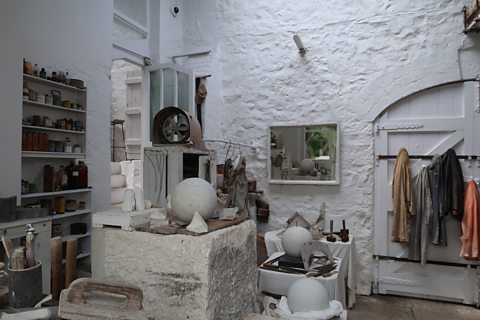
- Barbara lived and worked in St Ives, Cornwall for a lot of her life.
- The house she lived in is now a museum about her life and work. Many of her unfinished works and the tools she used to make them are still there.
- Barbara Hepworth was inspired by landscape and nature from an early age, especially after going on long car journeys with her father. She said "hills were sculptures" and "the roads defined the forms".
Quiz
Glossary
Here are the meanings of some important words.
Abstract - Art that doesn't represent reality, but uses shapes, colours and textures for effect.
Bronze - A type of metal.
Sculpture - A type of art that is three-dimensional or not flat.
Texture - How something feels when you touch it.
NEW Creative Lab game - winter update! game
Time to get creative! Creative Lab is an art and design game that lets you paint, draw, build and design. Now with added winter stickers and templates, for a limited time only.

More on 3D Art
Find out more by working through a topic
- count1 of 2