What are infinitives?
Just like in English, sentences in French usually contain a verb. Verbs can be used to describe an action, a feeling or to describe something that is happening.
A verb infinitive is the basic form of a verb. For example, 'to sing' is the infinitive form of a verb. You can recognise an infinitive in English as it begins with 'to'.
In French, you can spot an infinitive by looking at the end of the verb. All French infinitives end in either -er, -ir or -re.
For example, the infinitive of the verb ‘to sing’ is Check your connection, refresh the page and try again. in French. As it ends in -er it is called an -er verb.
In French, -er verbs are the largest group of verbs so it is important to know how to use them correctly.
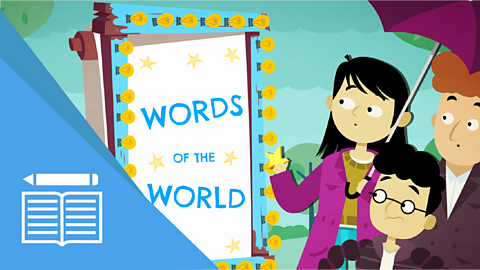
Learn about regular -er verbs in French with Burt Bessington
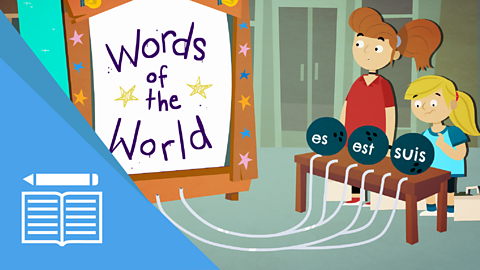
Burt: Hello and welcome to Words of the World and you're this week’s surprise contestants!
Here are the rules. A verb infinitive is the basic form of a verb. In French, verb infinitives change depending on who is doing the action. Here’s the infinitive of the verb: ‘to eat’ – manger.
If I want to say ‘I eat’, I change the personal pronoun to je, then change the ending of the infinitive by removing er and adding e.
Je mange
So in this game, all you have to do is choose the correct form of these -er verbs. Simple right?
Voice-over:Danser
Burt: To dance
It's je meaning ‘I’.
Mum:Je danse. I dance.
Burt: Nice moves! And you’re totally correct.For the je, you take off the er and add e.
Voice-over:Nager
Burt: To swim. It’s tu meaning ‘you’.
Mum:Tu nages. You swim.
Burt: That’s right. For tu, the er of the verb is taken off and you add es. What’s next?
Voice-over:Jouer
Burt: Which means ‘to play’.It's il meaning ‘he’.
Mum:Il joue. He plays.
Burt: Correct.For il, the er is removed and we add e. You’re on a roll.
Voice-over:Regarder
Burt: That means ‘to look’.
Mum:Elle regarde. She looks.
Burt: For elle meaning ‘she’, the er is changed to an e.
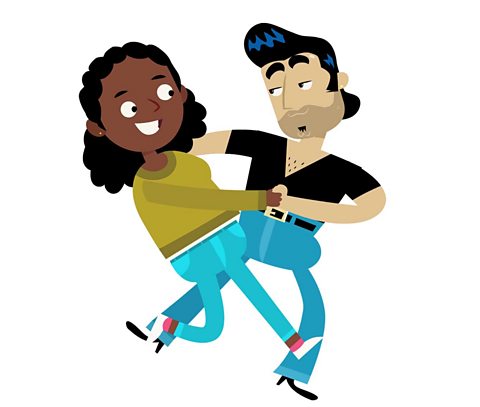
Right again! Time’s up! You did it! Congratulations, you’ve won today’s star prize! Tango dance lessons!
Mum: Ooooh!
What is a regular verb?

In French, the spelling of the verb changes depending on who is doing the action. Regular verbs follow the same pattern of spelling changes at the end of the verb.
Once you know how the spelling of an -er verb changes, you will be able to use lots of different regular -er verbs.
Can you remember some of the regular -er verbs from the video?
Check your connection, refresh the page and try again. – to dance
Check your connection, refresh the page and try again. – to play
Check your connection, refresh the page and try again. – to eat
Check your connection, refresh the page and try again. – to swim
Check your connection, refresh the page and try again. – to look
How to use regular -er verbs in French

How do you change the infinitive to explain who is doing the action?
Let's look at some examples with the verb, Check your connection, refresh the page and try again. (to eat).
Firstly, subject pronouns go before the verb to tell us who is doing the action, like ‘I’ in English, which is je in French.
Then follow the rule:
Remove the -er from the end of the infinitive and add the correct ending for each pronoun.
To say ‘I eat’, you use the pronoun, je (I). Remove the er from the infinitive to get the stem and add e.
Check your connection, refresh the page and try again. → Check your connection, refresh the page and try again. (I eat).
If you have the pronoun tu (you), you remove the er and add es.
Check your connection, refresh the page and try again. → Check your connection, refresh the page and try again. (you eat).
If you have the pronouns il or elle (he or she), you remove the er and add e.
This makes Check your connection, refresh the page and try again. (he eats) or Check your connection, refresh the page and try again. (she eats).
Verb practise
Try practising with this table. Look at the subject pronoun je and slide your finger along the table to find the correct ending for the verb.
Try this with another subject pronoun too. This pattern works with all regular -er verbs.
| Subject pronoun | Stem | Ending | Example | English |
|---|---|---|---|---|
| je | mang | -e | Check your connection, refresh the page and try again. | I eat |
| tu | mang | -es | Check your connection, refresh the page and try again. | you eat |
| elle | mang | -e | Check your connection, refresh the page and try again. | she eats |
| il | mang | -e | Check your connection, refresh the page and try again. | he eats |
Useful -er verbs in their infinitive form
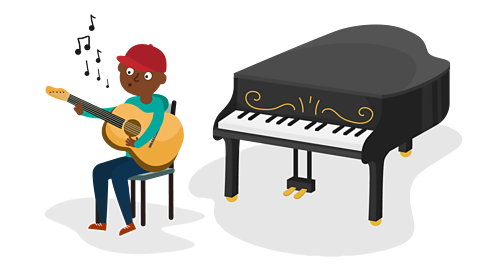
Here are some other useful -er verbs in their infinitive form:
Check your connection, refresh the page and try again. – to sing
Check your connection, refresh the page and try again. – to draw
Check your connection, refresh the page and try again. – to play
Check your connection, refresh the page and try again. – to play football
Check your connection, refresh the page and try again. – to play piano
Check your connection, refresh the page and try again. – to play guitar
Check your connection, refresh the page and try again. – to watch
Check your connection, refresh the page and try again. – to watch television
So you say Check your connection, refresh the page and try again. – I play football.
Use the endings in the table above to help you form these -er verbs. Now you can say what hobbies you do.
Did you know?
If you want to ask someone a question, you can use the tu form of the verb using the endings in the table above.
When writing the question in French, you leave a space between the final word and the question mark.
When you are asking the question, you stress the end of the sentence by saying the last syllable in a higher pitch. This is called rising intonation.
Check your connection, refresh the page and try again. – Do you swim?
Check your connection, refresh the page and try again. – Do you dance?
Check your connection, refresh the page and try again. – Do you sing?
Key French words
| French | English |
|---|---|
| Check your connection, refresh the page and try again. | to sing |
| Check your connection, refresh the page and try again. | to dance |
| Check your connection, refresh the page and try again. | to draw |
| Check your connection, refresh the page and try again. | to play |
| Check your connection, refresh the page and try again. | to play football |
| Check your connection, refresh the page and try again. | to play piano |
| Check your connection, refresh the page and try again. | to play guitar |
| Check your connection, refresh the page and try again. | to eat |
| Check your connection, refresh the page and try again. | to swim |
| Check your connection, refresh the page and try again. | to watch |
| Check your connection, refresh the page and try again. | to watch television |
Quiz
Play Dash and Blink: Forgotten French! game
Construct simple phrases and develop an understanding of vocabulary and grammar with this KS2 French game.

More on French grammar
Find out more by working through a topic
- count4 of 5

- count5 of 5
- count2 of 5