SHIP HORN BLARES
NARRATOR: Phew that was close, lucky these were here really. They look like magnets.
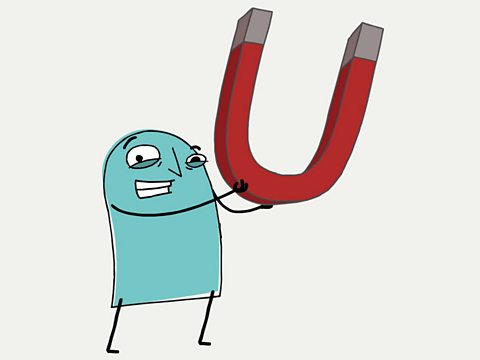
Yes look , they’ve got two poles; a north and a south. Even if the magnets aren’t touching, they can exert a force on each other.
CLANG
NARRATOR: Ha! Are you stuck?
The opposite poles of a magnet attract one another, and poles that are the same – south and south for example – repel one another.
I bet you guys use magnets every day. They’re in handbags, fridges, compasses…compasses!
Of course! Sailors have been using magnets in compasses to navigate for hundreds of years!
SHAPES CHEER
NARRATOR: If the magnets can move freely, it will always show which way is North.
There’s land! You’ve found it, head north!
ISLAND CREATURE ROARS
SHAPES: Argh!
NARRATOR: Eh, maybe we should see what’s south instead…
Magnetic forces
When two magnets are close, they create pushing or pulling forces on one another.
These forces are strongest at the ends of the magnets. The two ends of a magnet are known as the north pole and the south pole.
Same poles repel
If you try to put two magnets together with the same poles pointing towards one another, the magnets will push away from each other. We say they repel each other.
Different poles attract
If you put two magnets together with different poles pointing towards one another, the magnets will pull towards each other. We say they attract each other.
More on Forces
Find out more by working through a topic
- count8 of 11

- count9 of 11
- count10 of 11
- count11 of 11