Since long before we had cameras to capture their beauty, the Northern Lights have been enchanting everyone who sees their bright colours painting the night sky. Also known as the Aurora Borealis, the phenomenon has inspired painters, poets and now social media users captivated by the dancing waves of greens and pinks.
In 2026, the solar storms that cause the Northern Lights are expected to increase - so you’ll have even more of a chance to catch them.
Here’s our guide to everything you need to know to make sure you and your family can experience this spectacular sight for yourselves.
When will the Northern Lights be visible in the UK in 2026?
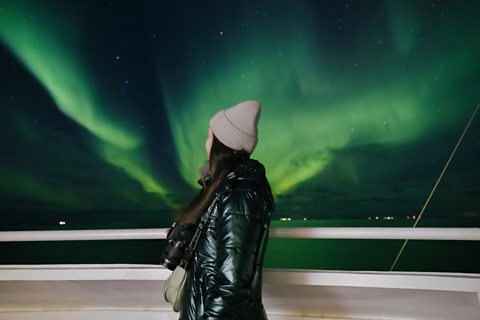
September to April is the best time for aurora spotting, mainly because the colder months of the year are also the darkest. The sun is currently in a period of increased activity, meaning there are expected to be more solar storms than usual in the first few months of 2026.
As well as causing auroras, these storms affect our planet in a number of ways. The charged particles hurled into space by the Sun - the same particles that create the aurora borealis - can unleash some extremely disruptive events that can affect electricity supplies, satellites and air travel.
Space weather can play havoc with sensitive electronics on board satellites and radio communications can be badly impacted with GPS systems lost or disrupted. Electricity grids can also fail, causing power cuts.
Read more about solar storms and how they can wreak havoc on Earth
What are the best places to see them in the UK?
Light pollution will make it difficult for your eyes to perceive the colours against the sky so if you can, try to pick a spot away from a city. In built-up areas the street and building lights mean it never gets fully dark.
Within the UK, the best places for viewing tend to be Scotland, the North of England, Northern Ireland and North Wales, particularly in designated “dark skies" areas that are celebrated locations for stargazing.
How can I find out when to see the Northern Lights?
Have you ever woken up one morning to messages from friends exclaiming about the beautiful night sky you missed the night before? There are ways to make sure you don’t miss out on an opportunity to see the auroras, as long as it’s not raining.
The Met Office regularly updates its Space Weather page with details of solar storms and its “Aurora forecast”, which tells you how likely they are to appear that night. Aurora Watch UK provides alerts of when the Northern Lights are likely to be seen in the UK through social media and apps.
What are solar storms and how do they cause the Northern Lights?
As the Sun rotates, it twists up magnetic fields - NASA describes it as “kind of like a disheveled head of hair after a fitful night of sleep”. When these fields get really tangled, they stretch so far that they snap before reconnecting again, which releases a sudden explosion of energy, particles and material.
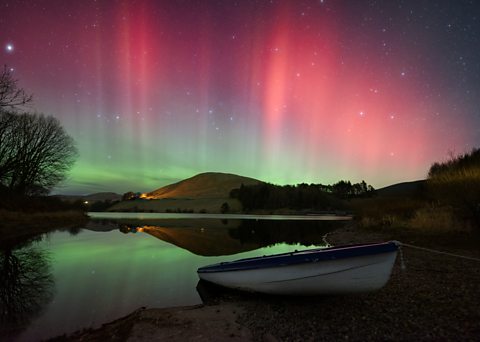
As the particles hit the Earth’s magnetic field, they are pulled towards the poles. There they bump into oxygen and nitrogen in the planet’s upper atmosphere and energy is released as colourful light.
What time of night can I see the Northern Lights?
While there's no specific time you can regularly view the phenomenon from the UK, scientists from Aurora Watch UK say you are most likely to spot them from 10pm to midnight, although sometimes they are visible all night.
Can you see the Northern Lights with the naked eye?
Sometimes but not always. It's easier to see them when they're high in the sky, rather than on the horizon where they can be tricky to pick out from the background.
During strong displays you might see vibrant arcs of greens, purples and pinks, but when they're weaker, it's difficult for our eyes to focus in the dark. They might appear as white or grey shimmering wisps or clouds.
Why do auroras look different on camera?
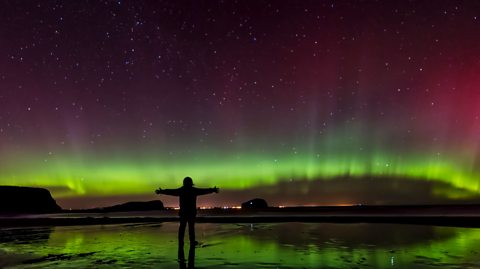
Human eyes can struggle to perceive colour at night. A single photographic image is created from a longer time period - the camera lets the light in for longer so is able to capture the colours more vividly. Some photographers use editing software to enhance their images of the Northern Lights but often adjusting the settings can be enough to create the sort of eye-catching image we imagine when we think about the auroras.
Are the Northern Lights affected by the weather?
The lights themselves are affected by what is sometimes known as “space weather” - the solar storms that cause them. They are not affected by our weather conditions here on Earth but our ability to see them is. You need a dark, clear night to be able to see the Northern Lights.
It's very frustrating when you hear there will be colours in the sky that night but there are clouds blocking your view.
This article was published in December 2025

Bitesize Parenting
Fun activities, real-life stories, wellbeing support and loads of helpful advice - we're here for you and your child.

The International Space Station at Christmas and how to look out for it
You can see the ISS with the naked eye! Here's what happens on the ISS at Xmas and how you can see it.

How to spot constellations and asterisms
Bitesize Parenting
Seven ways to get your kids outdoors
Getting your teens out of the house and into nature can boost their health and wellbeing. Tips on how to do it from parents who are outdoors enthusiasts.

How to catch a meteor shower
You might think spotting a shooting star is pure luck, but there is a way to predict when a meteor shower might hit.
How to spot bats in the UK
Where to find them, how to spot them and some bat facts to wow the kids!