When it comes to sport at Christmas, what comes to mind?
There’s the classic Boxing Day football fixtures, or a festive cricket Test match overseas. But what about darts?
Each December, the PDC World Darts Championships gets underway at Alexandra Palace in London with the new world champion crowned early in the new year.
But if you don’t know your double top from your oche, never fear! BBC Bitesize has you covered with a guide to your essential darts jargon.
Let’s. Learn about. Darts!
What is a dart?
The current world championships only began in 1994 following a split between governing bodies, but the history of the sport goes back much further.
An early form of darts was played in medieval times – with the darts themselves made using the stubs of arrows used in combat by soldiers.
While the game has progressed since then, the original game is still remembered today, with players often referring to their darts as arrows.
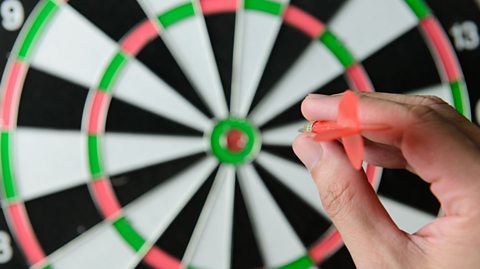
Official darts rules state that each dart must not exceed a maximum length of 200mm, nor weigh more than 40g. Each dart must feature a barrel, stem and a flight.
The barrel is the main part of the dart, which the thrower grips. The stem, also known as the shaft, screws into the back of the barrel and holds the flights which keep the dart stable in the air.
How does a dartboard work?
A typical dartboard is divided into multiple sections. The numbers on a board go from one to 20 and each number has its own triangular segment. On a classic board, the sections will alternate between black and white colours. Within each number’s section, there are two red (if the triangle is black) or green rectangles (if the triangle is white) – one at the outermost edge of each section and one in the middle.
The top coloured rectangle is known as the double – and as the name suggests, earns a player double that numbered score. The middle rectangle is the treble. All of the numbered segments lead to the central point of the board, known as the bullseye. This circle has an outer and inner ring – the outer, larger ring is worth 25 points, while the inner circle is worth 50. Despite the bullseye being the smallest section on the board, it's not actually the most valuable score a player can achieve.

The 20 is the highest individual number on the board - meaning its treble, worth 60, is the biggest score a player can achieve from a single dart. Players throw three darts on each turn, so three treble 20s in the same turn earns the legendary maximum score of 180.
Each section of the board is not only separated by a different colour, but by metal wiring. Because of its similarity in appearance to a web, this wiring is known as a spider.
Where do you throw your darts from?
For each player’s turn, they step up to the oche to throw their darts.
The oche is also known as the throw line or toe line and is 2.37m from the board – which must be placed on a wall so that the bull is 1.73m from the ground.
The oche was originally known as the hockey – oche is pronounced as hockey without the h. It’s thought the word may have derived from the old French word ocher, which means to cut a deep notch in.
How do you win at darts?
So now you know where to stand and what to throw, how does the game work?
Each player starts on 501 points. Every score from a throw is deducted from their total, with the first to reach exactly zero winning that leg of the match. Players need to throw a double for their final shot to reach zero – if they score more points than they have remaining, they are bust and have to try again next turn.

Once a player has 180 points or fewer, it may be possible for them to win the match. The total number of points they score on their final trip to the oche is known as the checkout.
This makes darts a game of not just skill, but also one that can involve quick-fire maths – all completed under pressure!
It is possible to complete a leg in just nine darts – known as a nine-darter or nine dart finish – but it is rare, happening fewer than 20 times in the first 30 years of the competition. The most famous example was during the 2023 final when both Michael Smith and Michael van Gerwen were both in with a chance of a nine-darter, with van Gerwen missing and Smith completing the feat. This leg has been described as the greatest in the sport's history.
The format for the annual December to January world championships features sets and legs. Each individual attempt to clear the 501 is known as a leg and players compete over a ‘best of five’ legs format to win a set.
First round matches take place over the best of five sets, while the final is a marathon battle over the best of 13 sets to be crowned champion of the world. Not a bad way to start the new year!
This article was published in December 2021 and updated in March 2026

The origins of football jargon
From hat-trick to volley, learn where some of the most popular football lingo comes from.
From Tests to The Hundred: A bluffer’s guide to cricket’s formats
How one of the oldest sports in the world kept up with the times.
Snooker jargon to get you through the World Championship
You never know when you need a spider - or will see a kiss

