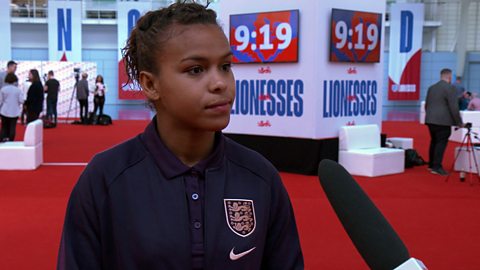
1984 finalists Kerry Davis and Pia Sundhage remember an eventful game
Kerry: A dream come true for me to play at that level
Pia: If you go with your passion it can’t go wrong
Kimberley: You guys famously took part in the first ever Women’s Euros Final back in 1984 which was obviously played over two legs representing Sweden and England. Just talk me through your memories of that time.
Pia: The word fantastic is not enough.
Kerry: A real important landmark for women’s football that UEFA and FIFA were actually wanting to take the game forward.
Kimberley: It’s actually known as The Battle of Kenilworth bog because of the state of the pitch. That just wouldn’t happen now in a major final would it.
Pia: It tells me what kind of journey the women’s football have done, because that would not be acceptable.
Kerry: The ball was not really rolling, you couldn’t play a passing game. Not in a million years would they allow anybody else to play a final on a pitch like that.
Kimberley: And both of you took a penalty, what was that like?
Pia: It was incredible of course, and I remember before I took the penalty usually I place the ball and the goalkeeper said just hit the ball and that’s what I did.
Kimberley: I’m sorry to bring up these pains and memories for you Kerry while your sat there. What are your memories of Pia scoring the winning penalty?
Kerry: I’m not sure why you’re bringing that up, I’m really not. Pia came with a reputation of a great player so when she went to take her penalty, I had a feeling that it could be it.
Kimberley: And big celebration from Pia or?
Pia: Yes, absolutely.
Pia: All the players ran at me and were jumping of course, and share the joy.
Kimberley: And of course you’re still very much in the game at the moment, you are head coach of the Swiss National Team, how are you feeling about Switzerland’s chances at this Euros.
Pia: We are gonna surprise. The best thing about the women’s football today you can actually beat a team that is so much more higher ranked.
Kimberley: I know you love your music and that’s something you use to really help yourself relax. What’s the impact that music can have?
Pia: Before there’s a lot of pressure, sometimes I need to turn off, I take the guitar and play and just put me somewhere else.
Kimberley: Kerry, obviously you’re still the third highest goal scorer for England behind Ellen White and Kelly Smith respectively. Is that a big sense of pride for you then?
Kerry: Definitely so, I’m really proud of that record because I’m much older than all of them and I’m still hanging in there.
Kimberley: You’ve also been invited to Saint Georges Park personally by Sarina Wiegman to talk to the current Lionesses about your experiences. Do you feel like you’re kind of getting the recognition you deserve now?
Kerry: It’s getting there and I think it’s important that players now know what happened before and how it was. Without the players of the past today wouldn’t happen. More investment, female coaches develop the players, they give them the right tools so they can do that.
Kimberley: Can either of you believe how far things have come since you were both playing? We talked about the Battle of the Bog, we’re in these magnificent stadiums now where the women’s Euro’s will be played. How does that feel?
Pia: You not only see that crowd in the box, you can hear it as well. That makes the difference, you want to come back.
Kimberley: To any little girls that are sat watching this now, and they want to play and they hope to have a career in it, but they’re not sure whether they can, what would you say to them?
Kerry: Football is for all, and if you want to play do it, just do it.
'Without the players of the past today wouldn’t happen'
Kerry Davis and Pia Sundhage both took part in the very first Women's Euros Final in 1984.
It was England v Sweden. Pia, who played striker for Sweden, told us it was fantastic, a “real landmark moment for women's football” and showed that the footballing authorities were really going to take the game forward.
Over 40 years later, Kerry remains England Women's third top scorer and Pia now manages the Swiss National Team.
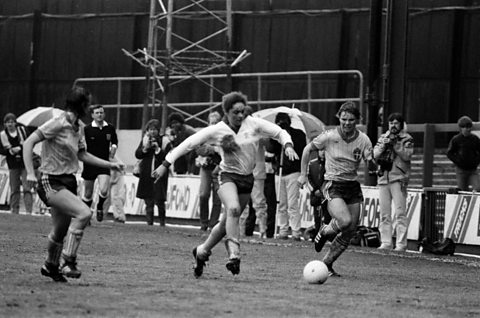 Image source, Getty
The Euro ’84 final became known as ‘The Battle of the Kenilworth Bog’ due to the state of the host club, Luton’s, pitch.
Kerry told BBC Bitesize the ball wouldn’t really move across the pitch and you couldn’t play a passing game. Pia agreed and said no one else would have been allowed to play a final on a pitch in that state and it would not be acceptable in the game now.
Despite the state of the playing surface, Kerry and Pia both talk about how significant the 1984 tournament and final game still are for women’s football.
The final was played over two legs, England lost the first in Gothenburg 1-0. The full-time score at Kenilworth Road in the return leg was another 1-0, but this time to England. Then after the toss of a coin, it was decided to go to penalties.
Kerry and Pia both took a penalty. Pia ditched her usual penalty routine and said she "just hit the ball". Kerry told us she had a feeling as Pia stepped up that she would score and knew that would be it for England. And she was right.

Pia Sundhage
Born: 13 February 1960, Sweden
- First woman to score a goal at Wembley: Sweden v England 2-0 in 1989
- Her image appeared on a Swedish postage stamp in 1988
- Upon retirement in 1996, held the record as Sweden’s highest goalscorer with 71, now ranked joint third
- Managed Sweden, US, Brazil and now Switzerland’s national team
Kerry Davis
Born: 2 August 1962, Stoke on Trent, England
- Previously the Lionesses’ all-time top scorer, (44 goals in 82 games) Kerry currently ranks third
- Kerry debuted for England when she was 19, scoring twice against Northern Ireland
- First Black player to play for the women’s national side
- 2024 Women's Football Awards received a lifetime achievement award
What was it like to play international football in the 1980's?
Kerry and Pia both started playing football against boys. Pia was even asked by one coach to change her name to Pele. They both carried on playing despite these early set backs.
Pia ended up representing Sweden when she was just 15 and Kerry too played international football while still a teenager.
Kerry says it’s important that current players understand the history of the game, “without the players of the past today wouldn’t happen” she said.
Asked how they feel about how far things have come since they were playing Pia said being able to see and hear the crowds makes a difference. The greater investment in female coaches and development of the players is something Kerry highlighted as having helped grow the game. Her advice to girls now? “Football is for all and if you want to play, just do it.”
For more insight and match coverage of the Euros 2025, go to BBC Sport Women's Summer of Sport
This article was published in June 2025
EUROS 1984 - The final hardly anyone watched…
Women's football historian explains how significant the Euros 1984 match has become
When is the Women's Euro and other facts about the tournament
What you need to know about the Women's European Championship 2025
Professional football: top tips from England's Women's World Cup team. video
Top tips from the Lionesses.