WARNING: This article contains discussions of adult themes and may not be suitable for people below Year 7 in school.
People are talking about X – the site once known as Twitter - because of concerns that its AI tool, Grok, has been used for inappropriate reasons.
There have been reports from reliable official news sources, including the BBC, that some users have asked it to create and share images of people who have not consented to this. Other Side of the Story has looked past the headlines to find out what’s really happening.
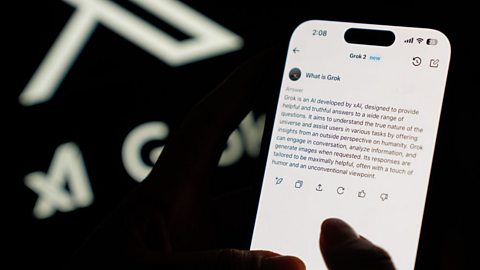
What is Grok and why are people concerned?
Grok is a free AI assistant that responds to users' prompts. People on X use it to find out more about the information being shared on the site.
You may have seen people tagging Grok in a post and asking a question to correct errors or potential misinformation, or just to give more context to a post.
The issue at the centre of the current news stories about X is a Grok feature which has allowed users to edit an uploaded photo to create naked or partially naked images of real people, including examples where it has been used on images of children. X has now limited image editing with the Grok AI tool to paying subscribers only.
Is X being banned in the UK?
Not at the moment but it is an option open to the UK’s communications regulator, Ofcom. The headlines about a possible ban have been prompted by remarks made by the technology secretary, Liz Kendall.
She told the BBC that she would back Ofcom if it was to block access to X for failing to meet the UK’s online safety laws. On 12 January. Ofcom said it had begun investigating X, to see if it had done its best to protect people in the UK from illegal content.
It said there had been “deeply concerning reports” of Grok being used to create and share inappropriate images of children, or of adults who have not given their consent. The act is intended to make the internet safer by protecting children and adults from viewing harmful and illegal material online.
What is Ofcom?
Ofcom is the regulator for the UK’s communications services, including TV and radio and broadband services. It also covers online safety.
In this case, government ministers have suggested that Ofcom could use its powers under the Online Safety Act, which came into force in 2023, to block UK access to X.
The act is intended to protect children from harmful material online. Ofcom has powers that could, among other things, fine sites for breaking rules or even ask the courts to block them.
What has X said?
X has referred to a statement posted by its Safety account. It reads: "Anyone using or prompting Grok to make illegal content will suffer the same consequences as if they upload illegal content.".
UK Prime Minister Keir Starmer has said that the government could take control of X if it cannot solve the problem of Grok being used for the wrong purposes. He told Labour MPs: "If X cannot control Grok, we will."
It's not just politicians in the UK who are concerned. Ireland's deputy Prime Minister, Simon Harris, said that making Grok only available to subscribers was not enough. He said that the question of paying for it wasn't the issue, it was that the technology was capable of doing things that are not appropriate or which are illegal.
What are the laws on image creation?
The discussion about Grok means the rules on what people can and can't do when creating images are set to change quickly.
It is against the law to share inappropriate images of a person without their permission. This includes deepfakes.
Before the New Year, it was not illegal to ask an AI tool to create these images, but the government is now bringing in a law which does make it illegal. The government has also said it will make it illegal for companies to supply AI tools which are designed to make these images possible.
When is a ban not a ban? How to spot fake news
When you read stories saying something could be banned, it’s important to check reliable sources to find out if this is true or misinformation.
If you see information posted on social media sites like X, make sure you think critically about what you’re reading and also look for posts that have come from trusted news websites.
In this case, Ofcom has a detailed explanation on its own website of exactly what it is investigating and why. If you want to find out more about the Online Safety Act and everything it covers, you can also find a collection of guides on the Government’s website.
- To find our more about deepfakes, how to spot them, and to get more skills which can help you online, check out Solve the Story.
This article was published in January 2026

Not sure if the news you’re seeing on social media is true or false? Can you always tell if the things you see online are real or fake? Learn how to get the other side of the story with our quizzes, videos and explainers.
How to spot AI images on social media
We look at some of the signs that you can use to tell if an image is AI or real

The history of fake news
Fake news is everywhere, but what is it and how can you spot it? Watch our video and read useful tips on how you can spot fake news quickly!