
Learning focus
To learn how to plan, structure and write an exciting story.
In Years 5 & 6, students are taught to plan their writing by:
- noting and developing initial ideas
- selecting appropriate grammar and vocabulary
- describing settings, characters and atmosphere and dialogue in story writing

Learn
Every story needs a plot – an exciting series of events.
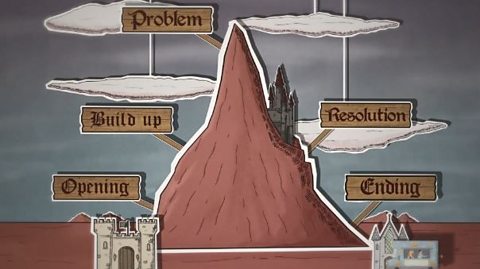
Lots of stories follow a simple structure, known as a story mountain. Different parts of the story mountain relate to the key parts of a well-structured story.
Watch this video to learn how stories are planned and structured.
Organise your plot and create a great structure with these story mountain tips.
How to create a story structure.
Every story needs a plot: an exciting series of events.
Most stories follow a simple structure that is called the story mountain, but obviously all stories don't have to have a mountain in them.
The foot of the mountain is your opening where you introduce your hero and start setting the scene.
Ah, a knight - a perfect character for your story. Your next stage takes you up thestory mountain. It's called the build up.
Here, you build up the main body of the story. A plot will always be engaging if you add in a conflict, a fight or a mystery to solve.
It seems that the evil wizard in the castle on the other side of the mountain has kidnapped the heir to the throne. What a rascal!
Our knight must do something about this.
Now you're at the top of the mountain where the story peaks and our characters encounter a major problem, obstacle or dilemma.
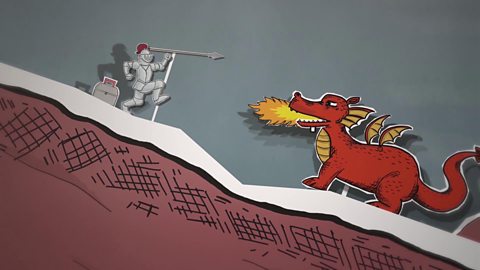
A dragon! I would consider that a fairly big obstacle and the evil wizard has an army as well. Goodness me. How is the knight ever going to get past them?
Is our knight going to be roasted alive? Like a metal kebab?
This is the most thrilling part of the story. Be sure to keep your readers in suspense.
Next, we need a resolution. How does your character deal with the dilemma?
This is the point at which your character has to solve or resolve a problem to reach their goal.
It's a good idea to try and make your resolution unusual and original.
Well, I didn't see that coming.
Serves you right, you weasel.
At the bottom of the mountain is the ending and conclusion of your story with everything resolved.
Just because it's the end doesn't mean you can't be creative.
You could add an unexpected twist.
Your story needs to engage the audience with an exciting plot and keep them engaged from the opening, through the build up, problem and resolution, right up to the ending on the final page and beyond.
Now, I think I'll have a wild boar cabbage special sandwich but on brown bread or white?
Oh, black it is.
- Opening:
Introduce the hero/main character and set the scene.
The brave knight who lives on the peaceful side of a snow capped mountain.
- Build up:
Introduce and build up the story. Perhaps there is a conflict or a mystery that needs to be solved?
The evil wizard has kidnapped the heir to the throne.
- Problem:
Here, the story peaks. The main character faces a major problem, obstacle or dilemma.
A fire breathing dragon protecting the evil wizard’s lair.
- Resolution:
The main character solves the problem in order to reach their goal. Make this unusual and interesting so it keeps your readers on their toes!
The knight fed the dragon the world’s most delicious sandwiches. In return the dragon destroyed the evil wizard’s clothes so that he ran away due to embarrassment!
- Ending:
The conclusion where everything is resolved. Keep it interesting and add an unexpected twist!
The crowd were pleasantly surprised to see that the knight was in fact Lady Faithful!
You may need paper and a pen or pencil for some of these activities.
Activity 1
Check your understanding by completing this story structure quiz.
Activity 2
You are going to plan and write your own story.
First, you need to decide what type of story (genre) you want to write.
Different genres typically contain different features.
Copy out the table below and complete it using features from the list.
The first row has been completed for you.
| Fairy tales or traditional tales | Adventure stories | Sci-fi stories | Mystery stories | Scary stories | Myths and legends |
|---|---|---|---|---|---|
| talking animals | an old map | aliens | a magic wand | a ghost | talking animals |
talking animals
a magic wand
aliens
a detective
a ticking clock
an abandoned house
a bow and arrow
an old map
a poisonous apple
a space-ship
a magnifying glass
a palace
a forest
a ghost
a child with super-strength powers
diamonds
a dragon
a waterfall
a witch

Top tip!
You might want to put some features in more than one column.
Activity 3
Choose one of the story types from Activity 2 and create a story mountain plan.
Draw a mountain on a sheet of paper (just like the picture below) and write notes about what will happen at the key moments in your story: the opening, build-up, problem, resolution and ending.
Use some of the features from Activity 2 to inspire you!

Top tip!
You’ll also need to consider:
- what the title of your story will be
- who your main characters are
- where it is set
Activity 4
Now write your story!
Aim to make it around 500 words long (about one side of A4 paper).
Choose each word wisely and don’t forget to follow your plan!
Where next?
In this lesson you have learnt how to plan, structure and write a story.
There are other useful articles on Bitesize to help you to understand more about creative writing:
There's more to learn
More English Guides
Take a look at our other English guides.

KS2 English
BBC Teach

More from KS2 English
BBC Bitesize

Bitesize games
Explore brilliant games from BBC Bitesize.