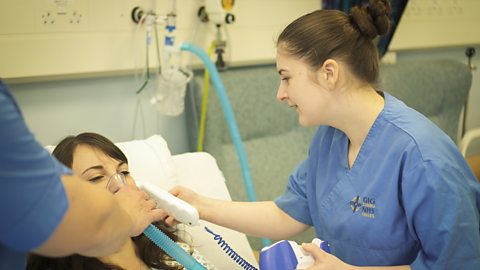
Meet Usman and learn more about life as a pharmacist for the North West Ambulance Service. Part of our Bitesize world of work series.
Usman
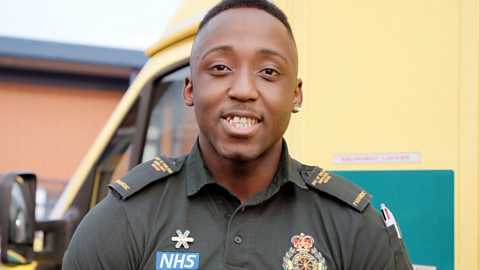
My name’s Usman, I'm 28 years old and I'm a pharmacist at the North West Ambulance Service. My role is an urgent care desk pharmacist. We deal with patients over the phone and we provide expertise on medicines. This knowledge is very important to the ambulance service.
Usman's colleague
We’ve got a patient that’s taken an overdose. Just a little bit concerned there's some clinical factors that I think need addressing potentially.
Usman
I am looking at a number of factors. One of these is how much the patient has taken in relation to their bodyweight to see whether they have exceeded what we call a toxic dose.
[Usman on the phone] "How much paracetamol did you say you’ve had? Right and the ibuprofen what strength are they? 200 milligrams? Okay and you weigh 10 stone. Okay, you have exceeded the toxic dose, so we will need to take you into hospital."
It could be errors with medication, the patient has accidentally taken double medication. However, intentional overdoses may require additional services, such as mental health services.
[Usman on the phone] "No, you're not wasting anybody's time today, okay? I don't want you to think like that. I'm here to help you, okay?"
It can be quite emotional. However, you have to try and keep that professional barrier, so that you can remain composed and dealing with that call in the best possible way.
[Usman on the phone] "Whilst you’re waiting for the ambulance if you want to have some food that will be good okay, ‘cause that will help just to ease your stomach and it’ll prevent the ibuprofen from causing you any damage. We’ll aim to have someone out with you soon, okay? All the best."
James, Usman's colleague
Usman is a real team player and fantastic to work alongside of, especially bringing his excellent knowledge and skill set to the job and the department.
Usman:
There's no specific time frame that you need to work as a pharmacist before working at the North West Ambulance Service. However, from my experience, I would say about 18 months to two years worth of experience. A pharmacist can also work in a hospital, can work in industry and can also work in other parts of the NHS.
[Usman to a patient] "We're starting you on these two medications. So this one is for cramping. You take one three times a day with your meals, okay, so that would be with breakfast."
I wanted to become a pharmacist because as a child I had asthma. I spent a lot of time in the pharmacy and speaking to my pharmacist and he helped me a great deal.
To become a pharmacist you need to have a master's in Pharmacy. Typically you need Chemistry and one of Biology and Mathematics, however, you could get in with History, with English, with Sociology. You would be required to do a foundation year which will help bring you up to speed with your sciences. I've always wanted to help people, so pharmacy seemed like the right career choice for me.
I've always wanted to help people, so pharmacy seemed like the right career choice for me.
- Usman is an urgent care desk pharmacist. He speaks with patients over the phone and provides expertise on medicines, for example where there are errors with medication or a patient has accidentally or intentionally taken the wrong dose
- He was inspired to become a pharmacist as he has asthma and, growing up, was helped a lot by his pharmacist
- It can be quite an emotional job but Usman has learnt to maintain professional boundaries so he can stay composed and do his best for his patients.

What to expect if you want to be a pharmacist
- Pharmacist average salary: NHS band [6-7]. Read more about NHS bands. Salaries will differ in private healthcare.
- Pharmacist typical working hours: 38 to 42 hours per week. You work shifts, which could include evenings, weekends and bank holidays.
What qualifications do you need to be a pharmacist?
To be a pharmacist, you'll need to complete a university degree (Master of Pharmacy (MPharm) degree) and a one year pre-registration training course in pharmacy. To get a place on the MPharm, you'll need two or three A-levels, or equivalent, including Chemistry. Alternatively, if you have one A-level or equivalent, you could apply for a two-year pharmacy foundation degree alongside gaining experience working in a pharmacy, and then apply to join the MPharm degree in its second year. Some universities accept vocational qualifications, such as BTEC Level 3, National Extended Diploma in Applied Sciences or the Access to HE Diploma. If you're based in England, you could also consider a T-level (equivalent to three A-levels).
Sources: National Careers Service, NHS Health Careers. GOV.UK.
This information is a guide and is constantly changing. Please check out NHS Health Careers and the National Careers Service website for the latest information and all the qualifications needed and the GOV.UK website for more on T-levels.
For careers advice in all parts of the UK visit: National Careers Service (England), nidirect (Northern Ireland), My World of Work (Scotland) and Careers Wales (Wales).
Work experience in your area
Find work experience placements with Workfinder.
Tips and advice
Help with interviews, writing a CV and all things work experience related.
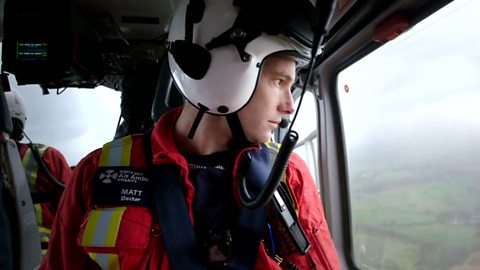
Matt: Air ambulance doctor. video
Matt works in A&E as an air ambulance doctor.
Tanoh: paramedic. video
Tanoh's a paramedic in the NHS.
Sarah: critical care staff nurse
Sarah works as a staff nurse in a critical care unit in Cardiff.