A meeting of minds can sometimes change the world.
And when it doesn’t quite do that, it can take us down an unexpected fork in the road, or just show us things in a different light.
Perhaps, more than anything else, a remarkable gathering can remind us of the importance of people talking to each other.Imagine what our lives might have been like if some of the greatest minds in history had kept to themselves?
Here, BBC Bitesize looks back at some significant meetings in history. Not all of them transformed our lives, but they all had the power to live in the memory.
Rosa Parks meets Nelson Mandela
In early 1990, Nelson Mandela was released from prison after serving 27 years. He was sentenced to life in jail for activities linked to his politics. This was at a time of apartheid in South Africa, where white people had more rights than their non-white neighbours - who had to live apart from them. Mandela had long campaigned to end the inequality.
Even while he was in jail, Mandela was a symbol of the international civil rights movement. On his release, he became one of the most recognisable people in the world and, eventually, the president of South Africa.

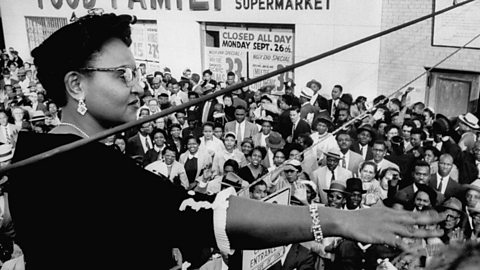
Later in 1990, Mandela toured the USA and it was here that he met Rosa Parks. In the 1950s, she had refused to give up her seat on a segregated bus in Montgomery, Alabama. Her stance got her arrested and made Parks a notable figure in the civil rights movement.
When Mandela touched down in Detroit, Michigan, as part of a tour in 1990, Rosa Parks was there and got to greet him. Photographer David Turnley was also present, and had been taking pictures of the Mandela family since 1985. He described the moment to a Detroit newspaper on the 30th anniversary of the visit: “One of the great moments for the Mandelas - in Detroit and throughout the entire journey - was when they met Rosa Parks. They were so happy to meet her as she was to meet them - the memory still brings tears to my eyes - it was like they had all met family.”
When Rolls met Royce
Frederick Henry Royce had a car he wasn’t too happy with. He was sure he could do better himself by improving the existing components in its two-cylinder engine.
Royce proved himself adept at these modifications and it brought him to the attention of Charles Stewart Rolls, who ran a London car dealership.
Rolls and Royce met in The Midland Hotel, Manchester, in May 1904. They discussed the latter’s talent for developing quieter cars which were lower on vibrations than others available. Rolls was so taken with Royce’s passion to make engines as precision engineered as possible that they decided to pool their expertise. It resulted in the Rolls-Royce partnership that became synonymous with quality motoring.
The real-life partnership came to a sad end in 1910 when Charles Rolls became the first British fatality of powered air flight, when the plane he was piloting crashed in Bournemouth during an aviation meeting. But the Rolls-Royce name endured.
Cassius Clay takes on The Beatles
The journalist who covered this story described it as “the day the Sixties began”. While that accolade is possibly up for debate, this meeting was definitely a moment when two of the decade’s biggest international names in music and sport came together for the first time.
Despite the global fame to come for both parties, neither really knew who the other was at the time. It happened on Miami Beach in February 1964, when The Beatles were the spearhead of the so-called ‘British invasion’ of UK pop acts which made it big Stateside. Cassius Clay, who changed his name to Muhammad Ali later that year, was preparing to take on Sonny Liston at the time in a world title fight. He already had a gold medal in boxing from the 1960 Olympic Games in Rome, but Clay was not expected to be a threat to Liston.

The New York Times journalist Robert Lipsyte (the same man who dubbed this moment a starting point for the rest of the decade) was present at the photo session. He remembered in a US radio interview that The Beatles’ encounter with Clay happened because Sonny Liston refused to have a photo taken with them. The four musicians then found their way to Cassius Clay’s boxing gym where a photo session eventually took place.
Lipsyte said in the interview: “I would have thought it was choreographed, except I knew they had just met… There are these pictures of the five of them in the ring and The Beatles line up, and he taps, I think… George on the chin and they all go down like dominoes.”
Cassius Clay upset his outsider odds of 7-1 to beat Liston. By the time of their rematch in 1965, he was fighting under the name Muhammad Ali - and won again. He would continue to be a dominant, charismatic force in boxing into the 1970s and beyond.
And The Beatles? They kept having hit, after hit, after hit, in the US, UK and across the world. They disbanded in 1970. Both they and Muhammad Ali could make valid claims to be icons of the 1960s, and perhaps even the 20th Century.
Mr Fagg and M. Cozette cement the entente cordiale
One of the world’s biggest engineering projects was underway in the early 1990s. It connected the UK with France via a 31-mile rail tunnel, with just over 23 miles of it running beneath the English Channel.
The construction phase involved three tunnel tubes being dug more than 100ft below the seabed. Teams began drilling at the British and French ends, meeting somewhere in between. That first moment of breakthrough, as well as having a cultural significance, would also show that the sums were right and the boreholes were in alignment.
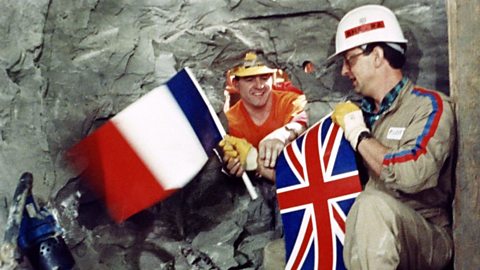
On 1 December 1990, British tunnel worker Robert Fagg was able to shake hands with his French colleague Philippe Cozette through a hole measuring three feet by four feet. That hole would eventually widen, physically connecting the UK to mainland Europe for the first time since the Ice Age. But it was two construction workers who first linked the land masses in a way that had never been done before. The two men were reunited in 2014 to mark the tunnel’s 20th anniversary of operation.
Stanley finally finds Dr Livingstone
This was a meeting that made headlines in 1871, largely because it solved a missing person mystery.
Nobody had heard from the Scottish missionary, and nationally famous explorer, Dr David Livingstone for some time. As one of the first European explorers to chart Africa in detail, he had become something of a celebrity, as well as an advocate for the abolition of slavery, but all contact had been lost after he embarked on a trip in 1866 to trace the source of the Nile. All anyone knew of his whereabouts was that he was somewhere in the African continent. To help determine that Dr Livingstone was alive and well, The New York Herald newspaper asked the journalist Henry Morton Stanley to find him.
Stanley had experience in exploring Africa and he didn’t travel alone. His search expedition was large and reportedly included 200 porters. They set off in March 1871 on a 700-mile trek through tropical rainforest, where conditions led to some members of the expedition dying through illness.
On 10 November, Stanley reached Ujiji in what is now Tanzania. It was there, near Lake Tanganyika, he was certain he had found the missing explorer, greeting him with the now famous words: “Dr Livingstone, I presume?”
And it was. Stanley had found who he was looking for. He wrote later that he wanted to embrace Dr Livingstone as he was overjoyed at finding him. However, there were so many other people present, he didn’t think it appropriate, so removed his hat and asked the legendary question instead.
Who was Rosa Parks?
Want to find out what happened to Rosa Parks on the bus? Find out more with Bitesize - KS1 History.

Five of history's most surprising bans
No popcorn in cinemas? Or football in England and Scotland?

Six key events in black history you may not know about
The Bristol bus boycott, the killing of Emmett Till and other events you may not have heard about.