“We arrived to play England in a furniture lorry because the bus didn’t turn up. We just played with our hearts more than anything else.”
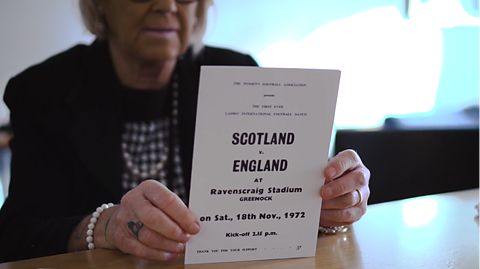
The road to women’s football has never been easy. On Saturday 18 November 1972, football fans flocked to the Ravenscraig Stadium in Greenock for a fixture that would go down in history.
The occasion was the first ever official women’s international friendly match between Scotland and England, taking place almost exactly 100 years after the first ever men’s international between the two teams.
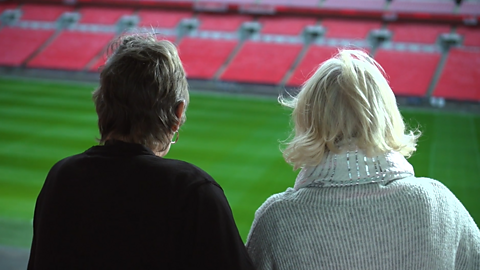
To celebrate this milestone, BBC Bitesize visited Wembley Stadium to speak to some of the game's original pioneering players.
Kim: Welcome to Wembley, you’re all back together again. What is it like to be reunited?
Sue: It feels like we’ve never been away.
Scottish players: I know absolutely.
Kim: Talk to me then about the actual England vs Scotland match, so we’ve got some goal scorers in our midst here. Jeannie, Lynda, can you remember what it was like when you scored?
Lynda: I scored the equaliser and as you say you don’t realise the importance to what it is now.
Linda: The pitch was absolutely frozen solid, and then it snowed during the game as well.
Jeannie: Scotland started really well, 2-0 we were down but that English spirit came, started fighting, 2-1, 2-2, lovely goal from Lynda and I must say I scored the winning goal, but it was lucky.
Kim: And Rose, you scored as well didn’t you?
Rose: Of course.
Jeannie: Offside!
Kim: It was the first officially recorded England’s women’s football match, did you realise at the time how big of a deal it was?
Lynda: To me personally, I was really proud that I got picked for England and it was a match and that was it.
Kim: Obviously as you say at the time, particularly for you guys from Scotland, it wasn’t recognised as an official sport at that point was it? That must’ve been incredibly frustrating when you’re all so passionate as your obviously are.
Rose: Not long after the England game, I got banned for life for playing for my country, playing for Scotland, so I had a football career in Italy, turned professional. I just put my head down and said, “Get on your bike, we’re playing football!”
Jeannie: I remember the headmaster calling me into his office. I was eight years old and short to the point, “Jeannie you’re banned.” So he explained it and that just completely shook me because there’s no other sport in the world that I’m interested in other than football.
Kim: When you look ahead to the Women’s Euros this year, which was one of the most celebrated women’s football tournaments ever, to know that every single one of you sat here kick-started that movement, how do you feel when you watch that on TV and think we had a massive impact on that?
Sue: It was only when Jill Scott said when she lifted the trophy that every women who ever wore an England shirt, their hands are on this trophy, and you realise that yes, we did it, we started it.
Rose: You know there is a sporting hatred between Scotland and England, but I was actually rooting for England because I think that us women should stick together. You know, we’ve had so many battles to play, I was crying when England won the Euros.
Kim: What do you think we can achieve in the next 50 years of women’s football?
Sue: The people who are bringing the cups home, the women, is it going to take another 50 years before they get parity with men in pay?
Kim: And what would all of you like to say to anyone who has ever said women shouldn’t play football?
Jean: We’ve had it for years and years, “Oh, women can’t play football”, I said, “Well have you ever come to a match to watch?”
Linda: I’d say nobody should tell you you can’t do something. If you want to do something, go for it.”
Lynda: Take no notice of what anybody says and just follow your dream. You can do what you want.
Rose: Don’t take no for an answer. If there’s a barrier there, you don’t jump over it, you don’t go under it, you don’t side step it, you smash it down.
Reflecting on the 1972 match
Jean Stewart, Linda Mellon and Rose Reilly of the original Scotland team and Sue Whyatt, Lynda Hale and Jeannie Allott for England were all players in the 1972 game. How did it feel to be reunited? Sue, England’s goalkeeper told us: “It’s been almost 50 years since we’ve last been together, but it feels like we’ve never been away.”
The players described how they found out they’d been called up to their respective teams. Sue recounted receiving the acceptance letter through the post. “I remember running outside and screaming and shouting, my family were so delighted.”
But the playing conditions on match day were far from desirable. Linda recalled, “I remember walking onto the pitch with the bagpipes playing, the pitch was absolutely frozen solid and it snowed during the match.”
The game kicked off at 2.15pm with Scotland gaining a quick 2-0 lead, thanks to a diving header from Mary Carr and a direct goal from a corner kick from Rose Riley. But England didn’t give up and suddenly it went to 2-1, then 2-2 and finally, 2-3.
The match was almost too close to call. Jeannie admitted that despite scoring England’s winning goal, it was very lucky. “If I’m honest it could have gone either way.”
The match was reported at the time by The Telegraph newspaper, who concluded that both teams, “Gave a lively and entertaining display in conditions which would have tested the most experienced male players, and won the hearts and vocal support of an enthusiastic crowd of about 400."
Overcoming barriers in women’s football
Despite the backing of 400 eager fans, the women’s game was far from supported by officials in Scotland. At the time, there was a ban on women's football and the match was not recognised by the Scottish FA. This was a ban that wasn’t lifted until 1974.
Rose told BBC Bitesize: “It was us against the world because we were banned from organised football pitches and referees.
“We arrived to play England in a furniture lorry because the bus didn’t turn up. We were sitting on sofas, with standing lamps around us. We didn’t have the resources of the England ladies.”
Years before, England’s Jeannie had also been punished for pursuing her love of football. She remembered being called into her headmasters office at the age of eight and being told she was banned from playing for being a girl. “But the next day I was still playing with the boys, I still carried on.”
Recognition at long last
Having defied the regulations placed upon them, the players admit that they didn’t realise how significant the match was at the time. Lynda said, “To me, I was proud I got picked to play for England and it was a match and that was it.
“But when we got recognised a couple of weeks ago, that’s when you realise what an impact we had.”
Lynda is referring to the England team gaining recognition for their achievement in October 2022. They received their caps at Wembley’s England vs USA match in front of 76,893 people.
The Scottish players were also honoured by the Scottish FA at the national football stadium Hampden Park. They walked out before the current national team to symbolise how they’ve led the way for women’s football since 1972.
Putting their sporting rivalries aside, all players agree that the success of the UEFA Women’s Euro 2022 has benefitted everybody. Jean agreed that, “It was a win for women’s football as a whole. Scotland or England, it doesn’t matter who wins.”
And any final advice from these sporting legends? Rose told us: “If you’re a girl from any walk of life, then don’t take no for an answer.
“If there’s a barrier in your way, you don’t jump over it, you don’t go under it, you don’t side step it, you smash it down.”
This article was published in November 2022
Six things you need to know about women's football
How have women shaped the beautiful game throughout history?
What impact did WW1 have on women's football?
A big one, as it turns out.
Rugby League World Cup 2021: Four reasons to follow the Wheelchair Rugby League tournament
BBC Bitesize went to the Copper Box in London to counts down 100 days until the 2021 Wheelchair Rugby League World Cup.