‘Fake news’ might be a phrase that everyone’s familiar with and aware of, but it’s still hard to know what to do when someone shares something that doesn’t seem quite right.
Starting a conversation about a piece of misleading information can be a bit awkward – especially if the person who sent it is a family member. They’ve probably got your best interests at heart and they most likely aren’t out to deliberately promote false stories.
In the latest edition of For Fake’s Sake, TikTok star Ehiz Ufuah meets Laura Garcia from First Draft (an organisation working to protect people against misinformation) to get some tips on how to talk to family or friends about fake news. It’s actually not as difficult as it seems!
Ehiz: Hello and welcome to For Fake's Sake. For Fake's Sake! I'm Ehiz and today we'll be talking about, how to talk about fake news. In other words, when someone you know says something false, what do you say to them? You would think it would be as easy as letting them know it's not true, but try telling my auntie she's wrong and she gets mad. So for some better ideas, I've invited Laura Garcia to the show today. So, Laura, thank you so much for joining us today.
Laura: Not a problem, it's my pleasure to be here.
Ehiz: So as a Training Manager at First Draft, what do you do?
Laura: So my job is to teach journalists and reporters how to spot and combat this information and that means any false or misleading information, that is being spread deliberately.
Ehiz: So what can you do if someone in your personal life is sharing false information?
Laura: Oh, it's really hard because the first thing we have to do is try and be patient and start a conversation and not an argument. Sometimes it actually really helps to ask that person, whether it's your aunt, or your uncle, or your friend, where they got that information from, where that fact came from. And that question is going to make them pause and maybe think a little bit more critically about where they're getting their information.
Ehiz: That's a great idea. Now, what if they claim that the post was just a joke?
Laura: It's super easy to just fob something off and say, "Oh, I just meant it as a joke," but jokes and memes, or funny YouTube videos carry information and therefore can also carry disinformation, that can have actual real world consequences. For example, if you find a funny meme that says, 'Onions can protect you against coronavirus', right. Maybe the first time someone hears it, they won't believe it, but if they get that same meme from you, from another friend, from a family member, they see it on Facebook, they see it somewhere else, slowly, our brains start to remember the things that we hear over and over, so memes can be really powerful as well.
Ehiz: That makes so much sense. And finally, sometimes I find it especially difficult if the post comes from someone who's a bit older. Like I want to be respectful, but at the same time I'm like, 'What you doing mum?'
Laura: Yeah and that can be really hard coming from parents or from grandparents, but I think it's important to remember that maybe they didn't grow up with the same technology and social apps that we have and it's about being patient. They might even learn something about how to navigate these digital spaces, if you're willing to offer your help.
Ehiz: That's a really good point. I will definitely try and keep that in mind. So do you have any final thoughts?
Laura: The most important thing is to try and be thoughtful and empathetic. We are not going to get anywhere by just having arguments, but if we have conversations with each other, we might learn something from each other and get through this together.
Ehiz: Great, thank you so much, Laura, this was very informative.
Laura: Yeah, no worries, see you on TiKTok.
Ehiz: Well, those were some great tips. Now, I've just got to avoid the temptation of telling my auntie, how wrong she is. So, ask where the information comes from and remind friends that even jokes have real consequences. And remember, that on this issue, you might know more than your elders, so be patient and try to help them navigate the difference between facts and fakes. And maybe, if we start having these conversations with empathy, truth will prevail. See you next time.
1. Ask them where the information comes from
Gently ask where they got their story from. They might have seen it on Facebook, Twitter, Instagram or TikTok, but if you can, try and find out which account or news source shared it. This will get them to think about what makes a reliable source more critically.
2. Remind them that jokes have consequences
It’s easy for someone to respond by saying “Oh, it was only a joke”, but sometimes satire and parody can be misinterpreted as facts. It’s really important for them to understand that a lot of fake news is spread this way, but don’t try to lecture.
Listen to their explanations and even point out that you hadn’t realised the post or story was a joke – this will help the other person empathise with you and understand your perspective.
3. Be patient and try to help
The most important thing is to be patient and respectful when asking someone about news that might be fake. They’re most likely worried about an issue or may have seen something that has upset them, so don’t shut them down and try to show kindness and concern.
You’ve got a much bigger chance of getting to the bottom of it this way and, if needed, it opens the conversation for future chats about false information.
Where next?
How false information spreads
Fake stories aren't just in 'the news' - they can be found in memes, videos and screenshots too. But how do they spread so quickly around your contacts and feeds?
What are reliable sources?
TikTok star Ehiz learns how to spot trustworthy sites when searching for the latest news or information.
Fake news and me
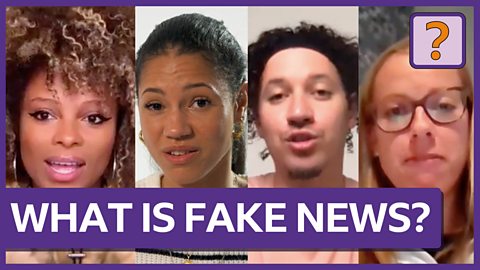
Famous faces share their experiences of fake news to show the harm it can cause.
Other Side of The Story
Find out how to spot and stop fake news with BBC Bitesize.