Whether it’s stage magic, table magic, or a big showcase in the street, sometimes you can’t help but be wowed by a mystical illusion.
There’s a reason why you see variations of the same tricks time and time again, and why they continue to captivate audiences today. We bet you’ve wondered how they do it, too. Well, a magician never reveals their secrets - but Bitesize knows a thing or two about magic.
From levitating princesses to disappearing elephants, here are five of the most influential magical illusions in history and how they worked.
Remember, these were performed by professionals after years of practice, so don’t try these at home!
A dividing classic
Sawing a glamorous assistant in half is a staple act in any magic show. There is debate around who invented the illusion, but it’s generally accepted that the first public performance of the ‘Sawing a woman in half’ trick was by P.T. Selbit in London, 1921. Selbit awed the public by seemingly sawing his assistant in half and even getting audience members involved by holding ropes that were tied around her hands and feet.
There are many ways which this trick can be performed, including slipping fake feet into the lower half and curling up into the top portion of the box, a method which was patented by Horace Goldin in June 1923. Variations of the trick include the use of transparent boxes, multiple chops such as in a ‘zigzag’ formation, and different types of saws or blades.
Historically there has been some division (sorry) among illusionists about preserving secrecy around their version of the act. Some performers have gone as far as to pursue legal action to keep their secrets from the public, while others, such as famous duo Penn and Teller, often reveal their methods as part of the act. Many of the variations of the sawing trick are still a mystery to non-illusionists, so we won’t spoil the magic!
An illusion of elephantine proportions
The disappearing act is the punchline of many a magician joke, and it’s a trick that certainly leaves an impact. Chances are you’ve heard of the father of escape arts, Harry Houdini - but he did many other great magic tricks, including making an entire five-ton elephant disappear.
On January 7 1918, Houdini astounded a large crowd at New York’s Hippodrome theatre when he made an elephant vanish from an oversized cabinet that could be viewed from most angles. Was the elephant still in the room? Yes, more specifically the cabinet - it never left.
To this day, no one knows exactly how he did it and there is no film record of the trick. Several theories have floated around, but a likely theory by Houdini writer J. C. Cannell is that the illusion was achieved by a handler and crew of twelve strong men. When the cabinet was closed with the elephant inside, the crew turned the front of the cabinet towards the audience. This process took seven or eight minutes - meanwhile inside, the elephant was shuffled to one side of the box by a hidden handler. When the front curtains were opened again, the elephant was stood behind one of the curtains, so a view all the way through the cabinet could be seen through the back doors.
Such a feat was so unprecedented that Houdini’s vanishing elephant went down in history as (literally) one of the biggest illusions of all time. Modern upgrades of the trick include transparent boxes and cages where the elephant or large object is visible, with the addition of smoke and mirrors to achieve the disappearing act.
Rising to the challenge
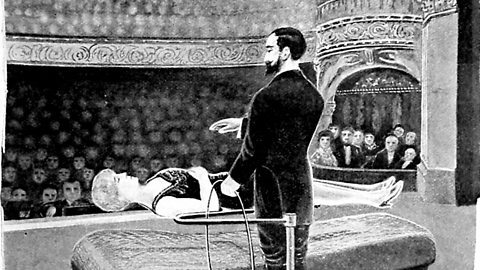
Levitation is an illusion that’s sure to have you gasping: “How do they do that?”. There are many different types including object suspension and flying illusions, often using wires and strings, but a common one you might recognise is the board levitation.
Harry Kellar pioneered this type of levitation and was often referred to as the first great American magician, with Houdini himself naming him as an influence on his own tricks. One of Kellar’s acts known as “The Levitation of Princess Karnac” is still replicated today. It worked using a metal board which Kellar’s assistant, Princess Karnac, concealed under her dress and lay down on. The board was hooked up to a machine which could raise and lower her, and Kellar then passed hoop back and forth over her to show she was not being suspended. The bar was S-shaped, which allowed the hoop to pass in a figure-of-eight, giving the illusion that it’s moving in a straight line when looked at from the audience.
The part most people don’t know is that the assistant has to lie flat as a board to maintain the illusion, requiring abs of steel!
Time for a change
If you’ve ever been in a rush to get ready for a party, you’ve probably wished you could snap your fingers and be in your fancy new outfit in the blink of an eye. This is where the quick change comes in handy.
‘Quick change’ is a general term for any costume change which is done rapidly, and there are many methods and styles of the trick. The quick change is not only a helpful thing to master behind the scenes of theatre, but has been elevated by some artists into an act of itself, and stands as one of the most famous and frequently used illusions today.
An early method of quick change is the ‘Fregoli’ method. Leopold Fregoli was a quick-change artist and actor in the late 1800s, and he would change in three seconds thanks to the help of several assistants. Modern quick changes often incorporate layered costumes held together by buttons, magnets or velcro, which can be torn away to create the appearance of transformation. You could see it a hundred times - possibly on the same performer - and it never fails to impress.
A tricky apparition
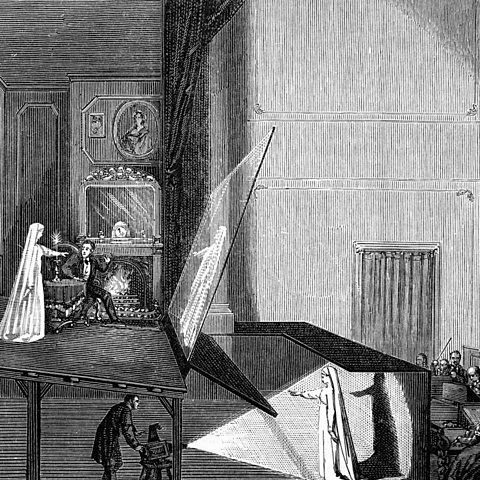
You’ve probably seen this next illusion more times than you know. Pepper’s Ghost, popularised by its inventor Henry Pepper in 1862, is a projection technique which involves two rooms and a reflective surface.
One room is hidden to the audience (the ‘blue’ room) and the other is visible, such as a set on stage. An actor stands in the blue room, often against a black background so nothing else is reflected. Then a sheet of perspex glass is placed in between the rooms and reflects the actor when they’re lit with a bright light. The result is a ghost-like projection in real time!
Most uses of the technique today involve video rather than a live actor, and Pepper’s Ghost has been used in concerts, attractions, museums and films. A famous example is a performance by deceased music artist Michael Jackson at the 2014 Billboard Music Awards, where an entire set and dance crew was projected onstage alongside the singer, performing the song Slave to the Rhythm.
How to run away with the circus (without performing)
Can you sew a costume, tie a knot or write a flyer? There might be a job for you in the circus...
Six secrets of movie posters
Find out how movie posters are designed to encourage us to buy a ticket.

Women who rule: Five formidable queens from history
Find out about some more famous queens from history.