The 2019 Women's World Cup kicks off this week, with England and Scotland facing each other in Nice on 9 June.
Playing in the French Riviera, there's every chance the weather will be glorious.
But if you come from colder climates, how does hot weather affect your body when you exercise? Dr Georgina Stebbings, Lecturer in Exercise and Sport Physiology at Manchester Metropolitan University, explains what happens to the body when the heat is on.
Kim: Being selected to represent your country at a world cup is the ultimate accolade but often we see footballers on the world stage struggle when it comes to playing in a different climate to the one that they’re used to. So what does it take to compete in the heat of international football?
Dr Georgina Stebbings is the expert on all things sports science at Manchester Metropolitan University. I asked her how the body reacts during exercise in hot conditions.
Dr Stebbings: Typically if you’re exercising anyway the body produces metabolic heat. 20% of that energy will be used to contract the muscle. 80% is then dissipated as heat which then needs to go somewhere to keep the body temperature relatively stable. In order to do this, that heat is then transferred into the blood which circulates around the body and starts to rise. Luckily for us we have thermal receptors which can detect that early elevation in core temperature and the body then adjusts physiologically to initiate more effective cooking mechanisms. We can increase sweat rate, we can increase blood flow to the skin so that our skin becomes warmer but then that can be dissipated to the environment. That’s usual if we’re exercising normally but then add to that, the environmental heat stress which can then have a negative impact on performance.
Kim: So, armed with Georgina’s expertise, we headed over to the heat chamber to put all this to the test with some rather keen students.
The science
- When exercising, the body produces metabolic heat
- 20% of the energy is used to contract the muscles being used, and 80% is then generated as heat
- The heat has to go somewhere in order for the body to maintain a stable temperature
- Heart rate rises in order to pump blood round the body and distribute heat. This causes core temperature to rise
- Heat receptors in the body detect this early elevation of core temperature. The body then adjusts physiologically to initiate cooling mechanisms
- These mechanisms include increased sweating, and blood moving closer to the skin to dissipate heat into the environment.
What about when you add heat from the surrounding environment?
Armed with specialist equipment, Dr Stebbings put some students to the test as they exercised in the rising temperature of a heat chamber.
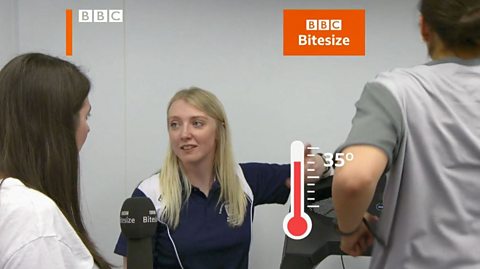
The heat chamber replicates the conditions of a warm climate. Two students, Flora and Nadia, were asked how hard they thought they were working as they ran on a treadmill in the rising heat.
After two minutes, Flora's heartbeat increased by ten beats per minute (bpm), her face became redder and she produced sweat. Six minutes in, Nadia was at 90% of her maximum heart rate, with the room at 35 degrees Celsius.
"It's kind of intense, the body's having to work to maintain this effort," says Dr Stebbings.
"I didn't think it would be so hard," Nadia says between breaths. "Full respect to all the athletes that do it!"
Dr Stebbings concludes: "Because of the increase in blood flow and all the mechanisms the body's using to increase our cooling capacity, there's got to be some compromise." Sprinting is directly involved in key match outcomes, so the heat of an international climate definitely has an impact the ability to complete those high-speed runs.
Professional athletes spend a long time preparing to compete in warm weather. But if you fancy a jog in the sunshine, remember to keep yourself hydrated, and try not to exercise during the hottest hours of the day.
This article was published in June 2019
What impact did WW1 have on women's football?
A big one, as it turns out.

SPOTY 2018: five sports stars on dealing with stress
Whether you're revising for exams, or gearing up for a big event, get tips on dealing with stress from these sports stars.

How a run can help your revision
Clear your head between study sessions with a good jog.