As a parent of a neurodivergent child, it can be difficult to comprehend their unique understanding of the world.
In a follow up to the BBC documentary Inside Our Autistic Minds, presenter Chris Packham, met people with dyslexia to explore how they experience life. Bitesize Parents’ Toolkit also spoke to experts at the British Dyslexia Association for advice parents of children with dyslexia may want about the topics explored in the programme.
What is dyslexia and who does it affect?
The British Dyslexia Association (BDA) defines it as a lifelong, genetic, neurological Special Learning Difficulty (SpLD) which affects people in all genders, ethnicities and social groups. It is not connected to a person’s intellectual ability and it can have an impact ranging from mild to severe.
Lee, one of the people Chris met in the series, explained how he could understand drawings rather than words, saying: “If I read this now, I’ll jump words. That will take me three times longer, just to know what is happening.”
As an explanation for this happening, Professor Joel Talcott, a neuroscientist, told Parents’ Toolkit: "The dyslexic brain uses the same brain areas as typical readers, but there's less coordination and less connectivity between these areas.”
And there are other challenges to consider: “Individuals with dyslexia may have difficulties in other sorts of working memory tasks, reading maps or understanding directions, following instructions, remembering words to a song, but also the ability to sustain attention to a task.”
Suiki’s story: How dyslexia can make life a challenge
Dyslexia can affect people in ways that may not be obvious to their friends and family, as Suiki revealed in a film she made to show her family about life with the condition.
She said: “For me, being dyslexic can turn simple tasks into real challenges. My thoughts are like fish in a pond. One moment they’re there, then suddenly, they’re gone, slipping out of reach.
VO: 1 in 7 of us have brains that work differently, with more people being diagnosed with conditions like autism, dyslexia and ADHD than ever before
VO: Difficulty reading and spelling is at the core of any dyslexia diagnosis…
VO: Many dyslexic people also experience problems with memory and organisation
Suiki: Even when it comes to going to work, that can be completely confusing for me because there’s so many small things that I need to remember. Do I have my bus pass? Do I have my phone? When I’m trying to schedule appointments, it can be quite …terrifying, honestly.
VO: Suiki works as a counsellor in a secondary school in London
VO: She was diagnosed with dyslexia as an adult
VO: It wasn’t spotted earlier because at school she worked extremely hard to disguise her problems
Suiki: It might take me a lot longer than the average person to recall something. For example, meeting up with friends and ‘Ah, I watched this great movie!’, ‘Oh, what was it called?’ and ‘Oh, I forgot…’. You know, that’s another thing with dyslexia. Sometimes you get an idea, someone’s talking and you desperately want to interrupt, because otherwise that that thought disappears. It’s sort of like a slippery fish and you’re trying to grab hold of it and you can’t.
VO: Suiki is close to her younger brothers, Antonie and Jacob, and her older brother, Roy
VO: But as close as they are, Suiki doesn’t feel like they quite understand her struggles with dyslexia
Suiki: It feels like, as much time as I spend with them, there’s sort of not enough time to talk about dyslexia with them and how much it affects me. They see me as the strong one but I think what’s difficult is always having that sort of mentality of you’ve got this and you can do it.
VO: Suiki had to be strong growing up
Suiki’s brother, Roy: When I was 19, and she was nine, our mum passed away, and I’ve seen her overcome the emotional difficulties that comes with that and the tenacity that she’s displayed in that. We’ve had to put a brave face on things from a young age so, because of that, there’s no real cries for help.
Suiki: Yeah, you’re putting a brave face on, about the hardest thing that I’ve probably ever had to face in my life. It meant that when it comes to other conversations about the fact that I’m really struggling with my directions or what have you, we’re not going to talk about it as much. But I want them, especially Roy, I want him to see that sometimes it’s not so straightforward. It’s not just about keeping my chin up. There’s some things that will be long lasting that I find challenging.
VO: Suiki made this short film to explain some of the difficulties she faces
[Start of short film]
Suiki: Roy.
You’ve always been more than a brother to me, but when you look at me I’m worried you only see the things I’ve achieved.Not how much I’ve struggled along the way.
How much I still struggle.
For me, being Dyslexic can turn simple tasks into real challenges.
My thoughts are like fish in a pond.
One moment they’re there, then suddenly they’re gone out of reach. If someone asks me a question, even an easy one like where we’re supposed to be meeting, the answer could be on the tip of my tongue but catching that thought and saying it out loud is harder than you could know.
Even simple conversations can leave me exhausted.
Often by the time I’ve ordered my thoughts, I forgotten what I was thinking in the first place.
In every moment, in every conversation, I feel like dyslexia is there waiting to catch me out.
I’m scared of what people must think of me.
That flaky friend always forgetting things…letting everyone down…
I’m scared of what you might think of me.
But I also know that being dyslexic makes me the person I am.
It makes me be creative, able to spot patterns and make connections. Helps me to solve problems others can’t.
I need you to know that dyslexia will always be a part of me. It’s not something we need to fix, but something we need to embrace.
They’ll be times when I’ll need your help, times when I need you to be patient, but more than anything, I need you to accept me just the way I am.
[End of short film]
Roy: Ah, that’s sensational.
Suiki’s brother: Hello.
Roy: Hi sis, how you doing, you alright?
Suiki: Yeah, I’m alright.
Roy: Personally, I thought it was really good film, come across really well, hair was did, so yous on point. But, just to let you know that whatever happens in life, I’ll never be disappointed in you. I am sensationally proud of who you are. Never ever worry about how I perceive you ever.
Suiki’s brother: We wanna know like, your struggle is part of you, innit. We’re literally the last people that will judge you on any struggles. Like we’ve been through literally hell and back.
Suiki’s other brother: I feel privileged to like go inside your mind and see what it’s like in your shoes.
Suiki: Honestly, I was so nervous to show you, I was so nervous because there’s just some things that are just difficult for me. But I think now what might change is that it will be easier for me to say, ‘Oh that’s my dyslexia’.
Roy: I think we save our vulnerabilities or sadness for places where we can’t be seen, and maybe that might not be the best way to deal with things now, so we’ll work with you.
Suiki: Honestly, I feel so grateful that I’ve got all of you as my brothers who support me so much.
Roy: I think we’ll have to seal it off with a group hug.
VO: To find out about dyslexia, go to bbc.co.uk/insideourminds
“If someone asks me a question, even an easy one - like where we’re supposed to be meeting - the answer could be on the tip of my tongue, but catching that thought and saying it aloud is harder than you could know.”
But Suiki also explained how she has taken ownership of the situation: “Being dyslexic makes me the person I am. It makes me creative, able to spot patterns and make connections, helps me to solve problems others can’t. It’s not something we need to fix, but something we need to embrace.”
Can dyslexia affect your memory?
“There are so many small things I’m trying to remember,” Suiki continued, “Do I have my bus pass? Do I have my phone? And when I’m trying to schedule appointments, it can be quite terrifying.”
The BDA finds that people who have the condition have difficulties with short-term memory and working memory (the kind we use when problem solving and need to hang on to information for a short space of time). They also find that long-term memory can be good, although this often requires repetition to become embedded.
Their advice to parents of children with dyslexia is to break instructions down into smaller, bite-size chunks and use a multi-sensory approach, such as giving verbal and written instructions at the same time.
Dyslexia and a sense of direction
When Chris and Suiki attempt to find a pub to meet her dad and daughter, she becomes frustrated with directions: “I feel very nervous.” she said, “I don’t know where it is, I feel like we’re going to get lost. I feel like it’s a bit of a disaster. But we’ll try and get there.”
The BDA finds that people with dyslexia ‘think’ in images rather than words. Processing directions as instructions can be a challenge, so they suggest adding a visual clue, such as an arrow, or phrases like, “turn left by the church” as it can create a clearer mental picture.
Lee’s story: Dyslexia and your career
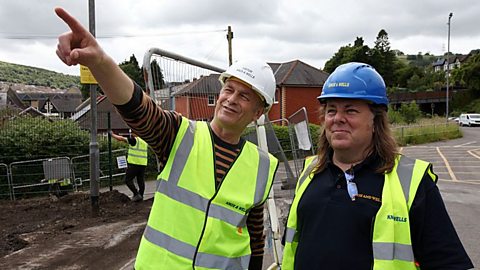
Lee works in construction, with a successful job as a carpenter, but found his dyslexia placed a limit on what he believed he could achieve. He told Chris: “I enjoyed school, but only the practical side of things.”
The British Dyslexia Association has found that many people who have dyslexia thrive in a variety of job roles and careers. A big influence can be an occupation based on a personal interest, or jobs where there is less emphasis on written work. However, the BDA is aware of people with dyslexia working in environments where the written word plays a major part. They also have evidence that areas such as problem-solving, creativity, innovation, artistry, reasoning, verbal communication and empathy can be where people with dyslexia excel.

The UK intelligence services, GCHQ, actively recruit employees with dyslexia. Their director of legal affairs, Shehzad Charania, told Chris, “A dyslexic person might be able to spot an anomaly in a huge data set that a neurotypical person might not be able to. The key here is the mix of minds that we have. Everything we do is about working in a team to solve the most complex problems. So, we need both neurodiverse people and neurotypical people to work together.”
Talking to children with dyslexia about jobs
When talking to young people with dyslexia about career choices, the BDA’s advice is: “Be led by your child and what they want to do. Do not discourage them from pursuing a career that they are interested in just because they are dyslexic. This should not be a barrier. Work together to understand more about their ideas. Look at what qualifications and skills will be needed for a chosen career and find ways to enable your child to develop these skills.”
They also advise: “If your child doesn’t know what they want to do, think about their strengths and the interests.
“Look at famous dyslexic people so that you can illustrate the wide range of occupations available and find out more about what is required in terms of qualifications and skills.”
VO: One in seven of us have brains that work differently, with more people being diagnosed with conditions like autism, dyslexia, and ADHD than ever before
VO: Difficulty reading and spelling is at the core of any dyslexia diagnosis…
Lee: Like if I read this now, I jump – I jump on the words. This will take me three times longer just to know what’s happening there.
VO: Like many dyslexic people, Lee can also struggle with memory and organisation
Lee: It’ll take me three days to understand it, that’s when the anxiety and that comes into it.
VO: He also struggled at school
Lee: When they used to say, stand up and read a paragraph of a book, I’d have a panic because I couldn’t do it. I didn’t know about dyslexia. I just thought I was thick. I just thought I couldn’t do it.
VO: Lee now works as a construction site manager
He’s the pillar of the local community…
[Chorus of men singing in a local community choir]
VO: …and he loves singing in his local choir
But he worries what people will think of him
So he’s written a song - to show everyone how dyslexia has affected him over the years…
and why he’s much more than, in his words, ‘just a builder’
[Short film ‘Somewhere There’s A Song’ starts]
Lee: [Sings] Nice to meet you. Why I’m a builder named Lee - nothing special.
Nothing smart about me. Just a builder, just a fellow next door. I’ve never been the sharpest tool in the drawer.
In the valleys, if you struggled in school, in the 80s, they just called you a fool. Can’t spell ‘Shakespeare’? – Well it sucks to be you. Be a builder, that’s the best you can do.
And I know I shouldn’t complain. I’ve got a life for your daughter giving everything for. But the question burns in my brain, ‘maybe I was meant to be so much more…’.
Somewhere there’s a song never to be heard. Oh, I can feel frustration stirring each and every word. Maybe I could sing it set those Demons free if I was anyone but me.
Lee: Guys, anyone seen my iPad?
Lee: Okay, thank you.
I’m a grafter. I work hard for my town. But dyslexia keeps dragging me down. Missed appointments, health and safety reports. Broken alphabets invaded my thoughts.
And my family, and my friends in the band cannot feel it, like they don’t understand. It feels like there is so much to say, if there wasn’t a war of words in my way. It might be hard to believe, but it can feel like a sea rising up around me. I need a moment to breathe. Take a deep breath and then count to three…
One…Two…Three…
Somewhere there’s a song… longing to be heard… and if I have to fight with each and every word, maybe I can sing, make my luck and see…if I was anyone but me.
[Choral male singing]
*Lee: Just a builder, but I build my own song whilst together, hands are making you strong, and dyslexia - it’s a tool in my trade. Just a builder, but look what I made.
If I was anyone but me…
if I was anyone but…
Why, I could not have sung it.
It sets this spirit free if I was anyone but me.
If I was anyone but me.
[End of short film]
[Applause]
Lee: That’s…that’s blown me away that, actually. It’s ‘wow’ isn’t, do you think?
Chris: It’s outstanding.
Lee: I’ve realised who I am. I might not be academically as qualified as some people, but I think outside the box.
Chris: Can I put some words in your mouth? I’m a builder called Lee and I’m in love with me and don’t put the ‘just’ word in.
Lee: Well, I am a builder called Lee.
Chris: ‘And I’m finally in love with me’.
Lee: And I am in love with me.
Chris: That’s a job done then, isn’t it.
Lee: I think so.
VO:_ To find out more about dyslexia go to bbc.co.uk/insideourminds_
Feeling limited by Dyslexia
After watching his film, Lee tells Chris, “I've realised who I am now. I might not be academically as qualified as some people but I think outside the box.”
Chris also urged him to describe himself without using the word ‘just’.
If your child is feeling limited or lacks confidence because of their dyslexia, the BDA says there ways you can help them:
- Children often build their self-esteem by measuring themselves against others. It is important to discuss these feelings with your child so that you can understand how they feel and find ways to support them.
- Talk about the things that your child is good at – this could include things like working hard, being kind, being a good friend etc, and the things that they find challenging.
- Many dyslexic children are unable to achieve feelings of success and achievement through school. So it is important to provide opportunities outside of school.
Watch all episodes of Chris Packham's Inside Our Minds on BBC iPlayer.
BBC Ideas has a collection featuring more films from this series.
For further support and reading on dyslexia:
The British Dyslexia Association offers education and advice for parents, carers and teachers.
The BBC Action Line page offers links to organisations that can support parents.

Bitesize Parenting
Fun activities, real-life stories, wellbeing support and loads of helpful advice - we're here for you and your child.

What is dyslexia and how can I help my child?
Parents can face worry and uncertainty when they suspect their child is dyslexic. We have advice on diagnosis, schooling and support.

Top tips to support your child's reading at home
Language development expert, Tara Parker, suggests some top tips to help you make the most of your child's reading time.

Five ways to support your child with dyslexia at home
Karen Mace provides tips on home schooling your child if he or she has dyslexia.

Seven ways to support your child with SEND at school
Dr Anne Emerson, Associate Professor in Special and Inclusive Education, provides tips on how to help support your child during their time at school.

What is a school SENCO?
Bitesize Parenting guide to the role of a Special Educational Needs Coordinator, what questions to ask a SENCO, and how can a SENCo help my child?