Welcome to The Regenerators.
If you’ve been thinking about how you can help in the fight against climate change, you may be wondering what careers are out there in that field.
The Royal Meteorological Society is an organisation that raises awareness about issues surrounding weather and climate. As part of BBC Bitesize's initiative The Regenerators, they introduce us to four people in various different climate-related fields, to explain what they do and how they got there.

'We run our flood risk models with a range of scenarios to account for more extreme weather events'
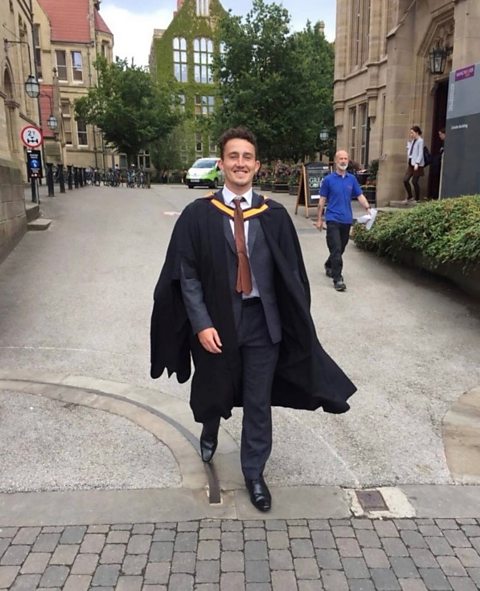 Image source, Dylan Jones
Dylan is currently on a 6-month placement working as a flood risk modelling officer at the Environment Agency. He says: "I review flood risk models for planning purposes, as well as develop flood forecasting models which are used during incidents to forecast where and when it may flood."
When Dylan was considering what he wanted to do as a career, he knew he didn’t want to be completely office-based, he enjoyed both design-based subjects and maths, and he wanted to make a difference. A career in engineering ticked all the boxes and led him to study Civil Engineering at university before joining the Environment Agency.
"With ambitious carbon targets being set by the government, the industry is continually learning how to adapt its practices and change its focus to carbon-effective designs. I felt the Environment Agency… was a great place to start my career and learn these practices.”
If you are interested in following a similar career path, Dylan’s advice is “simply, go for it! There are so many great opportunities in a wide range of industries looking to find new innovations and ways of thinking, which could influence the way the world looks within our lifetime. As the impacts of climate change become ever more prominent, the difference you can make as an individual becomes ever greater”.
Image source, Dylan Jones“I have known for a while that whatever job I ended up doing would have to be something that would directly contribute to the reduction of carbon emissions”
 Image source, Louise Guthrie
Louise is a Development Engineer at the National Grid and is working on a new Carbon Capture Usage and Storage (CCUS) project being developed in the Humber Region. CCUS involves transporting carbon emissions and storing them, so industries that want to use less carbon can keep going while alternative ways of operating are found.
"A typical day usually involves a meeting that can be about anything from the route the pipeline might take, to how we can design the Above Ground Installations to be as sustainable and energy efficient as possible," Louise explains. "This will be followed by analysis and report writing to record decisions."
Prior to this, Louise studied Electrical and Mechanical Engineering, before applying for internships in the power industry and working for the National Grid during her summers.
If you're looking at a career in engineering, Louise suggests you "look at apprenticeships and other technical placements that might exist… At the end of the day engineering isn’t just about doing maths and physics, you have to be able to communicate ideas and then implement them safely and effectively.”
Image source, Louise Guthrie'I was part of the team on the Paris Agreement, the Katowice rule book, and the bid for the UK to host COP26'
 Image source, Lucy Collyer
Lucy is Head of Strategy for International Climate Finance at the Department for Business, Energy & Industrial Strategy. They develop climate change programmes in developing countries, and Lucy’s role is to make these programmes as good as they can be by collaborating with their leaders, as well as senior civil servants.
She says: “A typical day can involve providing advice… on how to pitch new proposals, writing recommendations to ministers, and working with other government departments to ensure our international climate action is as tightly joined-up as possible”.
Lucy has always had an interest in climate change since she learnt about the Kyoto Protocol in school. Having studied undergraduate Geography and International Development as a postgraduate, she took up a variety of roles trying to find her place in climate change.
Ten years ago, she joined the previous Department for Energy and Climate Change working on the Energy Act and and eventually led negotiations on what later became the Paris Agreement. Lucy's also worked on over five COPs!
For those considering a similar career, Lucy says "experiment with different types of organisations and different types of roles. Be open, be flexible, listen and look around for what takes your interest. A career is part of life, and a process to enjoy, not an aim in itself”.
Image source, Lucy Collyer'I see my main role as giving the world the evidence it needs to prepare for climate change'
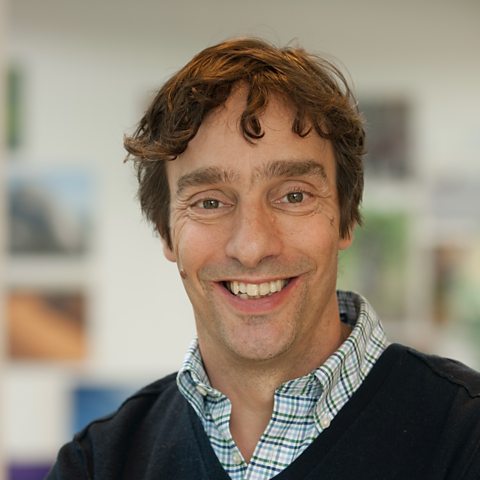 Image source, Piers Forster
Piers is a Professor of Climate Physics at the University of Leeds, and gets to work with teams of people around the world collecting data and running computer simulations of the climate. This then helps scientists and others decide what to do next in the fight against climate change. He also teaches climate science to prepare the next generation for all the cool green jobs of tomorrow.
More recently, Piers has become a member of the UK Government’s Climate Change Committee, within which he provides direct advice to help set national policy on climate change. it's a part of his job he really enjoys: "It’s a whole lot of fun, and rewarding, when you see government making legislation based on your advice."
Having always been good at programming and physics, and with a love for nature, Piers wanted a job that combined both. So, he decided to do a degree in physics, then a PhD in environmental science, before doing research jobs in the UK, Australia and the US. He then began to write reports for the United Nations, which got him more involved in international and national climate negotiations and setting climate policy.
In terms of advice, Piers believes you should follow your interests: "I wasn’t ever top of my class, but I loved the idea of problem solving and found something I really cared about… this has given me a job I love”.
Image source, Piers ForsterMake a difference
Discover more about the planet and how to protect it with the BBC.
Green careers
THE REGENERATORS

Is this the greenest football club in the world?
THE REGENERATORS
Four jobs that could save the planet
BITESIZE CAREERS

Back to The Regenerators
BBC BITESIZE