Exercise is key to feeling good and staying healthy for animals and humans alike.
Starting and maintaining an exercise routine can be easier to stick to when you have a friend to do it with, and there’s no better friend than your dog. Walking your pet dog can be a great way to get moving, but jogging with them can also be a great bonding exercise and keep them fit mentally and physically.
If you want to get more active, something like the NHS Couch to 5K challenge might be the perfect way to improve your fitness week-by-week. You could make it even more fun by having your dog learn along with you.
Sounds interesting? Jo Pay, dog agility instructor and owner of Standish Dog Trainer, has given us some tips to teach your dog to jog. Training needs to be done gradually and safely, and not all dogs can run, so talk to your vet before you start. Also make sure you ask your parents' permission or have them supervise you.
First, check if your dog is a runner
Before you even think about running with your dog, you should know whether they’re physically suited to long-distance running. Smaller dogs can’t always run at your pace, so might not make ideal running companions. It’s also important to consider factors such as age and breed.
“As puppies, dogs should be exercising for roughly five minutes per month of life, at a time,” says Jo. “So, if your puppy is three months old, each walk should be about 15 minutes long. This is really important for their bone, joint and muscle growth and development.”
Use this rule for the first 12 months of your puppy’s life. If you have a large or giant breed dog like a Labrador, German shepherd, rottweiler or great Dane, then you should wait until they’re at least 18 months old. Big doesn’t equal grown!
Breeds that are short nosed and have flatter faces are called ‘Brachycephalic’ (Brack-is-ee-falik) and heavy aerobic exercise isn’t good for them.
“Because they have short noses, narrow nostrils and often poorly formed windpipes, these dogs suffer from breathing difficulties,” says Jo. “They just can't get enough oxygen in with each breath that they take.”
Brachycephalic breeds include British bulldogs, pugs, Boston terriers, French bulldogs, affenpinchers and many others. Crossbreeds such as jugs (jack russell and pug hybrid) tend to have fewer breathing problems, but it’s important to get your vet’s advice on their potential as a runner. Do not push your dog to run if they're not suited to it as this is cruel and could really injure them.

What to expect as you build up to your first 5K
You'll walk more than you run in the beginning. You might feel intimidated by the idea of a 5K run, but won't jump straight into athlete-level exercise. The programme will help you build up gradually, starting with short bursts of jogging during your walk
You'll feel achy the day after. A mild aching is normal and a sign you're building stronger muscles. You can reduce Delayed Onset Muscle Soreness (DOMS) by warming up and cooling down properly. Recording this is important, as you'll see how much less you ache as you get better at running
You'll have ups and downs. You might have heard of hitting the 'runner's wall': a sudden feeling of fatigue during training. This isn't a step backwards, but your body's way of telling you to stop and have a snack and a sit down. If that's it for that day, that's okay! Taking a break to recover will help you push through it and come back stronger. Even the pros have bad runs, and seeing your progress laid out in front of you can help you soldier on and stay focussed on your goal
It'll all be worth it! There are many physical and mental benefits to exercise, and you'll start feeling the benefits of getting fitter in no time. Keep going.
Walk before you can run
Even if your dog is suited to running, you should still get a vet check to make sure your dog is up to the physical demands of joining you for a run.
“Dogs are so obliging and want to be with us, so they would probably run with you even if their hips or knees were hurting,” says Jo. “Before you start running with your dog it is a great idea to get a vet check to make sure that your dog is fit enough, and free of any pain or injury.”
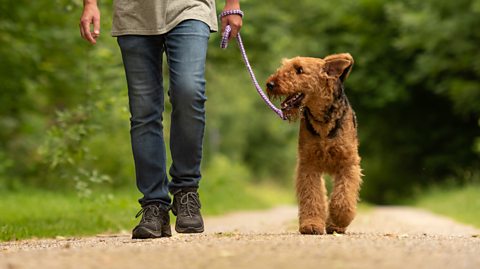
Dogs can run much faster than humans, so you need to train your dog to walk before it can run. If they dart in front of you or away from you while running, it’s unsafe for both you and your dog. So you must teach your dog the ‘heel’ command first. To do this, use toys or food treats to reward the right behaviour in your dog - it’s a great way to teach your dog to focus on you and stay by your side.
First, find a secluded place where not many people go and is away from cars or other loud noises, so your dog won’t get distracted
Let them go to the toilet and have a sniff around so they’ll be able to focus completely on you
Start training. Get their attention and offer them a treat so they come to your side. Then take another treat, walk a few feet with it in front of their nose while saying your chosen command word (such as ‘heel’ or ‘close’)
If they stay parallel to you, say ‘Yes!’ as you give them the treat and then lots of verbal praise
Repeat a few times, then let them have a break and an explore before starting again. It’s important that training sessions are kept short (no longer than 10-15 minutes), especially if it’s a new command, otherwise your dog might get overwhelmed and stressed. Your dog will let you know when they've had enough and will stop paying attention - it's not that they're being disobedient, so don't force them to carry on past this stage.
Another type of brake is also important:
“I would teach a ‘slow down’ and also a ‘stop’ cue,” Jo says. This will teach your dog not to pull ahead as soon as they’ve got the treat and keep you both safe when you’re running. Commands such as ‘this way!’ to indicate the direction you’re going can also be useful for keeping your dog safe and their attention on you.
Always keep yourself and your dog safe
Once your dog can heel nicely and consistently, you can start to jog with them. But there are still some steps you must take to prepare.
Only run in safe, dog (and ankle!) friendly places. Stay away from main roads or areas where there’s lots of ditches, water or potholes, or you could end up injuring yourself and your furry friend.
A well-fitting harness is very important for their spine and windpipe. Running with the lead attached to their collar is not a good idea, as this can be painful if they stop abruptly, and you’ll have less control over their movement. Keep the lead short but loose, so they can’t run too far ahead or in the wrong direction.
A warm up is as important for a dog as it is for a human. Walk your dog around for a few minutes, gradually increasing to a fast walk. Then give the dog some exercises to do that will gently stretch their muscles before you start training.
“Using tasty treats to lure your dog in a circle to the left and right will stretch out their neck and back,” says Jo. You can also use a treat to get them to bow and stretch out their chest, upper back and legs.
“Make sure that you don't put your hands on your dog to pull or push the stretch, let your dog move to their comfortable limit.”
Finally, do not run with your dog in hot weather as dogs have sensitive paws and can’t sweat the way we can to cool down. They overheat very easily during the summer months, and the signs of heatstroke (excessive panting, restlessness and vomiting) are often not seen until it's too late. Stay safe and judge when and where it’s okay for you to run.
Now you’re prepared, it’s time to run
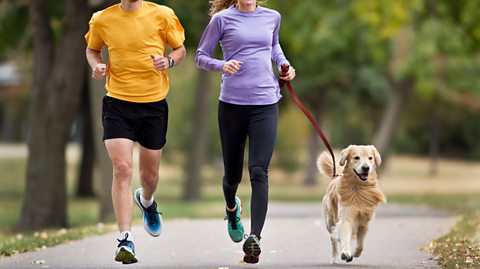
Well done, you’re ready to run! Make sure to work at your dog’s pace and not push them (or yourself) too hard. Here are the steps to jog with your dog:
After warming up, get your dog to heel
Choose a command such as ‘Start!’ or ‘Go!’ to signal to your dog that you’re both going to run
Say this command and pick up the pace. If your dog bolts ahead as you start to jog, tell them to stop and bring them back to your side. Walk a little and then try again
Once your dog understands they have to stay by you, jog for 20-30 seconds then tell them to slow down and stop. Give them a treat and lots of praise
Repeat a few times in short bursts with walking intervals, increasing the time running little by little
Make sure you cool you and your dog down too, don't just finish. Slow down gradually and do some gentle walking as their breathing rate returns to normal, as this will help prevent injury and muscle soreness in you both
Train little and often and remember to enforce good habits!
Tip: If you clicker train your dog, this can be really useful to help them understand when they’re running correctly, as you can use the clicker to reward them mid-run.
Jo reminds us to think of your running companion at all times: “Start with just a few minutes and build your pace together gradually as you learn together. Dogs find us running super exciting and are likely to end up doing zoomies or jumping up at you if you rush it.”
Remember to be patient with yourself as well as your dog - you’re learning together. Above all, have fun with your pet as you complete your Couch to 5K challenge!
How to create a bullet journal to help you reach your goals
Louise Chai shares the steps to starting a bullet journal to reach your goals.

The Couch to 5K number crunch quiz
Test your knowledge of distance, speed and time equations.
How to make the perfect study station at home
Studying at home might seem frustrating at first, but we're here to help.