Ffocws dysgu
Dysga sut i dreiglo’n gywir yn arbennig ar ôl y rhan fwyaf o’r rhagenwau, ee dy fam.
Mae'r wers hon yn cynnwys:
- pedwar gweithgaredd
Learning focus
Learn how to mutate correctly, especially after most pronouns, eg dy fam.
This lesson includes:
- four activities
For an English version of this lesson, scroll below.

Y treiglad meddal
Mae treiglo yn bwysig iawn er mwyn gallu siarad ac ysgrifennu’n gywir yn Gymraeg.
Y treiglad mwyaf cyffredin yw’r treiglad meddal.
Dyma dabl o’r llythrennau sy’n treiglo'n feddal a’r newid sy’n cymryd lle.
| Llythyren | Treiglad meddal | ||
|---|---|---|---|
| p | > | b | |
| t | > | d | |
| c | > | g | |
| b | > | f | |
| d | > | dd | |
| g | > | - | |
| ll | > | l | |
| m | > | f | |
| rh | > | r |

Gweithgaredd 1
Eisiau help i gofio treiglo’n feddal?
Edrycha ar y frawddeg yma:
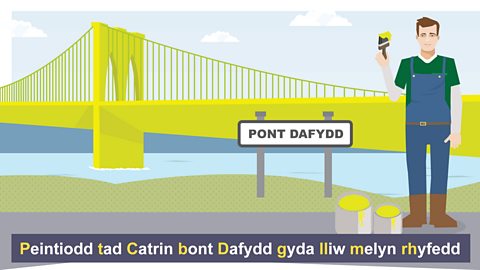
__P__eintiodd __t__ad __C__atrin __b__ont __D__afydd __g__yda __ll__iw __m__elyn __rh__yfedd.
Llythyren gyntaf pob gair yn y frawddeg yma yw'r naw llythyren sy'n gallu treiglo'n feddal.
Dysga a chofia'r frawddeg yma i dy helpu gyda'r treiglad meddal.
Beth am greu dy dabl dy hun sy'n dangos y llythrennau sy'n treiglo'n feddal, a'r newid sy'n cymryd lle?
Pryd i dreiglo?
Mae nifer fawr o reolau ar gyfer pryd i ddefnyddio’r treiglad meddal. Un o'r rheolau yw bod angen treiglad meddal ar ôl dau o'r rhagenwau, sef:
- dy
- ei (gwrywaidd)
Beth yw rhagenw?
Yn syml, gair sy'n cyfeirio at berson yw rhagenw.
Mae rhagenw yn cael ei ddefnyddio yn lle enw wrth gyfeirio at berson, er enghraifft 'fi', 'fy', 'chi', 'eich', 'ni', 'ein' ac yn y blaen.
Yn Saesneg, rhain yw geiriau megis I, me, my, you, your, we, us, our ac yn y blaen.
Mae'r tabl yn dangos y rhagenwau dibynnol Cymraeg a'r person maen nhw'n cyfeirio atyn nhw.
| Unigol | Lluosog | |
|---|---|---|
| Person cyntaf | Fy | Ein |
| Ail berson | Dy | Eich |
| Trydydd person | Ei (g) / Ei (b) | Eu |
Rhagenwau'r ail berson
Edrycha ar y tabl rhagenwau eto. Wyt ti'n gallu gweld bod dau ragenw ar gyfer yr ail berson? Rhain yw:
- ‘dy’ - unigol (your wrth gyfeirio at un person yn Saesneg)
- ‘eich’ - lluosog (your wrth gyfeirio at fwy nag un person yn Saesneg)
Mae’n rhaid defnyddio'r treiglad meddal ar ôl ‘dy’.
Does dim angen i ti dreiglo ar ôl ‘eich’.
Enghreifftiau - ail berson
Edrycha ar yr enghreifftiau isod. Wyt ti'n gallu gweld sut mae'r geiriau yn treiglo'n feddal ar ôl 'dy', ond bod dim treiglad ar ôl 'eich'?
tad > dy dad di
tad > eich tad chi
mam > dy fam di
mam > eich mam chi
ci > dy gi di
ci > eich ci chi
gweld > dy weld di
gweld > eich gweld chi
Gweithgaredd 2
Cywira’r canlynol:
- dy cefn
- dy cot
- dy bag
- dy llyfrau
- dy llaw
- dy esgidiau
- dy gwefus
- dy trwyn
- dy pen
- dy maneg
Gweithgaredd 3
Beth sydd o’i le yn y brawddegau yma? Wyt ti'n gallu eu cywiro nhw?
- Mae dy brawd yn olygus iawn.
- Mae eich fam yn garedig.
- Roedd eich fab yn gas i mi.
- Cafodd dy tad gar newydd.
- Cawsoch eich fwyd yn hwyr.
Rhagenwau'r trydydd person
Mae dau air yn y blwch unigol trydydd person, sydd wedi eu sillafu yr un fath:
- ei (g) - Ystyr 'ei (g)' yw his yn Saesneg. Mae'r (g) sy'n ymddangos ar ôl 'ei' yn sefyll am y gair 'gwrywaidd'.
- ei (b) - Ystyr 'ei (b)' yw her. Mae'r (b) yn sefyll am y gair 'benywaidd'.
Mae’n rhaid defnyddio'r treiglad meddal ar ôl ‘ei (g)’.
Mae 'ei (b)' yn cael ei ddilyn gan dreiglad gwahanol o'r enw'r treiglad llaes.
Enghreifftiau - trydydd person unigol (gwrywaidd)
tad > ei dad ef/o
mam > ei fam ef/o
ci > ei gi ef/o
gweld > ei weld ef/o
Trydydd person lluosog
Mae sillafiad y rhagenw trydydd person lluosog - 'eu' - ychydig yn wahanol.
Ystyr 'eu' yw their yn Saesneg.
Does dim angen treiglad meddal ar ôl 'eu'.
Gweithgaredd 4
Darllena’r disgrifiad canlynol am fachgen o’r enw Siôn. Mae pump o wallau yn y paragraff.
Chwilia am y gwallau treiglo - cofia fod ‘ei’ gwrywaidd yn achosi treiglad meddal.
Ysgrifenna'r paragraff cywir yn llawn ar bapur neu yn ddigidol ac wedyn gallet ti uwcholeuo neu danlinellu'r gwallau mewn lliw gwahanol.
Edrychai Siôn yn od o’i pen i’w draed. Roedd ei gwallt yn bentwr o gyrls sinsir, ei trwyn yn hir ac yn bigog, ei crys yn smotiau llachar a throwsus gwyrdd. Gwisgai esgidiau a oedd yn rhy fawr iddo, ac roedd ei cerddediad yn gam. Edrychai fel person o blaned arall!
The soft mutation
Mutations are very important in order to speak and write correctly in Welsh.
The most common mutation is the soft mutation - the treiglad meddal.
Here’s a table of the letters that mutate softly and the changes that take place.
| Letter | Soft mutation | ||
|---|---|---|---|
| p | > | b | |
| t | > | d | |
| c | > | g | |
| b | > | f | |
| d | > | dd | |
| g | > | - | |
| ll | > | l | |
| m | > | f | |
| rh | > | r |
Activity 1
Need help to remember the soft mutation?
Look at this sentence, where the first letter of each word shows the nine letters that can take a soft mutation:
__P__eintiodd __t__ad __C__atrin __b__ont __D__afydd __g__yda __ll__iw __m__elyn __rh__yfedd.
(Catrin's father painted Dafydd's bridge with a strange yellow colour.)
Learn the sentence and remember it to help you with the soft mutation.
How about creating your own table showing the letters that take the soft mutation, together with the changes that take place?
When to mutate?
There are many rules about when to use the soft mutation. One of the rules is that a soft mutation is needed after two of the pronouns:
- dy - your
- ei (masculine) - his
What is a pronoun?
In simple terms, a pronoun is a word referring to a person.
Pronouns are words used instead of names when referring to a person, for example 'I', 'me', ‘my', 'you', 'your', 'we', 'us', 'our' and so on.
The table shows the Welsh possessive pronouns and the person they are referring to.
| Singular | Plural | |
|---|---|---|
| First person | Fy | Ein |
| Second person | Dy | Eich |
| Third person | Ei (m) / Ei (f) | Eu |
Second person pronouns
Look at the table of pronouns again. Can you see there are two pronouns for the second person? These are:
- ‘dy’ - singular ('your' when referring to one person in English)
- ‘eich’ - plural ('your' when referring to more than one person in English)
You have to use the soft mutation after ‘dy’.
You don’t need to mutate after ‘eich’.
Examples – second person
Look at the examples below. Can you see how the words mutate softly after ‘dy’, but don’t mutate after ‘eich’?
- tad > dy dad di (father > your father - singular)
- tad > eich tad chi (father > your father - plural)
- mam > dy fam di (mother > your mother - singular)
- mam > eich mam chi (mother > your mother - plural)
- ci > dy gi di (dog > your dog - singular)
- ci > eich ci chi (dog > your dog - plural)
- gweld > dy weld di (to see > to see you - singular)
- gweld > eich gweld chi (to see > to see you - plural)
Activity 2
Correct the following:
- dy cefn
- dy cot
- dy bag
- dy llyfrau
- dy llaw
- dy esgidiau
- dy gwefus
- dy trwyn
- dy pen
- dy maneg
Activity 3
What is wrong with these sentences? Can you correct them?
- Mae dy brawd yn olygus iawn.
- Mae eich fam yn garedig.
- Roedd eich fab yn gas i mi.
- Cafodd dy tad gar newydd.
- Cawsoch eich fwyd yn hwyr.
Third person pronouns
There are two words in the third person singular box which have the same spelling:
- ei (m) - This is the equivalent of 'his' in English. The (g) that appears after the 'ei' stands for 'gwrywaidd’. We use (m) in English which stands for 'masculine’.
- ei (f) - This is the equivalent of 'her' in English. The (b) that appears after the 'ei' stands for 'benywaidd’. We use (f) in English which stands for 'feminine’.
Examples - third person (masculine)
- tad > ei dad ef/o (father > his father)
- mam > ei fam ef/o (mother > his mother)
- ci > ei gi ef/o (dog > his dog)
- gweld > ei weld ef/o (to see > to see him)
Third person plural
The spelling of the third person plural pronoun - ‘eu’ - is slightly different.
'Eu' means 'their'.
There is no soft mutation after ‘eu’.
Activity 4
Read the description below about a boy called Siôn. There are five errors in the paragraph.
Look for the mutation errors - remember that 'ei (g)' causes a soft mutation.
Write the correct paragraph out in full on paper or digitally. You could then highlight or underline the corrections in a different colour.
Edrychai Siôn yn od o’i pen i’w draed. Roedd ei gwallt yn bentwr o gyrls sinsir, ei trwyn yn hir ac yn bigog, ei crys yn smotiau llachar a throwsus gwyrdd. Gwisgai esgidiau a oedd yn rhy fawr iddo, ac roedd ei cerddediad yn gam. Edrychai fel person o blaned arall!
Hafan BBC Bitesize
Gwyddoniaeth, Saesneg, Hanes a mwy - mae popeth yma i ti
Cynnwys y tymor hwn
Fideos, cwisiau a gweithgareddau i dy gefnogi yn ystod y tymor hwn

TGAU
Canllawiau dysgu i'r rhai ym mlwyddyn 10 ac 11