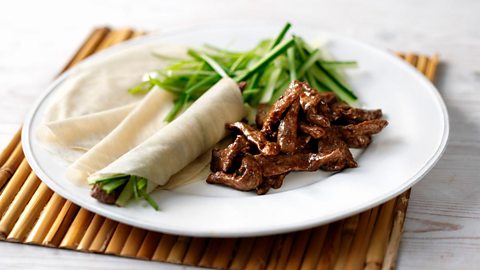
Chinese New Year (or Lunar New Year, as it’s sometimes called) will begin on 25 January 2020.
It’s the year of the rat, the first animal in the Chinese zodiac, and with it come fresh starts and new beginnings.
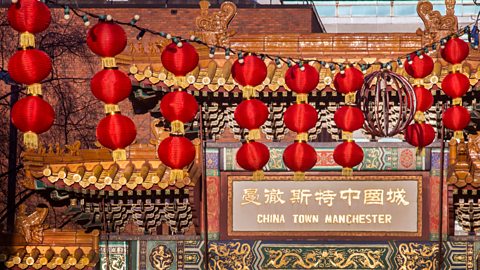
If you live in a big UK city, it’s likely the celebrations will be hard to miss. You might spot red lanterns hanging from trees, images of rats, and preparations for a big dragon parade.
It’s one of the most important festivals of the year in China, so what it is like to celebrate it from the other side of the world?
‘Like a bit of home’
There is a big Chinese population in the UK. For example, 120,000 Chinese students study at UK universities, meaning our unis host more students from China than any other country in the world.
From the 1940s onwards, there was substantial Chinese immigration to the UK too, so multiple generations of Chinese families now live all over the UK.
Manchester has the second largest community outside of London. The city’s Chinese Centre of Contemporary Art (CFCCA) works to connect that community to the city by displaying and promoting modern Chinese art and artists.
We asked Tiffany, a curator at the CFCCA from Hong Kong – the former British colony that’s governed separately from the Chinese mainland – about how she normally spends the festival if she’s not back home: “I sit around,” she said, “being homesick!”
Tiffany explained in Hong Kong, the evening before the first day of New Year, families normally hold a big reunion dinner, a bit like many UK households do on Christmas Day: “You go back to your family and you have a big meal, we tend to have more elaborate dishes… you could have red lighting and decorations.”
On the first day of the New Year, Tiffany said the tradition in Hong Kong is to visit your closest relatives: “I would go to my grandparent’s and pay a visit and say our blessings, then we receive these red packets with money in them, we’d eat sweets, sometimes we’d wear traditional Chinese clothing.” The ‘red packets’ are traditional red envelopes filled with money that married couples or the elderly give to children or younger generations.
But, while it can be hard to be far from loved ones and not experience celebrations on the same scale as back home, Tiffany says she’s felt the impact of the increased popularity of the festival in the UK: “Every year people are getting more involved, and you can see the decorations everywhere, like the dragon.
“It’s kind of like having a bit of home.”
The traditions
Food is a massive part of Chinese New Year, and having a large meal with friends is one of the things that Tiffany does to celebrate in the UK.
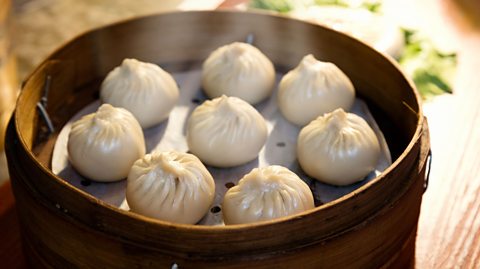
In China, although cuisine varies in different parts of the country and different families will have their own unique traditions, there are some foods that are commonly eaten at New Year. These include:
- Spring rolls - so named because Chinese New Year celebrates the arrival of spring
- Dumplings - these delicious treats are more commonly eaten for New Year in northern China. Some people even put a coin in one, and whoever eats it is said to have good luck for the year, kind of like a Christmas pudding
- Fish - this is because the word for fish (鱼 pronounced yú) and surplus sound very similar in Chinese.
A big part of the celebrations also includes decorating the house in red and gold. The colours symbolise luck and prosperity respectively, as a wish for the year to come.
The colour red comes from a myth about a monster called Nian. It supposedly used to terrorise people every year, until it was discovered he was afraid of fire, loud noise and the colour red, and so was defeated. This is also part of the reason you’ll see fireworks displays.
Superstitions have a part to play at New Year too - for example, it's thought that you shouldn't sweep the house for the first two days of the holiday, as you'll get rid of any potential good luck you had lying around.
Finally, in one of the more bizarre quirks, if it's your animal's year, it's thought you should wear red underwear every day of the year to ensure good luck. If your birthday fell in a year of the rat, it's time to get shopping!
Passing on heritage
The CFCCA’s CEO, Zoe Dunbar, told us Manchester’s community is a rich mix of different ages and people from across China, and the New Year festival is a great opportunity to celebrate its traditions and share them with others with workshops, exhibitions and family events.
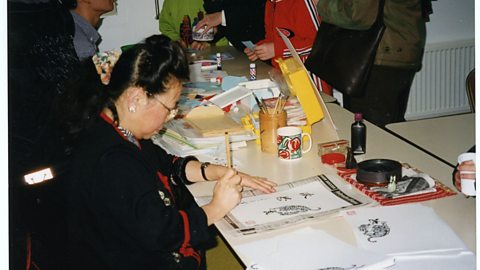 Image source, CFCCA Archive & Library
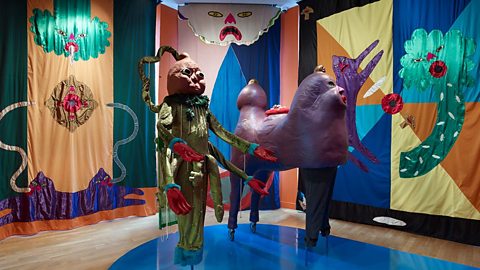 Image source, Michael Pollard
From the CFCCA’s point of view, art can be a great tool to help people understand Chinese culture, but also what it’s like to be Chinese and live in the UK. Zoe said: “I do think art making and that artist’s perception of specific cultural heritage, it’s an easy 'in' to understanding what the community’s about.”
By displaying contemporary art, they give an insight into what modern China is like, which can starkly differ from the traditional imagery we see at this time of year. But that doesn’t mean that the younger generation doesn’t take pride in their heritage – Zoe explained that young people and artists she speak to are in general “really happy that their culture is being reflected”.
Sharing and taking pride in Chinese traditions and culture is particularly important for the older members of the community: “I think there’s this real desire to pass on their heritage to other generations, whether that be within their own community or wider than that, to pass on their story,” Zoe said.
“I think Chinese New Year is a really important vehicle to be able to do that.”
But it works two ways: “On the other side there’s a real intrigue from the general UK public to learn more about China and what it’s about, as it grows economically and generally will have an impact on everybody’s lives.”
Image source, Michael PollardWhy a pig is the last animal in the Chinese Zodiac
The great race which decided the order of the different years.
Chinese recipes
Cook your own Chinese New Year feast with BBC Food.