Curiosity and science are eternally linked.
It could be a fascination with a particular branch of the subject, such as chemistry, physics or biology, which makes inquiring minds want to pursue it as career.
The chance of making discoveries that knock your socks off is another reason scientists enjoy their job - which is why Bitesize approached some to find out the facts their research has uncovered which really impresses them.
You may remember these scientists sharing their experiences with us. Here, we bring you some more.
Oil and water CAN mix
From: Dr John Loveday of the School of Physics at University of Edinburgh

We all know they can't mix, but…
Dr Loveday told Bitesize: “We all know that oil and water don’t mix. It is why you have to shake French dressing before you use it.
“The repulsion of water that oils have is what makes the walls of the cells in your body form. It also makes ice cream and mayonnaise have the pleasant feel that they do.”
However, when the oil methane, the natural gas used to cook with or heat our homes, is squeezed to a pressure 13,000 times higher than the atmosphere, it becomes possible to mix it with water.
'Like finding a dinosaur in the New Forest'
Dr Loveday said: “We were doing a routine measurement of something else and instead found that we had broken an important rule of chemistry. Methane and water are common, simple and highly studied things and I was shocked to find that they could do something so weird. It was like finding a dinosaur living in the New Forest.”
Another surprising aspect of this discovery was how the pressure required to make the two mix was, relatively speaking, not great. It is around 10 times the pressure found at the bottom of the ocean.
Dr Loveday added: “While this may seem huge, it isn’t on a global scale. The pressure at the centre of the Earth is five million atmospheres - or 500 times higher.”
The element that can be solid and liquid at the same time
From: Dr Andreas Hermann of the School of Physics and Astronomy at University of Edinburgh

When robots require a quick getaway
You may have seen sci-fi movies where robots can shift from a metal to liquid form, in order to escape pursuers through handy barred windows or grilles.
It was the stuff of fantasy, but now scientists have found a material that mimics this behaviour.
Dr Hermann explained: “The element potassium, when compressed to 300,000 times atmospheric pressure and heated to hundreds of degrees, takes up a new state of matter, the ‘chain melt’, which is roughly three-quarters solid and one-quarter liquid. Described like a sponge soaking up itself, the material would flow through holes or sieves and re-form on the other side.”
Sign of a strange world
“There are several cool aspects to this study.” said Dr Hermann. “Firstly, discovering that matter can take up such a strange state under extreme pressure/temperature conditions was a big surprise. It shows how much our imagination is tied to the conditions around us, and what a strange world is out there.”
Initial tests were carried out on potassium samples in the lab, with the latter part, where the chain-melted state was revealed, being observed through computer simulation. It brings Dr Hermann to another "cool" aspect of the study.
He added: “Secondly, it’s the power of big data in modern science. We used artificial intelligence models to train a computer to ‘learn’ quantum mechanics [by observing potassium atoms] - but without solving the complicated equations. That way we could afford to run the big simulations that proved our new state of matter was real.”
The Earth’s metal core may contain silicon from meteorites
From: Dr Tetsuya Komabayashi of the School of Geosciences at the University of Edinburgh
Between liquid and crust
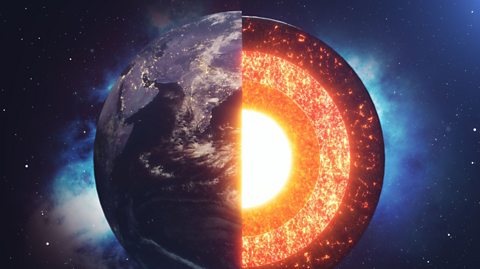
Look at a cross section of the Earth and it’s a bit like a gobstopper, with different and distinct layers around a central core. But despite their difference, new research suggests there may be shared elements between those layers.
A theory has long existed that the interaction between two types of meteorite, one of iron, and another of silicon-rich stone, caught up in a cloud of dust and gas, were responsible for the formation of the planet. Yet despite this colossal, cosmic mixing together, the iron did its own thing and formed the core of the Earth while the stone made up the crust (or mantle), with no shared elements between the two.
But Dr Komabayashi's research shows that both the core and the crust of the planet could actually contain silicon.
He explained: “The outer half of Earth is a rocky mantle and the inner half is a metallic core. The core is further divided into an outer liquid core and inner solid core.
“While its main component is iron-nickel alloy, the core contains a few wt% (weight percent) light impurities because the core is lighter than pure iron. Silicon is among several nominated light elements in the core."
This would come as a surprise to scientists who thought silicon was only found in the mantle of the planet, but further research suggested silicon is one of those detected impurities.
Dr Komabayashi continued: “Laboratory experiments demonstrated that adding 4 wt% silicon to solid iron-nickel crystal made its density match the inner core density, which suggests that silicon would indeed be in the core.”
So if there is silicon within the Earth's core, how did it get there?
The story of a planet
The reason this research is important to Dr Komabayashi is that it tells us, through the impurity elements in the Earth’s core, how our planet was formed.
He said: “We knew that the Earth was formed 4.6 billion years ago from two different types of meteorites: Iron meteorites with no silicon becoming the core and stony meteorites with abundant silicon becoming the mantle.”
It was also thought that the iron meteorites which formed the core and the silicon-rich ones did not mix when the planet was being created.
However, the possible presence of silicon in the Earth’s core now implies that the stony and iron meteorites were interacting with each other in that initial mix, transferring silicon from stone to iron alloy as the Earth was formed.
Dr Komabayashi said: “This tells us that the meteorites were well mixed in the proto Earth and then re-separated into the central core and surrounding mantle.”
If the theory is correct, the silicon didn’t just rise up to the surface, some of it found its way to the heart of the planet as well.
The science behind real life ice magic
Hair ice? Ice pancakes? Diamond dust? Here's the science behind these magical ice phenomena.

Science fiction or science fact?
It's a Bitesize quiz, Captain, but not as we know it...