For every success story on GCSE results day there is always a perceived failure. Not getting what you wanted, expected or felt like you deserved can be really hard.
We've been speaking to clinical psychologist Dr Rebecca Greenaway and Director of Education Policy at the Association of Colleges, Catherine Sezen, about how experiencing set backs could have a really positive effect on you. Here are three lessons we can learn from a musician, an athlete and a scientist – who say their setbacks provided them with an opportunity that later led them to success.

1. Look for the learning
Everyone knows the phrase ‘you win some, you lose some’, but what if it was tweaked to ‘you win some, you learn from some.’? In other words, you can learn from your mistakes.
Popstar and fashion entrepreneur Rihanna put it like this in an interview with the New York Times Style magazine: “How you gonna learn without making mistakes? Did you believe your mom when she said, ‘Don’t touch the iron’?”
Rihanna believes so strongly in learning from her mistakes that she has “Never a failure, always a lesson”, tattooed backwards on her shoulder so she can read it in the mirror.
Catherine Sezen, Director of Education Policy, Association of Colleges applies this approach to exam results.
“If your exams and grades didn’t go to plan, or even if they did, this could be an opportunity to explore a different avenue.” She advises: “Seek out some careers advice; the National Careers Service is one place to start or visit your local college and ask to speak to a careers adviser. There will be a path forward, it just may not be obvious straight away.”
Top tips:
- Accept that you can learn from mistakes
- Take a look at what happened and ask what you could do differently next time.

2. Remember you're building resilience
Sometimes we don’t do anything wrong ourselves but things beyond our control go wrong. Jessica Ennis-Hill is an Olympic and World heptathlon champion but winning gold medals is not easy. As well as training for 6-7 hours a day she overcame injuries that caused her to step away from competition and miss the 2008 Olympics, where she was hoping to win a medal.
Speaking about how she dealt with setbacks Ennis-Hill said, “It's hard when you feel down and you think, 'Why is the world doing this to me?' But you have to pick yourself up again. That's what makes you a better athlete.”
Ennis-Hill is describing resilience, the ability to bounce back from difficulties. Resilience doesn’t mean being tough. It’s about accepting setbacks, finding perspective and getting going again.
“When we have setbacks, we sometimes focus on unhelpful negative thoughts that prevent us from bouncing back,” says Dr Greenaway. “Try to spot unhelpful thoughts and ask yourself questions such as, ‘what is the evidence for that thought?’ Another good trick is to imagine how you will feel about the setback next week, next month or next year. This will help you see the bigger picture” says Dr Greenaway.
Building resilience is something you can learn and is easier to do with the support of friends and family who value and care for you.
Top tips:
- Ask yourself ‘how will I feel about this mistake in the future?’
- Accept that some things you try will be challenging
- Think about who you trust who could support you.

3. Keep trying
If at first you don’t succeed, try, try, try again. Heard this before? This was the approach taken by Nobel Prize winner Saul Perlmutter who made a pretty big mistake at the beginning of his career.
As a young astrophysicist, he and a team of scientists believed they had made an extraordinary discovery. Signals picked up on their telescope indicated they had found a planet outside our solar system, they released a research paper about the new exoplanet. However, the following year the team realised that these signals were in fact coming from the machine next to their telescope and there was no new planet, so they retracted their original research paper.
Perlmutter did not fixate on this set back, however. He continued to study and research, eventually making the monumental discovery that the universe is accelerating faster than ever before and for this he won the Nobel Prize in Physics.
As Dr Radha writes here “We often have a rigid idea of how things ‘should be’ and what we want to happen… The best things often come from the ‘best laid plans’ not working out, but it never feels like that at the time!”
Following that early mistake, Perlmutter could not have known that something even better would happen. But his story shows that by continuing to try, you can achieve success.
Top tips:
- Ask yourself ‘am I fixating on this mistake or thinking what I would do differently?’
- Think about new possibilities based on your learning.
Be kind to yourself
We all make mistakes and get things wrong in our lives more than once. Maybe it’s a wrong answer in a test or a critical error in a sports game. Making mistakes can result in feeling disappointed, or even like we have failed.
“Feeling difficult emotions at these times is to be expected,” says Dr Rebecca Greenaway. “Be kind to yourself and find positive ways to cope like talking to someone you trust or doing something you enjoy. Also, think about what you would say to a friend if they were in the same situation.”
Top tips:
- Remember everyone makes mistakes, it's not just you!
- Think what you would say to a friend in your position.

If you need support
You should always tell someone about the things you’re worried about. You can tell a friend, parent, guardian, teacher, or another trusted adult. If you're struggling with your mental health, going to your GP can be a good place to start to find help. Your GP can let you know what support is available to you, suggest different types of treatment and offer regular check-ups to see how you’re doing.
If you’re in need of in-the-moment support you can contact Childline, where you can speak to a counsellor. Their lines are open 24 hours a day, 7 days a week.
There are more links to helpful organisations on the BBC Bitesize Action Line page for young people.
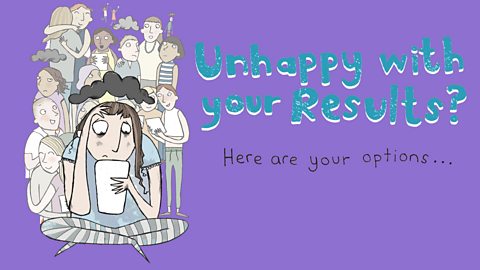
Unhappy with your GCSE or Scottish exam results? Here are your options
Unhappy with your GCSE or SQA results? Here are your options
How to manage anxiety on GCSE or Scottish results day
We look at how to manage your anxiety when it's results day.

How to turn your goals into reality: An A-Z of tips
Achieving your goals can sometimes feel a bit overwhelming, but our 26 handy tips can help you stay on track.