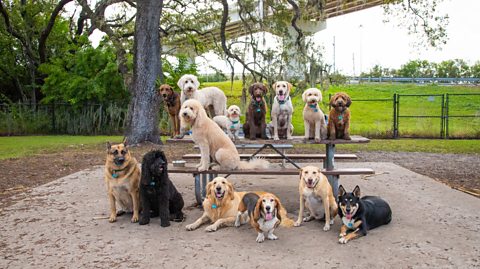
Crufts is one of the biggest dog shows in the world. As the crowds gather in Birmingham there are always tennis balls flying, blow-dryers on the go, and dog treats a plenty.
Around 18,000 dogs take part each year, with their owners all keen to get their hands on the coveted Best in Show trophy.
More than 200 breeds are likely to be represented, from dashing Dachshunds to diminutive Dandie Dinmont Terriers, regal Retrievers to handsome Huskies.
But do you know how different dog breeds are named? It’s often a mixture of history, geography, and modern languages. In this article, BBC Bitesize brings you the stories behind the names of some of the most popular dog breeds.
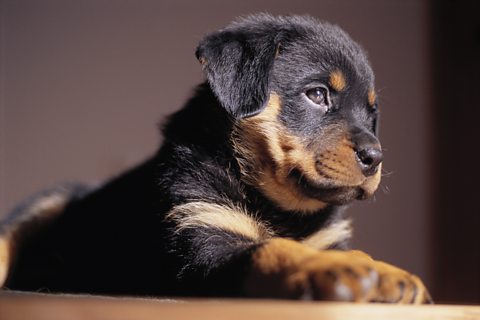
Rottweiler
Going back over 2,000 years when the Romans were setting out on their conquests, they were joined by some impressive and intense looking dogs. Strong, loyal and hard-working, it’s believed these large mastiff-like dogs were used to herd the cattle that the army relied on for food.
As the Roman Empire expanded, it’s said that as the armies moved north they would often stop and settle in an area we now know as Rottweil in Southern Germany. Here, the massive dogs brought by the Romans mixed and bred with smaller, local herding-dogs. Eventually, an entirely new breed of dog came into existence, known locally as the “Rottweiler Metzgerhund” - meaning butcher’s dog of Rottweil.
These dogs were used to herd cattle and pull carts of meat to market. They also often carried cash for the butchers in pouches around their necks.
Over time the need for Rottweilers to help move cattle and meat grew less and less - so much so that the breed nearly disappeared. However, people realised how intelligent and dependable these dogs are, and it wasn’t long before their numbers increased and they were again put to work, this time doing search and rescue, helping the police, and providing a bit of additional security at home.
French Bulldog
This one sounds like it should be straight forward, right? A bulldog from France? Well, the truth is we Brits might need to look a bit closer to home to discover the origin of this playful breed.
During the early 19th Century in Britain, many dogs were bred to take part in some pretty cruel and shocking activities. This included bulldogs who were used for bull baiting, a sport which was eventually outlawed in 1835.
In this period some bulldog breeders looked to breed bigger and heavier dogs, while others looked to develop a smaller, more toy-like version.
These smaller pooches were loved for their kind-hearted nature, in-particular by lace workers in Nottingham. It’s believed the dogs would keep the workers company and keep the mills free of rats!
So why not the “Nottingham bulldog”? Well, as the industrial revolution kicked in, many lace workers emigrated to France, taking their dogs with them. The smaller bulldogs became very popular with the French and soon enough, the Bouledogues Francais (or French Bulldog) was so named. Though it wasn’t until 1906 that The Kennel Club officially recognised the breed.
In more recent times these loveable dogs have hit peak popularity with many celebrities choosing to own them. From Dwayne “The Rock Johnson” to Lady Gaga. In fact, Megan Thee Stallion’s Frenchie, 4oe, has over half a million followers on Instagram. Tres bien!

Who was Jack Russell?
While there might be many Mr Jack Russells living on Earth, the small white and brown dogs we know today as Jack Russell Terriers are descendants of dog breeds developed by the Reverend John Russell, not Jack.
Why is a poodle called a poodle?
Despite the possibility of a whiffy story here, thankfully the answer lies in something somewhat fresher, water. Poodles often have a tremendously well-groomed appearance, but don't let looks deceive you. These fashionable fur-balls were bred in Germany to bring birds and ducks from the water. Their name comes from the German word ‘Pudel’ or ’Pudelin’ which refers to splashing in water.
Whippet
In an article about breeds that regularly appear at Crufts, it would be a mistake not to mention Miuccia. This delightful doggo won ‘Best in Show’ at Crufts in 2025. Hailing from Venice in Italy, she beat over 18,000 dogs from around the world to take the top-spot. If you’re wondering about her breed, she’s a Whippet.
These slender beauties were originally bred in Northern England as a mix developed from Terriers and Greyhounds. Their smaller than Greyhound size meant they were considerably cheaper to look after and were sometimes referred to as “the poor man’s Greyhound”.
The origin of the name ‘Whippet’ is a little unclear though. There are some suggestions that the word came from the term ‘whappet’ which was used to describe a ‘small dog that yelps’. Meanwhile others suggest that the name comes from a now obsolete English word meaning ‘to move briskly’.
And move briskly these dogs can! Whippets can reach speeds of up to 35mph. Although that doesn't quite make them the fastest dog at top speed, that record belongs to the Greyhound. Whippets are considered the fastest accelerating dogs in the world though, meaning they might actually beat a greyhound in a short race. But it’s worth pointing out that Whippets are equally happy having a chilled-out time on the couch.
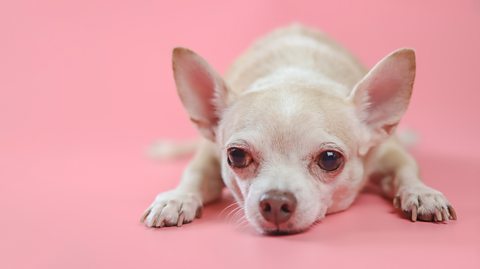
Chihuahua
Finally, we’re turning our attention from one of the fastest dog breeds to quite possibly the smallest…the Chihuahua.
These somewhat quirky and energetic dogs are bold and confident. What they lack in stature they make up for in attitude.
There is plenty of debate and mystery about the exact origin of these dogs. Some research points to Chinese ancestry, other work suggests they are Egyptian or Mexican. It’s little wonder that the American Kennel Club claims that the origin of the Chihuahua is “one of the world’s biggest puzzles".
However, one thing is for sure and that’s where these dogs got their breed name, that comes from the Mexican state of Chihuahua. It was here, in the 19th Century, where American tourists first came across the breed. Some were then taken back across the border where the Chihuahua as we know it was developed. The breed was formally recognised in 1904.
Where is Saint Bernard?
Saint Bernards are gentle giants, and the national dog of Switzerland. They are named after a monk who formed a hospice to care for travellers on the dangerous alpine routes in the Swiss Alps. For a long time, the dogs themselves provided rescue assistance in the same area.
Who is Dandie Dinmont?
The Dandie Dinmont Terrier doesn’t share its name with an actual person, but a fictional character instead! The character (Dandie Dinmont) is a farmer who features in Walter Scott’s 1815 novel Guy Mannering.
This article was published in March 2026
Dogs with jobs: Four paw-fessions for a human’s best friend
What does the modern working dog do? Here are four awesome paw-fessions suited for the fast and the furriest.
How were our favourite animals domesticated? A brief history of pets
BBC Bitesize takes a look at how our favourite animals became pets over the years.
What makes the bond with our pets so special?
BBC Bitesize spoke to Nat O’Leary, Owain Wyn Evans and Lauren Layfield to find out what they love about their pets.