Walk around any town or city for long enough and you’ll quickly spot that buildings come in all sorts of shapes, sizes and styles.
But take a closer look and you’ll start to notice that buildings from similar periods of history often share characteristics and features — they belong to the same architectural style. Once you know what to look for, naming their architectural style becomes much easier.
You might think you don't know much about architecture but you'd be surprised. BBC Bitesize will have you sounding like an expert in no time!
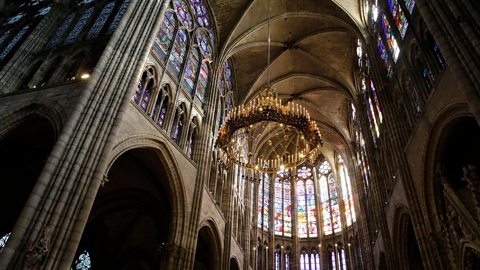 Image source, Godong
Gothic
Right across Europe, from the mid-12th to 16th Centuries, the majestic spires of cathedrals and churches began to rise higher and higher while their appearance became increasingly ornate. Thanks to advances in engineering, a new Gothic style was beginning to develop.
The use of architectural features such as An arch built against the outside of a building to help provide additional support., A vaulted roof which is supported by arches or ribs in a diagonal pattern. and pointed arches allowed for larger buildings to be built with greater space inside. Sculptures and gargoyles often decorated the outside of the building, sometimes doubling up as water spouts.
Large stained glass windows were another major feature, helping to bring in more light. To support the weight of the glass, thin stone bars known as tracery were used to divide the glass into different sections. This tracery could be highly decorative, creating flowing and twisting lines or the shape of a flower.
In Britain, the Gothic style was revived in the 18th Century, predominantly for churches and university buildings.
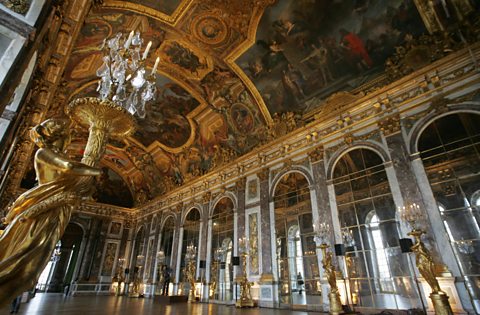 Image source, FRANCOIS GUILLOT
Baroque
Originating in 17th Century Italy, the Baroque style is incredibly ornate and ostentatious. There’s lots of gold A type of decoration where a very thin layer of material, such as gold leaf, is applied to a surface., dramatic paintings (often on the ceiling) and a general sense of grandeur.
Baroque architecture is closely entwined with the Counter-Reformation, an effort by the Catholic Church to respond to the rising challenge of Protestantism across Europe. Church leaders used things like architecture as a way of displaying their power, wealth and strength, as well as provoking an emotional response in the worshipper.
Common features of this very theatrical architectural style include strong contrasts of light and dark, bright colours, curves, large domes and A realistic art technique which gives paintings the illusion of being three-dimensional.. In paintings, figures would often appear to be caught in motion.
You may also see the Late Baroque period referred to as Rococo.
Image source, FRANCOIS GUILLOT Image source, Murat Taner
Neoclassical
Following significant archaeological discoveries at the ancient sites of Pompeii and Herculaneum in Italy during the 18th Century, there was a reignited interest in the architecture of the Greeks and Romans. Neoclassicism was a way of emulating their style.
Neoclassical architecture offers a complete contrast to the opulence of Baroque. Instead of bright colours and extensive decoration, neoclassical architecture focuses on symmetry, straight lines and flat surfaces. As a style, it was frequently used for government or institutional buildings.
Neoclassical buildings tend to be large in scale and a square or rectangle shape, with striking columns, typically in the Doric style. This means that they have little decoration beyond a series of parallel grooves carved into the surface.
Examples of neoclassical architecture in the UK include the western front of Buckingham Palace, the Chapel of St Peter and Paul at Greenwich's Old Naval College and Liverpool's St George's Hall.
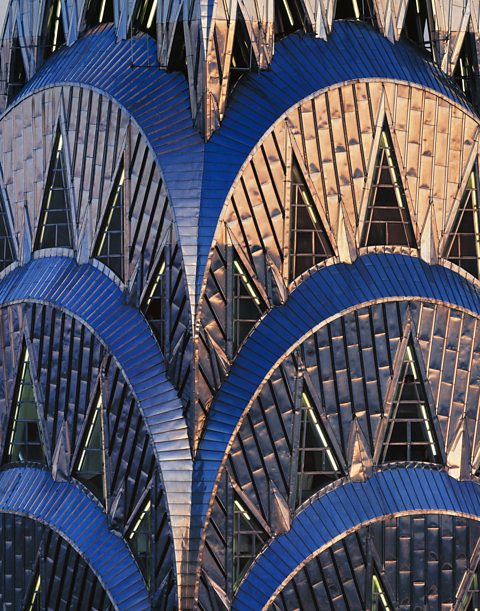 Image source, George Hammerstein
Art Deco
The term Art Deco stands for for Arts Decoratifs and comes from the Exposition Internationale des Arts Décoratifs et Industriels Modernes (International Exhibition of Modern and Industrial Decorative Arts), which was held in Paris in 1925.
Art Deco architecture focuses on geometric shapes (pyramids, chevrons, sunrays etc.), symmetry and an overall streamlined appearance. Typically both the interior and exterior of the building would follow a similar design, giving a sense of cohesion. Inside, bold colours would be contrasted against black or metallic detailing.
As industrial manufacturing developed further, Art Deco buildings made greater use of materials like concrete and stainless steel.
This style was supposed to project a sense of wealth, glamour and modernity, and so was frequently used on buildings and vehicles associated with the A period in the early 20th Century when new technology was being developed and manufactured.. These included cinemas, department stores and ocean liners.
Image source, George Hammerstein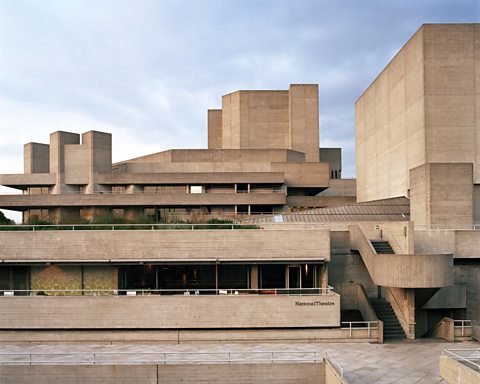 Image source, shomos uddin
Brutalism
The term Brutalism might evoke words like ‘brutal’, but it actually comes from the unfinished concrete used in so many buildings of this style. Béton brut is French for ‘raw concrete’, which evolved into the Brutalism label.
Brutalism began to gain in popularity during the 1950s and 1960s as countries began vast rebuilding projects following World War Two. Concrete was cheap and so an ideal material to work with.
Within Brutalism, the emphasis is on minimalism, the texture of the materials used and how the building is constructed. There is little additional decoration beyond the impactful shape of the structure, which is often modular and monochromatic in appearance.
There are many examples of public or institutional Brutalist buildings in the UK, and also a number of well-known Brutalist high-rise residential buildings, such as the Barbican Estate in London.
This article was published in April 2022.
Art styles you didn't know you knew
We bet you know more about art than you think you know.

10 pieces of classical music you didn't know you knew
Classical music is everywhere in pop culture if you look hard enough.

The Seven Wonders of the World quiz
From the ancient to the modern, how much do you know about these famous landmarks?