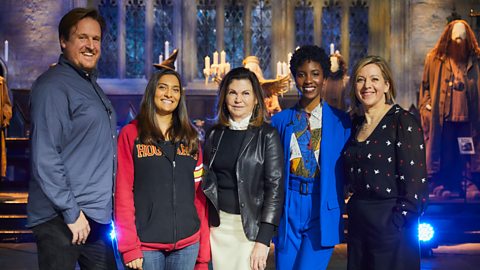
BBC The Social is a digital platform based in Glasgow that develops new talent from across Scotland – but what's it like to work there?
The Young Reporter team went behind the scenes of some popular BBC brands to find out which jobs go into making hit content.
From production management assistant to presenter, join us for a sneak peek at some of the roles on The Social.
Rachael McDonald, production management assistant
It's normally the production management that are the first in and the last out on any production. So I really enjoy seeing a project through from start to finish.
Rachael's top tip
Take a chance on yourself. If you're interested in a role and passionate about it, take a chance on applying.
My name's Rachael. I'm the production management assistant on BBC 'The Social'.
So, I do a lot of organisation for the team. There's times where I'll be booking kit, booking flights, accommodation, car hire. It's sortof, kind of admin-y sometimes, but this job has a unique element where there is an element of editorial to it where I can go throughthe applicants for The Social and help the producers decide which ones we should move forward with. Every day's an experience!
It's been a while since I was in school, but when I was in high school, my favourite subject was English. Putting my words downon paper was always something that really appealed to me. Also with those subjects you have to be really organised, but you haveyour beginning, your middle and your end of everything and it's the same in production.
So, I went to university when I left high school. I went to study Psychology and absolutely hated it. So, I left and spent a couple ofyears working, doing loads of different jobs. It was good at the time, but it wasn't what I wanted to do. And then one day I decidedI'm going to apply for the BBC production apprenticeship. I've got nothing to lose. I might as well apply. And then all of a sudden, Ihad something to lose because I got to the interview stage. And then I've not left! It's a good way to get your foot in the door.
My favourite thing about the job is I get to talk to a lot of different people and I love when things all come together. Because of thenature of my job, I start off at the start of the production and I stay behind it. It's normally the production management that are thefirst in and the last out on any production, so I really enjoy seeing the project through from start to finish. Because of the nature ofthe job and the fact that no two days are the same, everything changes every single day.
For this role, the best things are that you can be passionate about it because the team are relying on you to get things done for them, so you need to be passionate about what you do. You have to be really organised and it would help to be a people person because I spend all my day talking to lots of different people about lots of different things. I'm contacting suppliers, hirers, talent and talking to senior management all the time. So, it's really important that I know how to get on with people and how to talk to them.
When I was in school, it was you went to college or you went to uni. That was it. So, for me there was no other options at the time. But, as I've got older, I've realised that there are other options. So, I'd just say, take a chance on yourself and if you are even remotely interested, apply for jobs. There's loads of brilliant industries out there. Apply for it, take a chance and be passionate about what you think you're wanting to do. It's a really rewarding industry and nothing beats seeing your name up on the credits at the end of a production. It's always nice to see and gives you something to show for it.

Darren Dowling, presenter 'Get Battered'
I grew up in council houses all my life and now do stuff for the BBC… you don't need to be the person that you'd think you need to be, if that makes sense, to work at the BBC.
Darren's top tip
Be nice to everyone that you meet. Don't expect everything to happen straight off – you'll need to work hard but that hard work will pay off.
Hello, my name is Darren and I work in the social media team at STV but you also might know me on The Social going aroundScotland trying chippies and reviewing them.
"My name's Dazza, and I am a fish supper expert. Growing up, I survived on two things and two things alone. One: oxygen. And two: fish suppers."
So, in primary school, I actually had quite a rough time in primary school. I went to seven different primary schools because I hadquite a lot of behavioural problems. And then I went to a behavioural school that kind of straightened me out a bit and then when I went to secondary school, I'm not gonna pretend I enjoyed every bit of it because it's school, but at the same time it was quiteenjoyable. I preferred the practical subjects in school a lot more because with Maths and English or them kind of things I wasn't tookeen on because I didn't really get it, but stuff like woodwork and computing and home economics, I mean I still didn't do very well,but I enjoyed it a lot better.
So, the way that I got into The Social was my pal had applied to the work experience programme and he got in. And I had then been speaking to my pal like "Are you enjoying it?" and he was like "Well, aye. I spoke to somebody at The Social, they're looking for people to make content." That isn't the only way into The Social by the way. It's not just oh you know this person – it's really not a person's game. It's more like if you can make content or if you know what you want to make, then literally just apply. It's as simple as that. There's an application, type it into Google and it will pop up. I think The Social is probably the best way to get into the BBC, in Scotland anyway.
I grew up in council houses all my life and now do stuff for the BBC and I work for STV which is just down the road as well. You don't need to be the person that you think that you'd need to be, if that make sense, to work in the BBC.
"You can just hear the crisps, listen."
I think the reason that 'Get Battered' works is that, on paper, it's a guy going about reviewing chippies and it's quite daft. But, if youactually think about it, it's a format that really works because everybody's got their favourite chippy. Like every single person hasgot an opinion on their favourite fish and chips somewhere, anywhere. So, I think I would never look at an idea and go "that'snever going to work, that's rubbish". Try it. Just try it once and if it completely fails, it's fine, it was only a day of wasted time. But, if it actually does work, you might have something really good that can then follow up and forward and into something that is a decent idea.
"I'm going to give this fish a rating. A fishy seven."
"As you can see as the sun glistens through this golden brown chip, that's what I look for in a chip."
So, a normal day filming 'Get Battered' is long, nothing happens like that, it takes a long time. So, usually pre-stuff is what Holdenhas done. So he would contact the chippy, get all the consent forms filled out, get times arranged, all that kind of stuff. And we would then go to the chippy, we would film all the establishing shots like the food getting cooked, all that kind of stuff. And then we would go back out, film me ordering at the chippy, go back in, film that getting cooked as well as some more establishing shots if we still need it. And then we go and find a bench somewhere in whatever location. And then, after all that's done, it then goes back and it needs to be edited up which doesn't take as long as you would think because it's not really that long a video. It'll be about three or four minutes but the actual recorded footage would be about twenty, twenty-five minutes total and then you just cut that down. I think my best tip for getting into the industry is be nice to everybody that you meet and don't think that everything is just gonna happen just like that as well. It isn't as easy as just walking in the door with a good idea and that's it, you're sorted. You will need to work hard, but if you do work hard it will eventually pay off no matter how much it seems that it won't.
Olivia Topalian, contributor
You have to be able to collaborate quite well and take on things that people have said to you might work.
Olivia's top tip
Learn from the videos you make. Looks at the analytics, think about what's catching people's eye and how you can capture their attention in the first three seconds of your content. Really practise your craft.
Hello, my name's Olivia Topalian and I'm a content contributor for The Social and BBC Short Stuff.
So, I did Higher English, Higher Art, which went on to Advanced Higher Art, Higher Modern Studies and Intermediate 2 Biology which I wasn't very good at. But when I first started school I was very, very quiet and then I didn't really fit in the same, I had this really big side fringe and really heavy eyeliner and it just wasn't really for me. And then by my fourth year, my mum enrolled me into a drama class in the city centre, so I not only got into the way of performing, but I also got a lot of friends out of it from all different areas of Glasgow, so I wasn't on my own any more. But I really enjoyed Art, I really enjoyed English and those were the two main things I needed for art school, for essay writing and also for practical work as well. So, it was it was quite good the way it worked out.
So, at the end of my third year of art school, it was coming up to the summer holidays before I went into fourth year and I thought Ireally need to get a job. So, I went for an interview at a retail company and was about to leave for it, but I was ready too early toleave the house, I was kind of nervous, so I thought OK, what can I do in this spare bit of time and I thought I'll make a TikTokaccount. So, I put up six videos or something, I went to town on it, and I'd put up a few, and I came back out of the interview and I had I notifications of people liking it and it was just that kind of dopamine rush of oh people are liking this and that got me into making TikTok videos and then after a few months of that I was able to contact The Social and say I'd really like to work with you.
"Right, and she's the mum? Nope she's the aunt. So, she's having the affair with… No? Nope, oh OK. Can we pause it cos I'm kind of lost."
"I can't touch the remote, I've got crisp dust."
So, I'll come up with an idea. I'll write a script for it. I'll send it on to my content producer. He'll give me feedback on it and saywhether or not he thinks there are more jokes that are needed or something that needs taking out, something that needs putting in. We'll work on that. And then I go ahead and self shoot. So, because we're in a moment of pandemic, I self shoot and edit in my own home and then pass it on to him, he passes that on to the editor and then they do subtitles and things and then that's it up.
It's back and forward and you have to be able to collaborate with people quite well and take on ideas that people have said to you itmight work and then you can say to them oh actually I want that changed. It's a quite a to and fro thing whereas with TikTok it's allyour own stuff, things that a spare that I think can't use it for social, can't use it for Short Stuff, so I'll put it on to TikTok instead.
I think going out and making a video is one thing. But learning from the video, you know, looking at the performance, looking atanalytics on social media, looking at what people like, what is relevant at the moment, what will catch people's eye. Can you startwith something that within the first three seconds you've got an audience hooked? Practising at something and wanting to improve at it and taking the time to learn how to do those kinds of things, but put it into yourself and you'll find that it will pay off. The hardwork definitely does.
Roisin Kelly, researcher
If you're somebody who's not got into uni or not got the grades you wanted, don't let it put you off because there are a million other ways you can get into doing something like this.
Roisin's top tip
Get started on trying to build up experience relating to media and the creative industries. You don't need loads of fancy equipment or to be working for an official production – there's loads you can teach yourself from tutorials online or through making your own content for social media.
My name's Roisin. I am a researcher for BBC The Social and we're here at Pacific Quay in Glasgow.
I had to work really hard when I was at school to stay afloat because a lot of the subjects didn't come automatically to me, shallwe say. But I liked English, and I liked Media and I did not like Maths and I never passed it.
I applied for a production apprenticeship when I had just left school and I had got to the final round of interviews and I was really sure I was going to get it, and I got the phone call and I didn't get it. So, that was a bit rubbish. And then I decided that I would go to college for a year and a did a HNC in practical journalism and I thought I'll apply again to the BBC. So, I applied for the same production apprenticeship scheme and then I got in. And after that one of the departments I worked and was The Social so then I ended up with a job here.
The Social helps new talent, whether that be in writing, or making like, shooting videos or scripting comedy videos. They help newtalent in Scotland. So, as a video editor what I would do is, I edit videos that contributors send in. That could be comedy sketches. It could be videos on wild swimming in Scotland. It literally can be anything which is good because it keeps me excited.
As well as having an eye for detail, I think people skills are really important in this job and most jobs to be honest. I think you need to be quite encouraging when you're giving contributors feedback. Also I think being able to work in a team is crucial when you'redoing this because I work closely with our producer. My producer will tell me, basically, what to do. What videos to edit. They mighthave ideas for the edit. I may not like the ideas, they might not like my ideas, so we need to be able to get somewhere and find aresolution with everybody's ideas.
Try and identify what it is you want to do it. You can obviously change that if you find something better. But my advice would be start now. Start whatever you want to do now. If you want to be a podcaster, start your own podcasts. I know it's not that easy, but if you want to be an editor, teach yourself how to edit and you don't even need all the equipment to learn how to edit. I taught myself how to edit off YouTube videos. So, even if you don't really think you're learning how to edit but if you're putting TikTok clips together and making a one-minute video, that's still editing. You don't need to do it on a big production-level scale to be able to dosomething because everything that you can do relating to media and the creative industries is useful.
If you are somebody that's not got into uni, or you've not got the grades you wanted, don't let it put you off because there's a million other ways you can get into doing something like this and I have never in my four years of working here been asked what I got in my highers or if I had a degree.
Making the Magic: Inside jobs in film. collection
Are you spellbound by the Wizarding World films? Meet the people who work in the film industry and make the magic happen.