For the competing nations in the Eurovision Song Contest, every point matters - so making an impact is paramount.
Not only do they need to come up with a song that stands out from the other 30-plus entries in that year’s line-up, they must match it up with an act that delivers an incredible vocal performance and staging which lingers in the memory. Get all three elements right and the professional juries and viewers at home will crown it the winner - but creating that on-stage moment with universal appeal isn’t as straightforward as it seems.
BBC Bitesize has taken a look at the official Eurovision rules, and found there are certain things Eurovision entrants are not allowed to do while on stage. Keep reading to find out how acts can play the game fair and square, and avoid meeting their Waterloo.
Can I bring an animal on stage to woo the Eurovision voters?
In short, no. Live animals are not allowed on stage during a Eurovision performance, as clearly stated in the rules. Although no official reason is given, it has been suggested by some observers that this is most likely to ensure the welfare of any animal involved, who may find the experience of a live arena distressing. There is also the potential added task of keeping an animal safe backstage throughout the rehearsal period and live shows, plus any quarantine laws in the host country to consider.
That hasn’t stopped some countries trying. In 2016, the Belarusian entrant Ivan was such a fan of wolves, he wanted live ones with him on stage in Stockholm during the performance of his song, Help You Fly. When this wasn’t possible, holographic wolves featured in the act instead. This technological achievement wasn’t enough to impress the voters - Ivan failed to advance to the final.
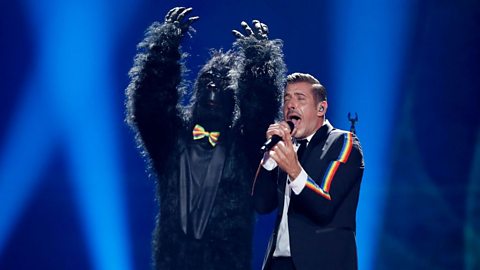
Another more successful method of incorporating ‘animals’ into a performance happened in 2017. The Italian entrant Francesco Gabbani was among the favourites to win before the competition with Occidentali’s Karma (Westerners’ Karma) with themes of a spiritual life versus a supposedly superficial one. Francesco was keen to get his belief across that, as he said in one interview: “In the end we become aware that after all we’re naked apes." To underline the sentiment, he was joined onstage at the final in Kyiv, Ukraine, by a dancing gorilla - otherwise known as dancer and choreographer Filippo Ranaldi. They did well - finishing sixth, and no actual gorillas were made to dance on stage, in keeping with the rules.
Did Sam Ryder play his guitar live at Eurovision?
He didn’t. Plugging your electric guitar into an amp for that soaring solo in the final third of your song may sound like the ideal opportunity to impress the voters with your musicianship, but it’s simply not allowed. Nor is any other live instrument.
Acts have around a minute to set up their staging between entries, so getting a full band kit on stage, plugged in, checked, and ready to go is simply not possible, especially when you consider the rest of the props that come in with it.
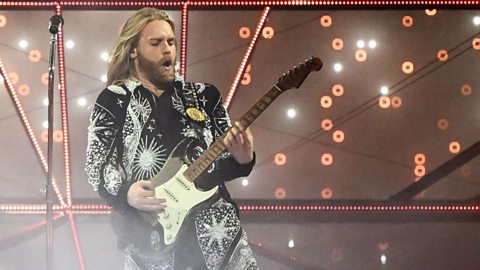
As well as prepping Sam Ryder’s guitar for his performance of Space Man for the UK in 2022 (which didn’t appear until moments before the song’s climactic finish), the stage crew also had to assemble a large starship-esque structure around him. That wouldn’t save much time for doing a sound check before the song was due to start.
There have been exceptions to the rule. In 2025, Italy's entry Lucio Corsi played the harmonica down the mic towards the end of his song. In 2026, Finland's song is set to include live violin playing, something Eurovision organisers have said is "artistically justified" after the Finnish team asked for permission.
But that surprise bit of guitar playing from Sam - which didn’t feature on the radio version of Space Man - was pre-recorded well in advance of the final in Turin and he simply mimed playing those big chords. Regardless, it helped him come in second on the big night.
Are children allowed on stage during a Eurovision performance?
They’re not. But it hasn’t always been the case.
The junior version of the Contest launched in 2003, giving younger performers an annual opportunity to impress the judges with their musicality. Prior to that, there was a time when kids were allowed to take part in the adult version.
Spain finished second in 1979 with Su Cancion (His Song), where soloist Betty Missiego was backed by a four-strong group of children providing a chorus of la-la-la’s. Belgium’s sole Eurovision victory to date came from teenager Sandra Kim in 1986, who was 13 when she performed the electro-pop hit J’aime La Vie (I Love Life) - even though the lyrics stated she was 15.
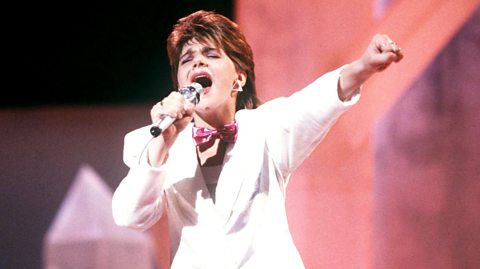
In 1989, Lausanne in Switzerland hosted the show and two other countries fielded younger-than-usual entrants. Gili Netanel, of the Israeli act Gili & Galit, was 12, while France’s representative, Nathalie Pâque, sang J'ai volé la vie (I Stole Life) at the final aged 11. The official Eurovision website states that this “raised the age question” when the 1990 Contest was being organised, leading to a new rule that all entrants must be at least 16 years of age in the year the competition is staged.
A quirk of this new rule meant that the UK fielded the youngest 1990 competitor. Emma Booth - who sang as simply Emma - was 15 when she performed Give a Little Love Back to the World in Zagreb, Yugoslavia. She turned 16 later that year, making her (just about) eligible for national singing duty.
In 2027, it's all change for younger performers again - the minimum age for entrants is being raised to 18.
Can our entry be backed by a huge gospel choir?
No, only a small one. The practicalities of getting more than 20 acts on and off the Eurovision stage in the same evening means the number of performers allowed per entry is a maximum of six.
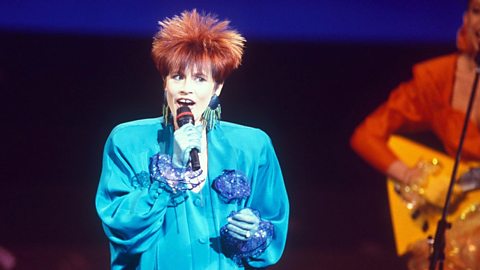
There’s no real way of getting around this rule, although in 2007, Switzerland’s DJ BoBo had some mannequins strategically placed behind him and his backing singer and dancers to make the stage seem more populated than it was. In 1988, the Danish group Hot Eyes came third, with singer Kirsten Siggard joined on stage by bandmate Søren Bundgaard and four other performers. That made the maximum six people on stage, although Kirsten was in the advanced stages of pregnancy at the time - bringing the number up to seven - but it’s safe to say her son, born three weeks later, was definitely not competing.
Until recently, all vocals at Eurovision must be performed live (unlike any on-stage instruments), which used to mean backing vocals alongside the lead vocal. In 2021, Rotterdam hosted the first Contest since the world went into lockdown, with rule changes to make staging the Contest easier. To reduce the number of people required to travel to the Netherlands from each competing country - such as backing singers - pre-recorded backing vocals were allowed for the the first time. However, the lead vocal still had to be performed live.
It means that gospel choir sound is more possible now thanks to the rule change - but you’re never going to fill the stage with one as a competing act.
Eurovision Song Contest 2026 from Vienna, Austria, is on BBC One on 12, 14 and 16 May. You can also catch up on BBC iPlayer.
This article was updated in May 2026
Quiz: Can you put these Eurovision winners in the correct order?
Måneskin, Loreen, Johnny Logan - they're are all champs but who lifted the trophy the earliest?

Is there a formula for winning Eurovision? The experts speak
BBC Bitesize spoke to five people with different perspectives and experiences of the competition.
Can the Eurovision running order affect a song’s chances?
Experts assess if certain spots in the Eurovision Song Contest can make an entry boom or flop